Feeds:
Posts
Comments

I got back home Wednesday from a trip “back East,” where I visited relatives and friends in my hometown of Louisville and attended the Women’s Final Four in Indianapolis.

I’ve admitted, unabashedly, to being a big fan of women in long shorts, and the Final Four exceeded my expectations.

For one thing, I sure didn’t expect Texas A&M and Notre Dame to be playing in the championship game. Like almost everyone else, I thought it would be Stanford and Connecticut. But Notre Dame dumped UConn by nine on Sunday, and, in Sunday’s other game, Kansas City’s Tyra White made a driving lay-up with three seconds left to give Texas A&M a one-point victory over Stanford.

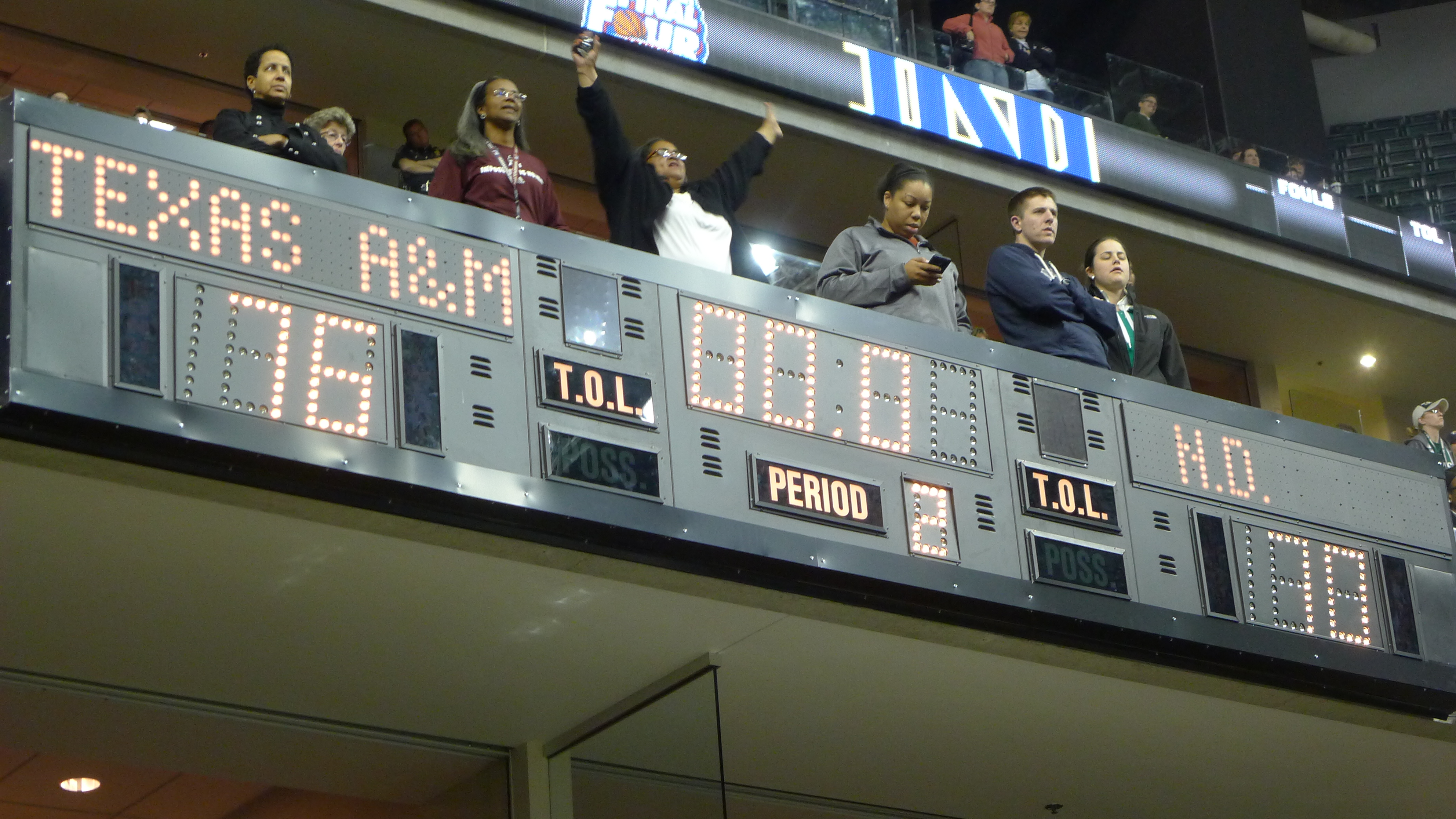
In Tuesday’s finale, White and another Kansas City girl, Danielle Adams, combined for 48 points, and the Aggies prevailed by six points.

One of the joys of the trip was stumbling upon the Irish’s beachhead — the Ram Restaurant & Brewery on Illinois Street in downtown Indianapolis.

From the Ram and also from Conseco Fieldhouse, then, here are some scenes from tournament weekend.

Sunday, pre-game "warmup"

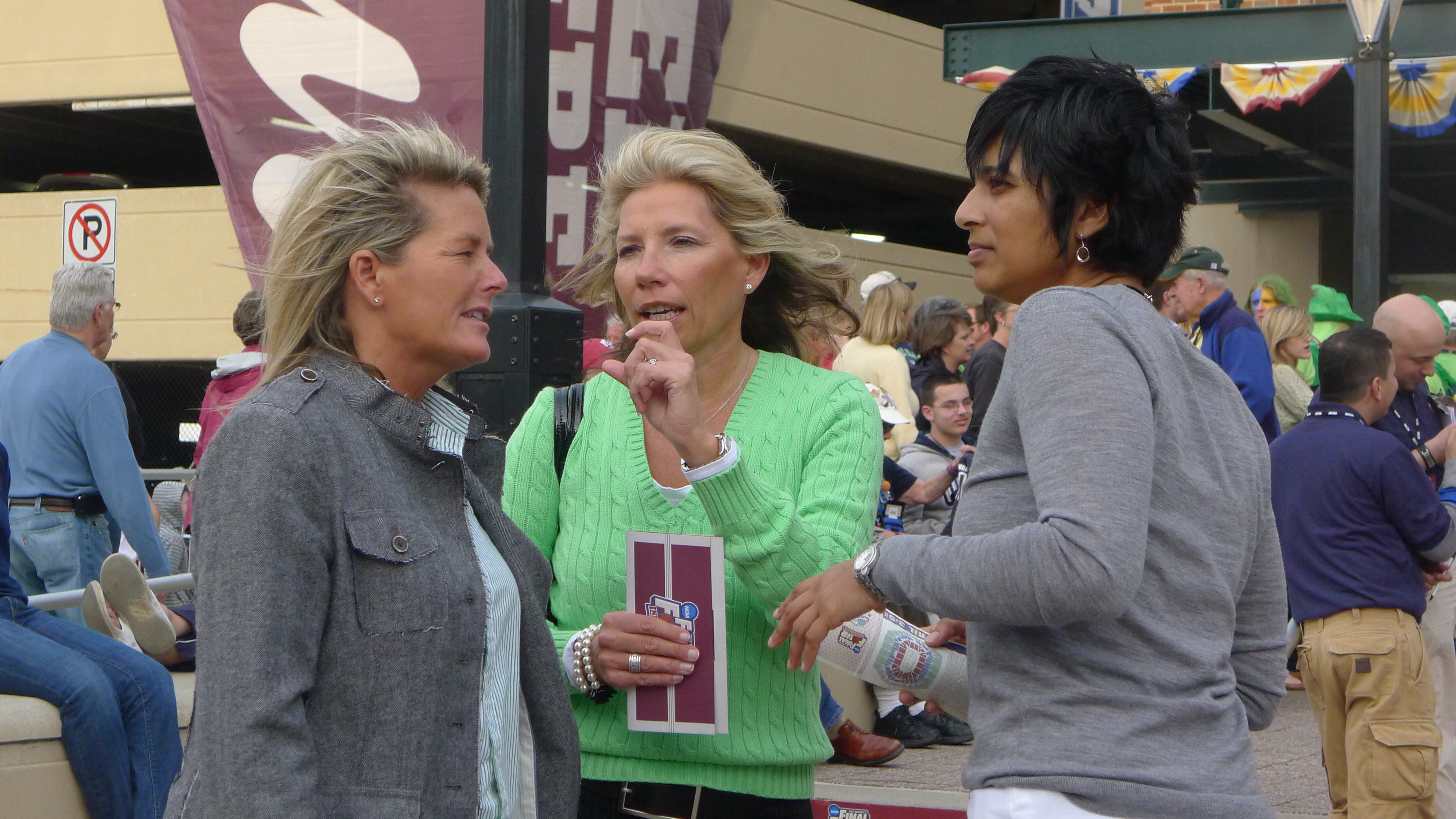
Is that a "hook-em" signal? Nah, must be some secret Irish sign.

What a beautiful eye


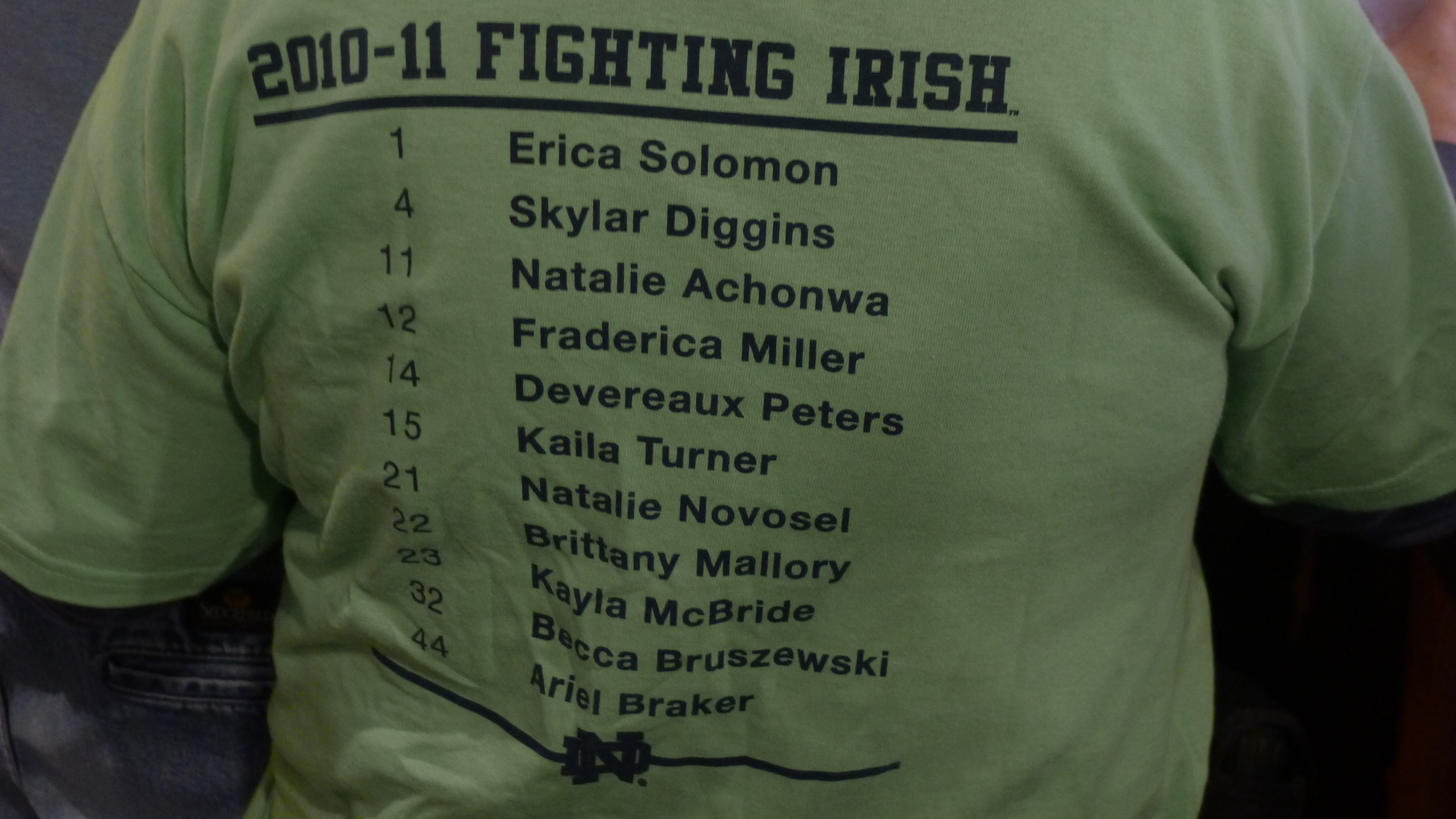
Carrying the team on her back

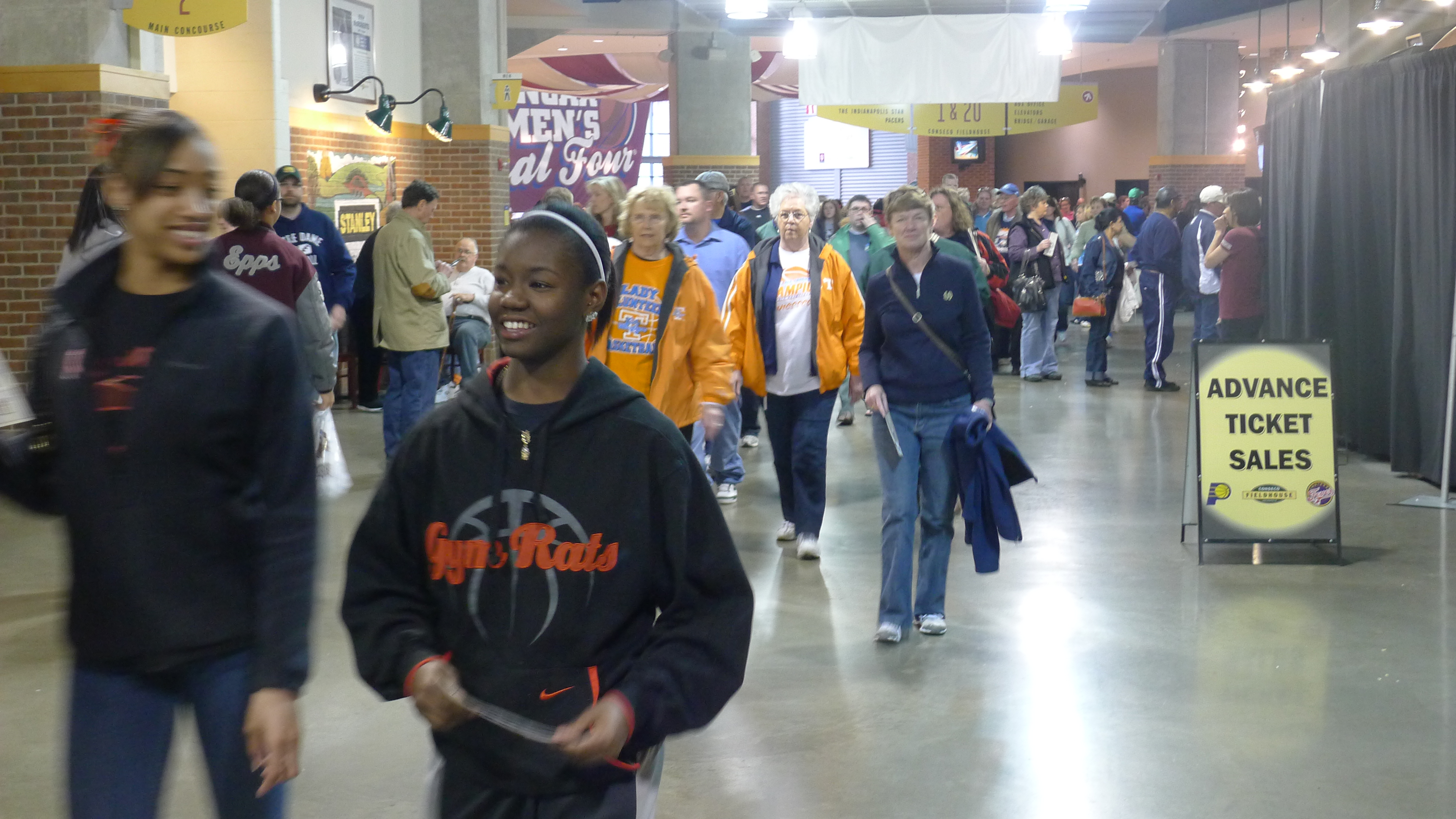
Outside Conseco Fieldhouse

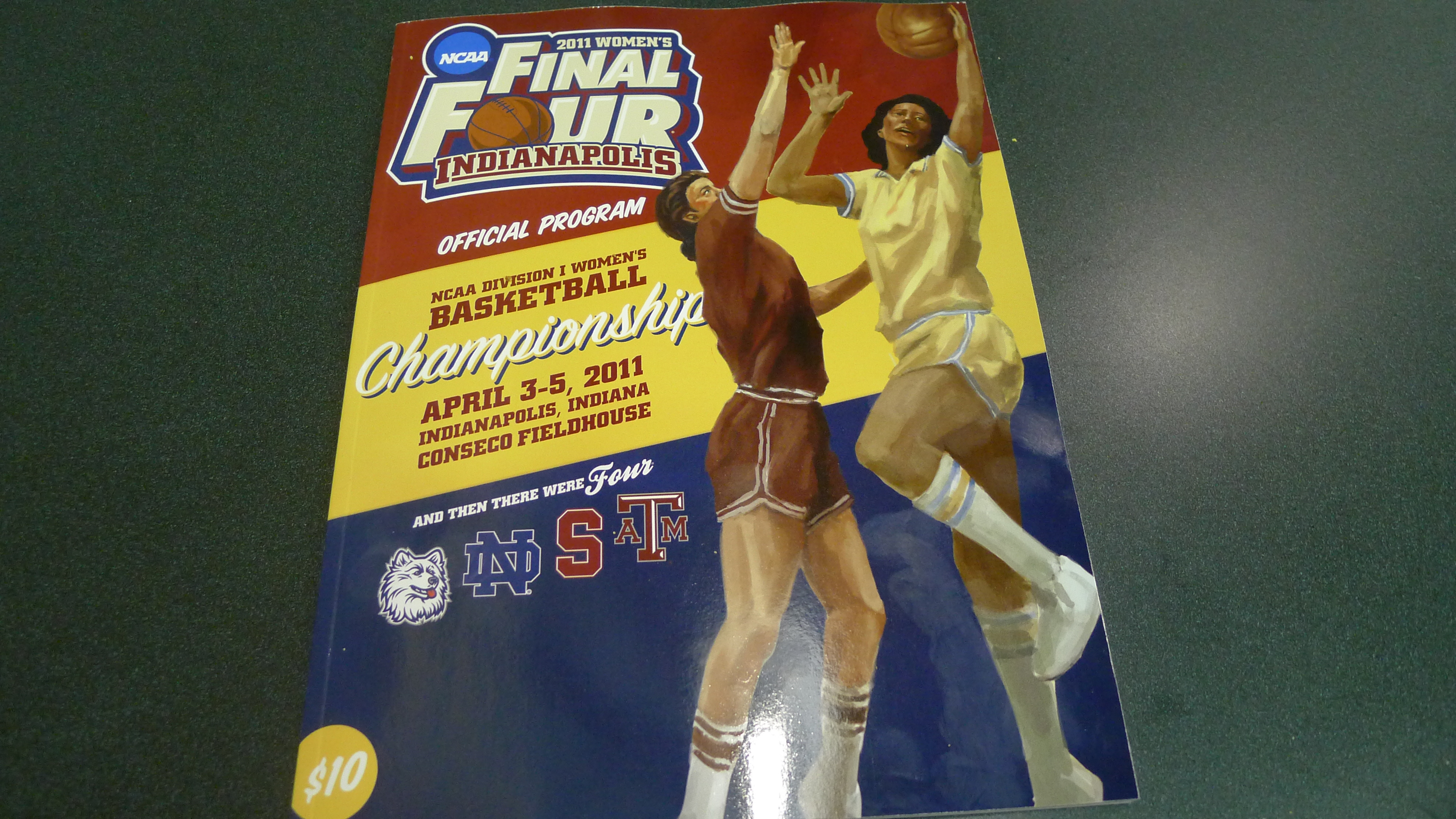
The Program

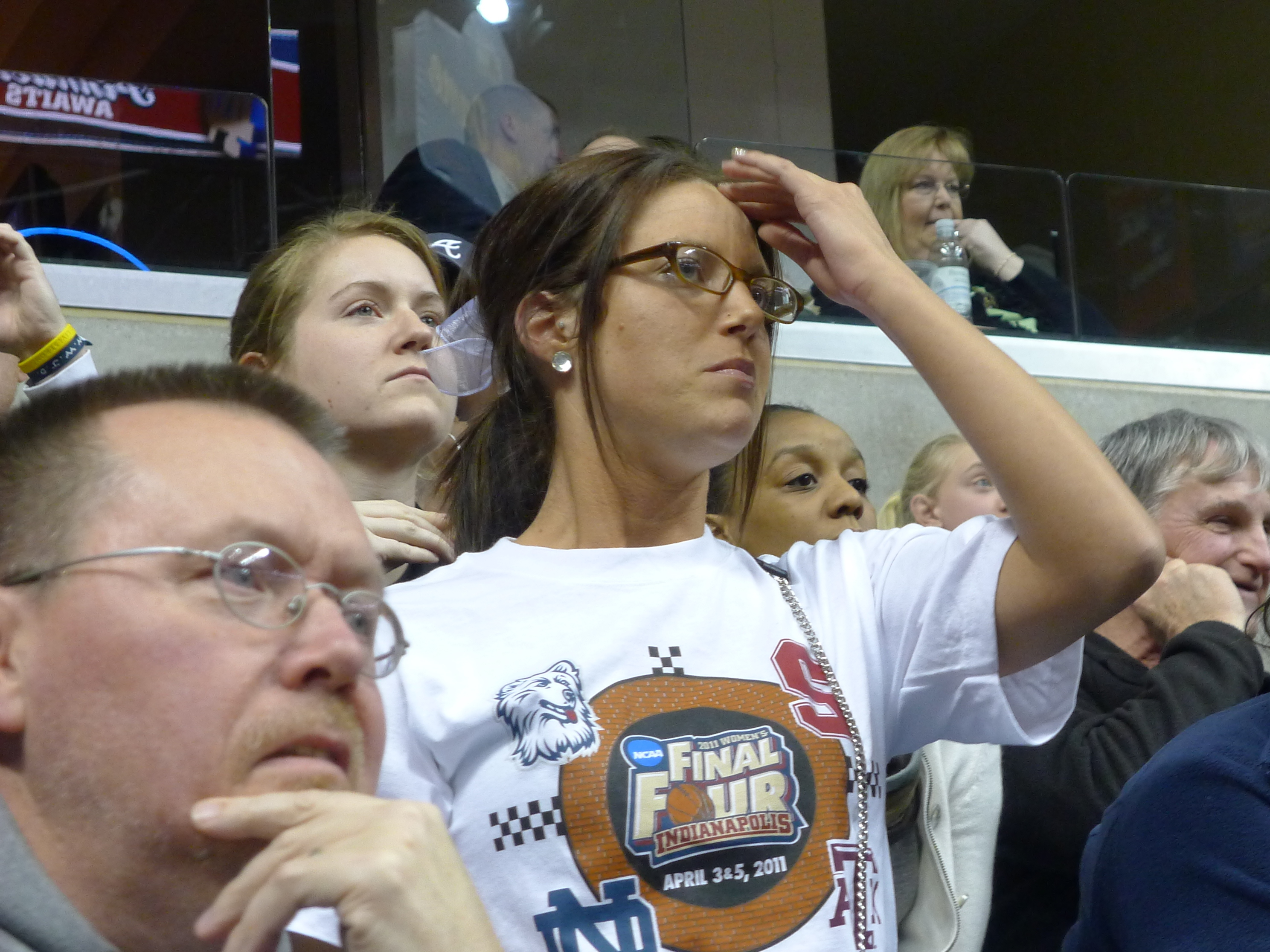
Nice hat

Arriving for Tuesday's championship game

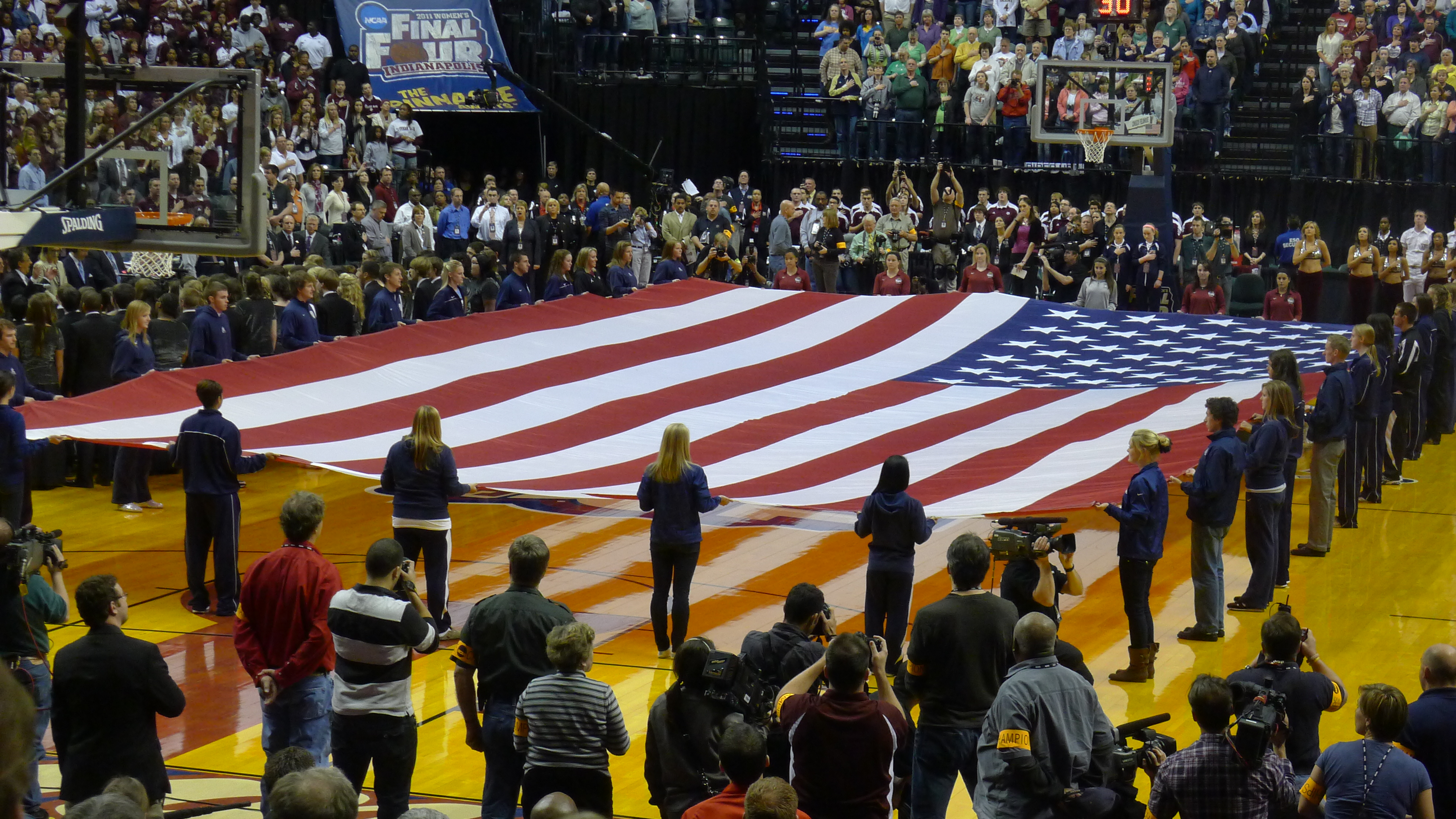
Texas-sized presentation of the colors

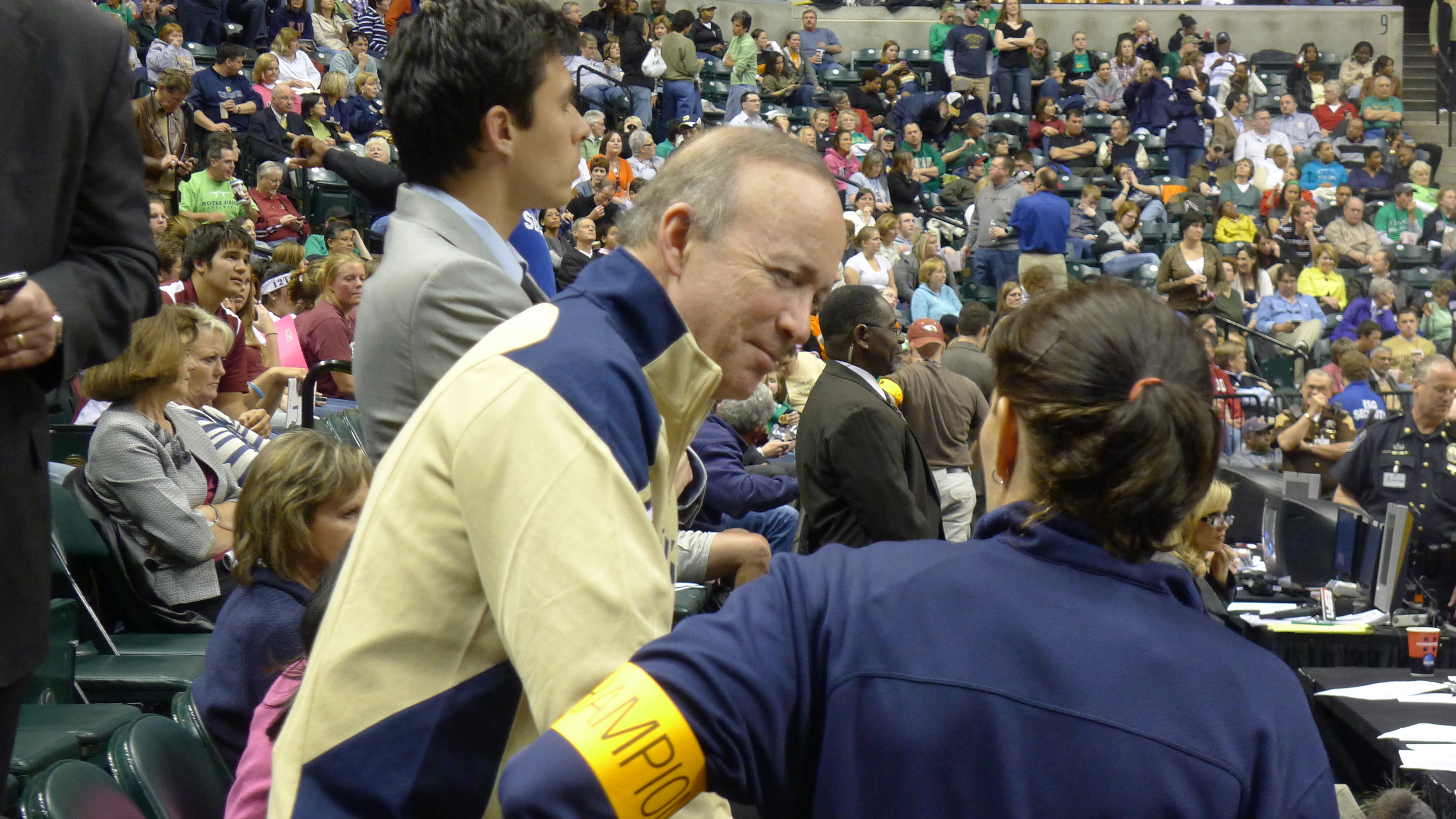
Just another green-and-gold-clad fan -- Indiana Gov. Mitch Daniels

How will it end?

Like this...

Very interesting, this E-tax situation. Not just the Kansas City situation but the combination of Kansas City and St. Louis.

Quite a contrast, actually. In both cities, voters overwhelmingly approved retention of the one-percent tax on salaries and business profits. But that’s where the similarities end.

Consider:

— In Kansas City, the opposition, led by eastern Missouri billionaire Rex Sinquefield spent about $600,000 trying to defeat the tax. In St. Louis, there was no organized opposition.

— In Kansas City, all indications are that it will be “business as usual” at City Hall and that a serious, extensive review of city taxes and finances is not likely to occur. In St. Louis, however, it appears that it’s almost a foregone conclusion that the E-tax will be eliminated before the next retention election, which would take place in five years.

So what’s the deal?

Well, it seems clear to me that, in St. Louis, Sinquefield and Mayor Francis Slay, a friend of Sinquefield, made a deal.

Here’s how the conversation that led to that gentleman’s agreement likely went…

Rex — “Uh, Francis, you know you’ve got to get rid of that E-tax; it’s killing job and business growth.”

Francis — “Yes, Rex, I realize that. But we can’t chop it off all at once, you know. How about this: If you don’t contest it on April 5, I promise you that we’ll get rid of it before it comes up for retention in five years, and we’ll come up with ways to replace the revenue.”

Rex — “You got it.”

How could such a clear-cut deal take place in one city, while, at the other end of the state the battle will be re-engaged every five years for the foreseeable future?

It’s the difference between a strong mayor form of government (St. Louis) and a council-manager form of government in Kansas City.

Slay can make that deal without having to worry about being undermined by the Board of Aldermen. In Kansas City, however, the mayor can’t promise anything, unless he’s got the signatures of six other council members, giving him a 7-6 majority, including himself.

Slay

To see the difference in the E-tax intentions of leaders in the two cities, one had only to read Slay’s comments in today’s St. Louis Post-Dispatch and Mayor-elect Sly James’ comments in The Kansas City Star.

James: “What a great victory. We now have confirmation that we’re going to have the earnings tax that we need so much.”

Slay: “What we saw here was a step, an important step toward what I believe to be a necessary and inevitable change in the way the city delivers services and the way the region is governed.”

The Post-Dispatch story went on to say that city officials already had begun talking about other ways of getting the revenue that the E-tax generates. “I don’t think there’s going to be another campaign on this earnings tax” in five years, Richard Callow, pro-earnings-tax campaign manager was quoted as saying.

That about says it all, doesn’t it? The wheels are in motion in St. Louis, and the E-tax is going away.

Now, if Kansas City leaders are paying attention, that should set off all kinds of alarms.

Two reasons:

1) The E-tax undoubtedly is hurting business and job growth in Kansas City. We’re already getting poached to death by the Kansas side, and now, with many Missouri-side suburbs growing, they, too, will pick up the cherry-picking pace.

2) After St. Louis gets rid of its E-tax, it will start competing more stoutly for businesses that are looking to relocate to Missouri. And when it lays out its package of incentives, it can say, “If you come to St. Louis, you won’t have to worry about an earnings tax, but if you go to Kansas City, you’ll be hit for one percent of your profits.”

Ouch!

Let me make this clear: I was not only for the E-tax, I was on the Save Kansas City Committee steering committee and made two presentations on behalf of the tax. At both appearances, however, I advocated for a thorough review of Kansas City finances.

And while I like the idea of forcing the “sundowners” — those who leave the city after work each day — to help pay for the amenities and facilities that bolster the urban core, I think this newfound focus on the E-tax is fostering a lot of unnecessary resentment among the sundowners.

You remember, don’t you, E-tax proponent Dan Cofran’s now-famous quote to a woman who was frustrated because she had to pay the tax even though she didn’t live in Kansas City? “Then, don’t work here,” he said.

Ouch…again.

The reply didn’t hurt the tax’s chances of passage at all, but it didn’t help relations between those of us who live in Kansas City and those who don’t. We shouldn’t allow the E-tax to drive the wedge even farther between us and them.

So, let’s see what we can do about getting rid of that E-tax, OK, Sly? OK, council members?

The last thing we want, other than that wedge being driven deeper, is the sight of St. Louis steaming by us as we cling to a tax that only about 20 percent of the largest cities in the U.S. are holding on to.

Sinquefield

Also, this looks like a case where the big dog, Sinquefield, isn’t going away. He’ll be back in five years — assuming he’s still alive — and he and his minions will dump several hundred thousand more dollars into that campaign, and he’ll make our business community shell out another $1 million or so to try to beat him.

To me, he looks an awful lot like Local 42 of the International Association of Fire Fighters: He won’t quit until he gets what he wants.

As you read this, I’m on the way to Louisville, which I’ll use as my base to make forays to Indianapolis for the women’s NCAA basketball semifinals and finals Sunday and Tuesday.

So, I want to leave you with something entertaining. And what’s more entertaining than some of the weird things that come out of people’s mouths? (Sometimes, unfortunately, I hear weird things coming from my own mouth, but in this case I’m going to focus on the folly of others.)

Three examples:

1) As you know by now, Karen Pletz — she of the spiked, blond hair and surgically altered face — was indicted yesterday for allegedly embezzling $1.5 million from the school she formerly headed, Kansas City University of Medicine and Biosciences. Among other things, according to documents filed in U.S. District Court, the 63-year-old Pletz forged approvals of bonus payments totaling more than $1 million.

And what was the reaction of her lawyer, Brandon J.B. Boulware?

“With today’s indictment, the federal government has injected itself into the civil litigation dispute between KCUMB and its former president, Karen Pletz…It is unfortunate, in our view, that local federal prosecutors would choose to spend public resources on a case like this when there are other, legitimate processes already at work to resolve the issues in dispute.”

Pletz

Whichever Kansas City Star reporter interviewed Boulware — Alan Bavley or Tony Rizzo — must have had to stuff a handkerchief  in his mouth to keep from laughing.

“Dispute”? Oh, yeah, a little dust-up over a $million or so.

How about the federal government “injecting itself” into the case? Shocking! Why, those brazen prosecutors ought to be put in time out.

“Other, legitimate processes already at work”? Can’t we all just get together over coffee and work this out?

Personally, I think Karen’s hair will settle down after a few weeks in prison. And I think Brandon B.S. (I mean J.B.) Boulware will get over his indignation.

2) Earlier this week, federal prosecutor Richard L. Hathaway (there go those prosecutors again) said that former KU assistant athletic director Rodney Jones used proceeds from stolen tickets on “an extensive rolling party scene that persevered for five years.”

God, how I used to hate those persevering parties! They just would not stop. You’d invite a few people over, and pretty soon everybody would be drunk, and days would turn into weeks, and weeks would turn into years.

In Jones’ case, though, law enforcement authorities plucked him off the merry-go-round, and now he’ll have to persevere through 46 months in prison.

3) In a March 25 story, Kansas City Star sports writer Mike DeArmond clicked off the steps leading up to Mike Anderson’s decision to resign as men’s basketball coach at the University of Missouri and take the same post at the University of Arkansas.

It was high drama, the way DeArmond and Mizzou athletic director Mike Alden recounted it.

Alden

“At 6:20 p.m., Alden said, his telephone rang. It was Anderson calling with a request for Alden to meet him around 6:45 p.m. in Anderson’s office at Mizzou Arena. Alden made the walk from his office on the opposite side of the arena to Anderson’s door.

‘He informed me at that time that he was going to be resigning his position with the University of Missouri as our head men’s basketball coach,’ Alden said.”

Well, thank you, Mike Alden, for letting us know exactly what Anderson’s title was, and thank you, Mike DeArmond, for taking up three lines of newsprint with that powerfully redundant information.

Now, I can hardly wait to see who Alden is going to hire as the next head men’s basketball coach at the University of Missouri.

Or should I say next head men’s basketball coach at the University of Missouri-Columbia?

Out here in blog land, a story is circulating that Dan Cofran has been given the hook as the “main debater” for the Save Kansas City Committee, which is pushing for retention of the earnings tax.

The implication is that Cofran has been reined in because of a statement he made to a woman who asked him what her options were if she worked in Kansas City and paid the E-tax but didn’t live in the city. “Then don’t work here,” was Cofran’s, sharp-elbowed response.

E-tax opponents have jumped all over it, featuring it in two TV ads.

And now, says a local blogger whose first name happens to be Tony, Cofran has been “sacked.”

Not exactly. Here’s the full story.

First, a disclosure: I am a member of the Save Kansas City Committee’s steering committee and have spoken to two groups, urging retention of the E-tax.

Cofran

Cofran, a lawyer and former city councilman, indeed has been the main speaker on behalf of the campaign, although other officials, including civic leader and campaign co-chairman Anita Gorman, have also appeared.

Cofran has made a dozen or more appearances on behalf of the committee and represented the committee in a Kansas City Star debate, published last Sunday.

Cofran is not getting paid; he is volunteering his time.

The main spokesman for the opposition, a nebulous group called Freedom PAC, which has an address in Kansas City, North, is Woody Cozad, a former Missouri Republican state chairman.

He is getting paid.

The problem that has crept up on our side is that Cofran, while representing Save Kansas City, has also been working — for pay — as chief opponent of the proposed Polsinelli, Shughart building on the Plaza.

He and lawyer Dave Fenley of the Husch Blackwell firm debated the Polsinelli issue on KCUR yesterday.

Steve Glorioso, a consultant to the Save Kansas City Committee, said that even before Wednesday’s debate, “we’d been a little concerned about him (Cofran) mixing the two issues.”

“It’s confusing to people,” Glorioso said, referring to Cofran being perceived as a “swivel top,” that is, pitching retention of the E-tax one day and opposing the Polsinelli building the next.

Glorioso said he asked Cofran early this week if he could postpone Wednesday’s debate with Fenley, but Cofran said he couldn’t do that, primarily because a City Council committee is scheduled to consider the matter next Wednesday, the day after the E-tax election.

On Tuesday, Glorioso said, he learned that Cofran planned to debate not one but both issues on this week’s edition of KCPT’s Week in Review, which will be taped tomorrow morning.

Glorioso said Week in Review moderator Nick Haines had set up the show so that Cofran and Fenley would debate the Plaza building for 15 minutes and then Cofran would square off against Cozad on the E-tax for the remaining 15 minutes. Cofran agreed to the format.

That was way too much swiveling for Glorioso and other Save Kansas City officials.

Glorioso said he called Haines and said, “This thing on Friday just won’t work.” He told Haines that the committee would be sending Dianne Cleaver, a committee co-chairman, in place of Cofran.

Glorioso said he then sent Cofran an e-mail, laying out his concerns and telling him about the change of plans. He said Cofran sent him a response, essentially saying, “That makes sense.”

A group of ministers with the Metropolitan Organization for Racial and Economic Equity (MORE2) appeared today outside City Hall with Mayor-elect Sly James to endorse the earnings tax, which will be on the ballot Tuesday in Kansas City. More than 90 groups have endorsed the tax. (Photo from Save Kansas City Committee.)

With just four days left before the election, only one more event is scheduled — on Monday — and Glorioso said Cofran had not been in line to be the speaker.

So, yes, Cofran got reined in, but not because of the “Don’t work here” comment.

And, by the way, I can’t see that comment persuading a large number of Kansas Citians to vote against the E-tax. Half the people who pay the tax live outside the city. And don’t you know we Kansas Citians just love having our friends who live outside the city help us pay for the streets, parks, entertainment venues and arts facilities that our “visitors” regularly use and enjoy?

Here in Kansas City, we already know a little more about Wal-Mart than a lot of people because a former Wal-Mart c.e.o., David Glass, owns our Kansas City Royals.

The common complaint is that Glass runs the Royals like Wal-Mart executives run their company — on the cheap.

Well, cheap is one thing, but allowing unsafe employment practices is something altogether different. And that’s what it looks like Wal-Mart is guilty of in its two-year-old battle to overturn a $7,000 federal fine that stems from a customer stampede on Thanksgiving weekend, 2008, at a Long Island, New York, store.

Damour

In case you’ve forgotten — although it’s pretty hard to purge this from the memory — a 34-year-old temporary worker named Jdimytai Damour was trampled on Black Friday as he and other Wal-Mart employees attempted, unsuccessfully, to hold back a crowd of shoppers who charged into the store when the doors were unlocked at 5 a.m.

A story published in today’s New York Times summarizes the situation: “Eight to 10 employees were pushing against the door to counteract the press of customers trying to get in…Once the doors were unlocked, customers fell in the vestibule and employees climbed on top of vending machines to protect themselves. As in years past, the doors popped off their hinges. Mr. Damour was trampled. He died at the site.”

The Occupational Safety and Health Administration (OSHA) fined Wal-Mart $7,000 — the maximum penalty — and last Friday, the agency’s chief administrative law judge, Covette Rooney, upheld the fine, concluding that unruly crowds on Black Friday in each of the three preceding years — 2005, 2006 and 2007 — should have prompted Wal-Mart to take precautions by 2008.

And what was Wal-Mart’s reaction? Accept the $7,000 fine and pledge to improve conditions? Oh, no, it’s planning to appeal the fine to the full OSHA review commission.

Well, you’ve got to hand it to Wal-Mart; it has been consistent on this. The company has spent more than $2 million on legal fees trying to overturn the $7,000 fine. Of course, the fine isn’t the point with Wal-Mart. It’s all about a bigger principle, the principle of the government sticking its nose in the company’s (and other companies’) business.

Specifically, according to another New York Times story, “Wal-Mart asserted that OSHA was wrongly seeking to define ‘crowd trampling’ as an occupational hazard that retailers must take action to prevent.”

In other words, Wal-Mart is saying, “Let us deal with our crowd-trampling problem, if, indeed, we have a crowd-trampling problem.”

Well, now, that rings a bell with me — and perhaps you, too — on a problem we had here in Kansas City regarding smoking in bars and restaurants.

If you’ll recall, when city officials first began proposing a limit or ban on smoking in bars and restaurants about 20 years ago, the proprietors raised a hue and cry. I remember, specifically, Carl DiCapo, owner of the former Italian Gardens, appearing before a City Council committee and saying, “Please, let us police ourselves.”

For a long time, DiCapo and other opponents of a ban were able to hold the city off — and did little more than designate, in some cases, nonsmoking areas. Finally, three years ago, a citizens initiative petition got enough signatures to put the issue to a vote, and voters implemented an effective ban on smoking in indoor, public places.

The idea of letting Wal-Mart and other big retailers police themselves in the matter of crowd control makes about as much sense as letting Carl DiCapo — a fine citizen in every other respect, by the way — and his entrepreneurial pals decide how to control smoking in bars and restaurants.

Fortunately for big-box employees and customers, as long as the $7,000 fine stands, retailers will have to begin putting in place new crowd-control guidelines that OSHA issued last year.

Wal-Mart wisely implemented some changes at all of its New York stores as part of a 2009 settlement with Nassau County, and it has extended the approach to most of its stores.

For one thing, Wal-Mart stayed open from 7 a.m. on Thanksgiving Day through the night. For some special-sale items, like electronics, people were given tickets so they did not have to surge into the store and make a run for the items. Also, outside the store, officials set up steel barriers in zigzag patterns to prevent a massive, forward press of shoppers.

The steps that Wal-Mart took were in line with the new OSHA guidelines.

The guidelines, according to today’s story in The Times, “say that barricades should start away from the store’s entrance, and that they must have breaks or turns in them to prevent customers pushing from the rear. The guidelines also say that employees should be assigned to specific spots, and that the local police, fire department and hospitals should be alerted about an event that might draw crowds.”

Sounds reasonable, doesn’t it?

I don’t know about you, but I’d rather have OSHA setting the crowd-control rules than relying on Wal-Mart to do so. After all, if Wal-Mart was so on top of things, wouldn’t it have taken action earlier, after surging crowds had popped the doors off the hinges at the same Long Island store in 2005, 2006 and 2007?

No, didn’t happen, not even after three consecutive years of difficulty managing Black Friday crowds.

And the result? The doors popped off the hinges again, and a 34-year-old temporary worker — a little guy working for a big, big company — lost his life.

I’m sure Wal-Mart regrets the loss…just not enough to allow the big, bad, federal government to hand down crowd-control guidelines.


The winners go on to run the city. And good luck to them. I hope they — and the city — prosper.

And the losers? Well, we had a nice, wrap-up breakfast today at Kansas City Cafe, 1532 Grand.

The breakfast was compliments of our leader, Mike Burke, who will now focus on rebuilding his caseload at King Hershey, the real estate law firm that he heads.

I took the occasion to tell the group that a political race was like a horse race: You never know how it’s going to turn out when the horses enter the starting gate. But it sure is exciting when your horse is head to head with another runner coming down the stretch. Of course, it’s terribly disappointing when the other horse surges and beats you by a neck…but that’s racing, and that’s politics.

So, join me now in taking last look at our candidate and some of the people who helped him make it a stirring stretch run.

Roxsen Koch, a Burke law partner, and Ray James, former K.C. Election Board leader and Burke volunteer

Jason Parson, campaign manager, and Klassie Alcine, volunteer

Mary O'Halloran, message crafter, and John Burke, son and driver


Donna Mandelbaum, communications coordinator, and Tony Ladesich, TV ad producer

Marnie Burke (no relation) and Matt Pepper, volunteers

The recovering candidate, with Greg Williams, strategist, and Bob Reiter, Burke cousin and volunteer

Susan Ramirez, volunteer: "I'm warning you; this could turn out unhappily."

As you know (and thanks for not raining ignominy down on me) my postmortem of the mayor’s race was slightly off — not to mention my prediction that Mike Burke would win.

Leave it, then, to Charlie Wheeler, pathologist and former mayor, to come up with an alternate postmortem.

“You can beat the fire fighters, or you can beat The Star,” he said Tuesday night, “but you can’t beat the fire fighters and The Star.”

Quite an insight, I think.

I would augment that slightly to say it’s almost impossible to beat a candidate who has The Star, the fire fighters, is well-funded and has a ton of personal appeal.

Sly James was such a candidate. I didn’t want to admit it during the campaign because, of course, I was “all in” for Burke.

But now that it’s over I will tell you that one of the reasons I liked the mayoral forums — before and after the Feb. 22 primary — was waiting for James to come up with a funny line or employ a unique image or metaphor. He seldom disappointed.

The winner

My favorite James line, which he uttered at a February Chamber of Commerce forum was: “Until I see a headline that says, ‘Ph.D. shoots master’s candidate at 39th and Troost,’ I’m going to continue to believe that education is the key to long-term reduction of crime.”

Let’s face it: James was not only a good candidate, he was an interesting candidate.

Burke was also a good candidate. But, let’s face it, he wasn’t interesting. As much as I like him and as much as I think he would have been a better mayor, he was careful and fairly predictable. Because of his charm and spontaneity, James connected with many more voters than Burke.

Burke, with (from left) campaign volunteer Klassie Alcine, mother-in-law Dorothy Stoeger, wife Melinda and campaign treasurer Joanne Collins

And so, it’s time to offer congratulations to James and all of his connections, including campaign manager Brian Noland, state Rep. Jason Kander and his wife Diana, and my friends Donovan Mouton and Mike and Carol Grimaldi. Everyone connected with James is rightly proud and thrilled, I’m sure.

When Mouton, former neighborhood liaison in Kay Barnes’ administration, told me about two years ago that a friend of his named Sly James was running for mayor, the first thing I said was, “Kansas City is not going to elect a man named Sly as mayor.”

Well, not only did Kansas City elect a man named Sly, it elected a fat black man named Sly.

That says a lot — a lot — about the man, the voters and our city. Sly convinced the voters that he’s anything but sly. He convinced them that he’s sharp, funny, forthright and likeable. It’s a winning formula, isn’t it?

You know, when you get beat by a 54-46 margin, it’s hard to go back and say, “Our TV should have been better,” or “We should have been tougher,” or “We should have been more specific about our candidate’s record.”

No, when you get beat 54-46, it’s usually the opponent who did it to you; you didn’t beat yourself.

At the watch party Tuesday night, I heard one Burke backer say that we should have capitalized to a much greater extent on Burke’s opposition to the proposed Shughart, Polsinelli building on the Plaza. Another was furious at K.C. Star reporter Dave Helling for his stories about Burke and his law firm’s dealings with the Port Authority.

Forget about it. None of that mattered. We — those of us on the Burke team — were up against personal magnetism, magnetism projected by a guy who made sense when he opened his mouth and who never got rattled.

At our Feb. 22, primary-election victory party — the night the TV cameras caught me dancing with council members Cindy Circo and Jan Marcason — an acquaintance of many years, Susan Stanton, offered a word of caution about the upcoming general-election campaign.

“Never underestimate a charismatic candidate,” she said.

I heard her, but I didn’t really believe her. I thought experience would count more than personality. Man, was I wrong.

At the same time, I have no regrets. It was a great, two-month run. Some people contended that it was dull, or that there wasn’t much to choose from between the two men. From my perspective, however, it was anything but dull; it was exciting, it was intriguing; it was good political theater. And I’m going to miss the curtain going up on the show night after night.

I am happy to report that Mike Burke will be elected mayor today.

All those years that I was with The Star, the editors would never let me report a victory, or a loss, before it happened. But now that I’m a blogger, substitute school teacher and a quasi-political operative, it’s different. I checked the Blogger’s Code of Ethics (which I wrote) and found nothing that prohibits me from reporting the outcome of a political contest in advance.

Of course, you might wonder how I can confidently report, before dawn of Election Day, that Burke will prevail over Sly James.

Well, I’ve been pretty close to this race;  I contributed more than $5,000 to Burke, whom I’ve known for 25 years, and was fortunate enough to be included in his inner circle the last two months. As a result, I’ve seen the ebb and flow of the race up close, and I have observed the critical developments and milestones.

Join me, now, in taking a look at some of the key milestones, starting from the most recent and working backward.

Saturday, March 19

A nasty, anti-Burke piece hits mailboxes, accusing Burke of capitalizing financially on his “insider” connections. Although the piece was not financed by the Sly James for Mayor committee, it denied James the moral high ground he had claimed a day earlier, when a third-party-financed TV ad slapped James for being indecisive. The anti-Burke mailer quickly put both camps back on equal footing as far as moral rectitude.

Thursday, March 17, and Saturday, March 12

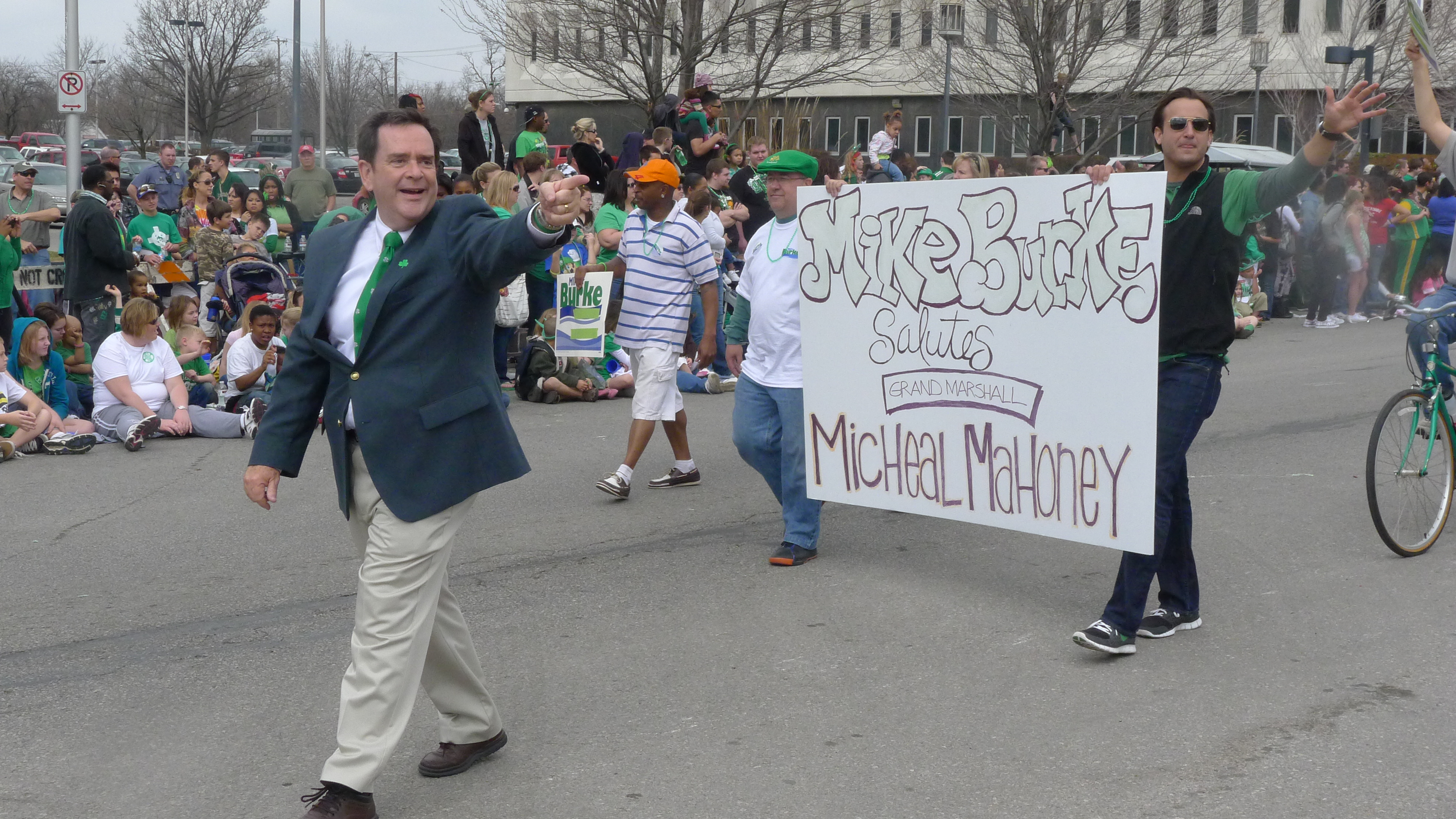
Perhaps never in the annals of American politics have parades played such a big role in the outcome of a political race. In the St. Patrick’s Day Parade on Broadway, Burke, wearing a snappy, spruce green blazer and bright-green tie, walked the route and pressed the flesh on either side of the expansive boulevard. Trailing him was a group of enthusiastic, sign-waving supporters. James, on the other hand, rode in a fire truck and was photographed in proximity to a man wearing a T-shirt that said “Drink Up Bitches.”

Five days earlier, in the Brookside parade, Burke, wearing a bright green sweater, greeted a wildly responsive crowd at street level, while James sat on the back of a convertible, waving to the crowd from “on high.” (Side note: The Burke contingent, which was supposed to be immediately in front of James’ car, near the end of the parade, shrewdly took advantage of a lull in the pre-parade queue to jump the line well ahead of James. Take a bow, campaign communications coordinator Donna Mandelbaum.)

Thursday, March 10

They were billed as joint appearances in the Northland — one at Northminster Presbyterian Church, the other at Harmony Vineyard Church. But only one one candidate showed up. That was Burke. James, meanwhile, sent a representative, state Rep. Jason Kander, to “drop by” on his behalf.

Translation: James had conceded the Northland.

In a voice lowered and made raspy by a cold, Burke told about 35 people at Northminster, “I don’t think we can afford a learn-on-the-job mayor.”

Thursday, March 10

In a column that was shocking because of its criticism of KC Star-endorsed James, Star editorial writer Yael Abouhalkah said: 

“James recently hasn’t taken definitive stands on the Polsinelli law building/Country Club Plaza dispute, the future of Acting City Manager Troy Schulte and pension reform. His continued reservations won’t earn him points with voters who want leadership on issues that have been discussed for months, sometimes years…”

Tuesday, March 8

At a Chamber of Commerce debate at Union Station, when asked what could be done about the Police Department administration’s go-it-alone, keep-us-clear-of-City Hall attitude, James suggested mediation. Burke replied: “Sometimes it’s not about mediation; sometimes it’s about being tough.” He went on to say that millions of dollars a year could be saved if the city and the Police Department collaborated on health insurance, vehicle maintenance and computer operations. “Let’s do it,” Burke said. “There’s no sense in reinventing the wheel.”

There might as well have been a referee in the house, shouting “…eight, nine, 10” over James’ inert form.

Thursday, March 3

The Burke campaign announced the endorsement of mortgage banker James B. Nutter Sr., who had backed Deb Hermann in the primary. (Subsequently, Nutter and his wife Annabelle contributed $6,000 to the Burke campaign, and Nutter put $30,000 into a third-party committee that financed the TV ad that said James was “lost in a fog of indecision.”)

Tuesday, Feb. 15

Former mayors Richard L. Berkley, Kay Barnes and Charles B. Wheeler announced their support for Burke at an electrifying news conference at Burke headquarters, Broadway and Valentine. Barnes was for Burke from the outset and had been quoted in a campaign flier. In a series of meetings and calls, Burke managed to win over Berkley, who had never endorsed anyone in a mayor’s race, and Wheeler, who, up until the news conference, was one of six opponents to Burke in the primary. “When I heard the other two were endorsing Mike, I decided that was good enough for me,” Wheeler said in his inimitable nasal-driven voice.

Saturday, Feb. 5

The Star endorses Burke and Sly James in the primary, clarifying the primary-election picture  and giving both candidates a huge edge over their five competitors.

There you have it, the pre-postmortem…unless I’m wrong.

It started on Broadway and ended on Broadway. Where else?

The crowd was 10 deep in places.

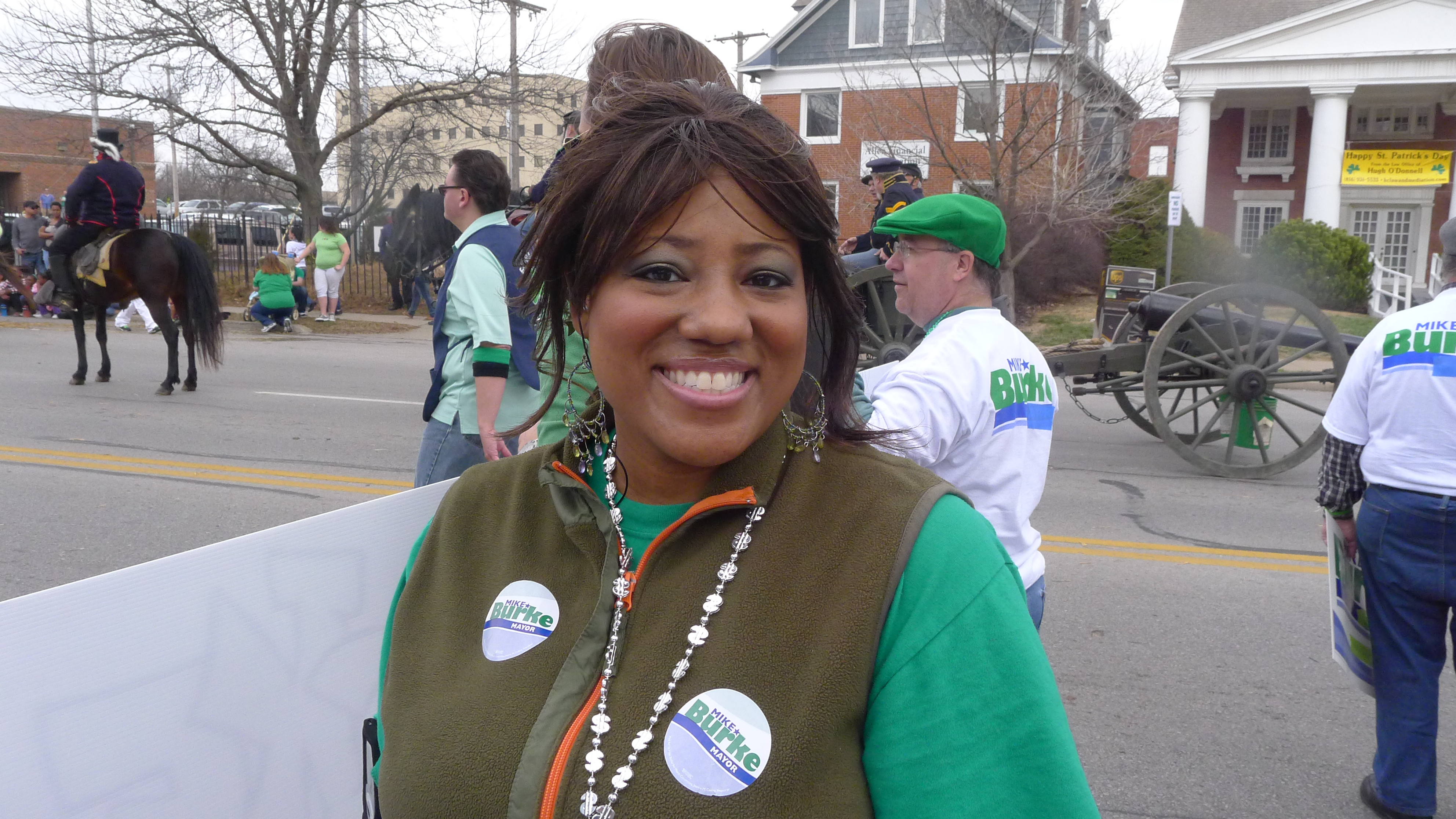
Here are a few of the people — most of them with the Burke campaign — who celebrated St. Patrick’s Day in Kansas City.

Burke campaign headquarters, Valentine and Broadway, about parade time

Volunteers nonpareil Marnie Burke (left -- no relation) and Becky Faust

Donna Mandelbaum, communications coordinator

Get-out-the-vote specialist Brendan Rhyne and volunteer Bob Reiter

John Burke...yes, related (offspring)...driver and photographer

Former Democratic state Rep. Jason Grill, volunteer

Kevin Murphy, wordsmith and legendary former KC Star reporter

Klassie Alcine, volunteer and political star of the future

Face in the crowd...best parade make-up

Dr. Charles Wheeler and friends

The Burke "float," compliments of Kite Singleton

The man of the hour

Excited voters of tomorrow

Despite the blogs, the TV ads and the candidate forums, most frequent voters still rely on The Kansas City Star to help them sort out the issues and gauge the candidates in the mayor’s race.

In recent days, The Star has, in some instances, yielded valuable insight. On the other hand, it fell face-down in the mud on a story last Friday about the legal cases that candidates Mike Burke and Sly James — both lawyers — have handled.

Let’s get the mud-splatter job out of the way first.

Political reporters Dave Helling and Steve Kraske set up their front-page story about Burke’s and James’ legal backgrounds by quoting Jim Bergfalk, a longtime political consultant who engineered the ill-fated campaign of Deb Hermann, who finished fifth in the Feb. 22 primary election.

On the front-page part of the story, before it “jumped” to an inside page, Helling and Kraske said that “because both men have thin experience in public office, some attention has turned to the pair’s legal careers for clues about their approaches to government.”

Then came the stage-setting quote from Bergfalk: “It (the legal perspective) is absolutely relevant. It’s the only real body of work that voters have” for the two contenders.

Oh, really?

Never mind that Burke has served as chairman of three economic development agencies, headed the city’s Public Improvements Advisory Committee for five years, founded the July 4 Riverfest celebration and headed the committee that got Kansas City named an All-America City in 2006. And forget that James was co-chairman of the Save our Stadiums committee and served on the boards of Operation Breakthrough, the United Way and Genesis School.

First, shame on Bergfalk, who should and does know better. I don’t know what the hell he was thinking or doing when he said that. Maybe whichever of the two reporters who interviewed him led him in that direction. Maybe he was thinking about how, on his watch,  Hermann plummeted from favorite a month before the primary to fifth on Election Day.

But the bigger shame goes to Helling and Kraske, who also know the quote is completely misleading and are guilty of using it to artificially pump up the importance of that day’s story. OK, the candidates’ legal backgrounds are relevant — no doubt about that — but is it…

“the only real body of work that voters have” ?????

Come on…In my view, those two reporters were trying to sell their story to both their editors and their readers. Once again, as is often the case at The Star, one or more editors failed to rein in the reporters. One of an editor’s main jobs is to make sure a story is balanced and in perspective. Sometimes, editors have to stand up to heavy-hitting reporters, blow the whistle and say, “No, that’s outta bounds.” Unfortunately, the editor who handled this story was a milquetoast.

Just that one quote blew the legal backgrounds of the two candidates out of perspective and, correspondingly, unfairly denigrated their respective civic-activist backgrounds.

…Guess I’ve gotta rein myself in here…Let’s move on to the next point.

On Thursday, Yael Abouhalkah, Op-Ed columnist and member of The Star’s editorial board had a column that, in part, addressed the two candidates’ leadership styles.

As a Burke contributor and supporter, I have to say, I loved that column. To my surprise, Abouhalkah said that James’ emphasis on being a mediator was “starting to wear thin.”

I say that surprised me because The Star recently endorsed James, although it was complimentary to Burke.

It sounds to me, just from that column, like Abouhalkah either didn’t cast his editorial vote for James or he’s had second thoughts.

Listen to what he went on to say…

“James recently hasn’t taken definitive stands on the Polsinelli law building/Country Club Plaza dispute, the future of Acting City Manger Troy Schulte and pension reform.

“His continued reservations won’t earn him points with voters who want leadership on issues that have been discussed for months, sometimes years (such as city pensions).”

Wow. Those are two powerful paragraphs that the Burke campaign could blow up into 60-point type and smack James in the head with.  Whether the campaign will take advantage of that godsend remains to be seen.

That brings us to side-by-side stories in Sunday’s “A” section. Reporters Lynn Horsley and Michael Mansur interviewed both candidates on the most important issue in the race — Why should voters choose you? — and ran excerpts of the interviews.

Both stories were excellent and riveting — riveting to those of us who like politics, anyway. Here’s a link to the Burke story, and here’s a link to the James story.

Congratulations to Horsley and Mansur on stories that might prompt many voters to go for one candidate or the other.

I will leave you with the final questions and answers.

Question to James: Is there anything else we haven’t touched in terms of differences (between you and Burke)?

A: The key difference between Mike Burke and Sly James is we’re totally different people. Because I’m willing to accept that he has good ideas doesn’t mean we’re the same. … I believe I’m the leader that we need to go forward…I believe that the past is part of the problem for why we are where we are. I’m not saying that’s his fault. I don’t want that to be said at all. I’m just saying the time for politics as usual needs to cease and we need to do things a little differently in this town.

Question to Burke: Anything else in contrasting yourself with Sly James?

A: The main thing is who’s ready to walk in the mayor’s office and know how City Hall works, know who at City Hall are the good administrators, are the people you can trust for advice. That’s something I’m sure he can learn over time, but I don’t think we have a year or two of on-the-job training.