Feeds:
Posts
Comments

A truly remarkable, singular story led Sunday’s New York Times.

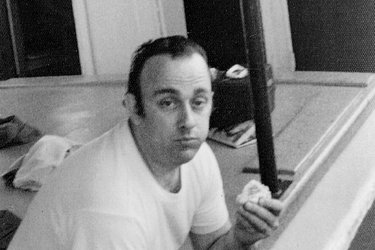
The story — “The Lonely Death of George Bell” — was about the death of a 72-year-old, retired moving company worker who had no relatives, one friend who hadn’t seen him in months and an apartment full of junk and empty cans and packages of food.

His body was only discovered because a woman in a neighboring apartment in Queens observed that his car hadn’t moved from its parking spot in several days…and then she noticed an odor coming from his apartment.

Reporter N.R. Kleinfeld, who goes by the nickname Sonny, decided to follow the case of George Bell after he started to wonder about two things: What happened to people who died lonely and their bodies went unclaimed, and how is it that people can die alone in a city the size of New York without anyone paying heed for several days or longer?

(Be advised: The story is long, very long. But it is worth every word. As George Zimmer, formerly of Men’s Warehouse, used to say, “I guarantee it.“)

The story struck deep and wide: Thousands of people either commented or shared the story and, in addition, The Times did a follow-up story on reader response.

The follow-up said, in part:

“For some of the thousands of people who shared or commented…’The Lonely Death of George Bell’ offered a moment of reckoning, a haunting reminder of the pockets of solitude that swallow people in every community.”
kleinfeld

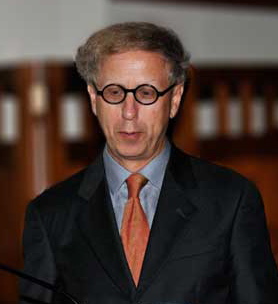
New York Times writer N.R. Kleinfeld

Kleinfeld, who is in his mid-60s, is no stranger to memorable stories. A Times staff writer for more than 35 years, he was part of a team that won a Pulitzer for a series called “How Race Is Lived in America” and the lead writer on a diabetes series that was a Pulitzer finalist. In addition,he has written eight nonfiction books and has written for several national magazines, including Harper’s, The Atlantic, Esquire and Rolling Stone.

Kleinfeld meticulously reported the George Bell story for more than a year, as the case sifted its way through probate court and the medical examiner’s office, and as government officials attempted to track down people named in a will Bell had prepared more than 30 years before his death.

**

Kleinfeld’s exhaustive reporting was just 50 percent of the reason the story resonated so deeply — and why it will likely win the 2016 Pulitzer Prize for feature writing.

The other 50 percent of the story’s resounding success lies in Kleinfeld’s compelling and distinctive way of writing.

Listen to the first paragraph of the story…When I say listen, I mean read it aloud. Slowly. Chances are you’ll feel the tentacles of the opening sentences begin to slowly envelop you as they did me.

They found him in the living room, crumpled up on the mottled carpet. The police did. Sniffing a fetid odor, a neighbor had called 911. The apartment was in north-central Queens, in an unassertive building on 79th Street in Jackson Heights.

Now, focus on the three adjectives in those lines: “mottled”…”fetid”…”unassertive.”

They imbue the opening sentences with a richness that James Joyce would envy.

…But the biggest hook in that opening paragraph is the construction of the first two sentences:

“They found him in the living room, crumpled up on the mottled carpet. The police did…”

Think of how much more impact those sentences have as written, rather than if the writer had said…

“The police found him in the living room, crumpled up on the mottled carpet.”

That is a brilliant stroke of writing — flipping the discovery by police to a subservient position. The reason he wrote it like that is because the point is not that the police found him, it’s that he was found at all. It didn’t particularly matter who found him.

**

A particularly sensitive pocket of great writing occurs about halfway through the story, when Kleinfeld describes a funeral director named John Sommese retrieving George Bell’s casket at the morgue and transporting it to a crematory…

 “Next stop was U.S. Columbarium at Fresh Pond Crematory in Middle Village, for the cremation. Mr. Sommese made good time along the loud streets lined with shedding trees. The volume on the radio was muted; the dashboard said Queen’s ‘You’re My Best Friend’ was playing.

“While the undertaker said he didn’t dwell much on the strangers he transported, he allowed how instances like this saddened him — a person dies and nobody shows up, no service, no one from the clergy to say a few kind words, to say rest in peace.

“The undertaker was a Christian, and believed that George Bell was already in another place, a better place, but still. ‘I don’t think everyone should have an elaborate funeral,’ he said in a soft voice. ‘But I think burial or cremation should be with respect, or else what is society about? I think about this man. I believe we’re all connected. We’re all products of the same God. Does it matter that this man should be cremated with respect? Yes, it does.’ “
george bell

The late George Bell

The same section contains at least two instances of striking phraseology:

— “He (Sommese) consulted the mirror and blended into the next lane.”

consulted the mirror…

— “Squinting in the sun, Mr. Sommese paced in the motionless air. After 15 minutes, the dock opened up and the undertaker angled the hearse in.”

…paced in the motionless air…angled the hearse in…

Exquisite, wouldn’t you agree?

**

Anticipating a strong reader reaction and curiosity about his story, Kleinfeld wrote an accompanying “Times Insider” story, explaining why he was drawn to George Bell:

“The people I spoke to consistently wondered why I was writing about George Bell. He was just another man. Well, that was why.”

_____

The hallmark of a great photographer is that he or she produces special photos regardless of the assignment.

Last week, for example, The Star’s Keith Myers was in the thick of the biggest story we’ve had around here in years — the fire at Prospect and Independence avenues that took the lives of two firefighters.

Yesterday, Myers was a Dub’s Dread Golf Club in Kansas City, KS, covering the Kansas Class 5A individual championship. He got this picture of the winner, Caroline Klemp of St. james Academy getting a “sandwich hug,” as Myers described it, from her mother, Joni Klemp and her sister Audrey.


Caroline

The only place where I’m pretty good at haggling over prices is outside sporting events when negotiating for tickets.

My biggest coup was in 2000, when I bought a $500 face-value Kentucky Derby ticket for $200. It got me into the lofty, 4th-floor “Jockey Club Suites,” where I was among celebrities such as then-University of Kentucky basketball coach Rick Pitino and then-U.S. Defense Secretary William Cohen. (I was so lucky that day that I even had the Derby winner, Fusaichi Pegasus.)

Normally, however, I overpay for items and services that don’t carry non-negotiable prices.

Five years ago, for example, Patty and I paid at least 30 percent more than we should have for two rugs while we were on a trip to Turkey. I went into the negotiations uninformed and uninitiated and was hornswoggled by a charming salesman named Celal Belli, who also went by “Jelly Belly.”

So, it came as no surprise to me when I learned in recent days I was paying more than several other people I know for the print edition of The Star.

I had heard that because of the steep drop in circulation the last several years, subscription prices were somewhat negotiable. I’ve never tried to negotiate it, however — just paid what they said I owed and charged it automatically each month to my credit card.

At the start of this year, my subscription price rose from $27.51 to $34.51 per month, right at 25 percent more.

Within the last few days, a friend got a special, discounted price of about $16 a month for six months.

Told how much I was paying, my friend suggested I conduct an informal survey of several friends to find out what kind of disparity there was.

So, I sent emails to several former Star colleagues and asked what they were paying.

Here’s what I found:

— Former business reporter Julius Karash said he was paying $35.39 a month before he recently dropped the print subscription because of delivery problems at his downtown condo.

— Former Metro reporter Kevin Murphy said he was paying “about $30 a month.”

— At the other end were former architecture critic Donald Hoffmann and former society editor Laura Hockaday, both of whom are paying $14.83 per month. Laura didn’t know why her rate was as low as it is, but Don said it’s because former KC Star employees are entitled to a 50 percent discount.

I knew that many years ago, probably back in the 80s and 90s, I was getting The Star delivered to my home at a discounted price — probably the 50 percent Hoffmann alluded to. But I thought the Star had dropped that perk years ago, and I hadn’t inquired about it or thought about it in years.

Don said he had been getting the discounted rate since he retired in 1990.

If that’s the case, I say, good for Don and good for Laura and other former Star employees who are getting a great discount…And one more thing: I’ll be calling The Star this week to try to get the discounted rate.

**

On the haggling, my survey yielded a lively email thread among me, Julius and a another former reporter who declined to be identified.

20150521_131947

Julius Karash

Julius had suggested that I include the other reporter in the survey because “he says whenever they try to hit him with an increase, he tells them he wants to drop the paper and then they back off.”

When I sent that reporter an email telling him what Julius had been paying and asking what he was paying, he wrote back saying, “J (Julius) is being robbed.”

Conspicuously missing was how much he — the other reporter — was paying, so I pressed him, saying, “Out with the number!”

He wrote back, “They pay me!”

…I don’t think I’d want to be in a poker game with that guy. But then again, he probably doesn’t engage in games of chance because he’s obviously very good at holding onto his money.

**

If you’d like to get in on this survey, pray, tell us here at jimmycsays what you are paying for your print subscriptions…Even if you aren’t a former Star employee, if you are armed with enough “comps” — the term used in the real estate business to help set home prices and tax assessments — maybe some of you will be able to fight back and shave a few dollars off your monthly rates.

Enough of the negative…Let’s turn to some of the great work Kansas City Star reporters have been doing.

As much as readers and we self-appointed critics highlight the deficiencies of The Star and its owner, the McClatchy Co., it is important to acknowledge that The Star remains a lot better than most other major metropolitan dailies.

Maybe you saw former business reporter Julius Karash’s  comment on my previous post, saying basically it would be a debacle if McClatchy sold its papers to Gannett, the nation’s largest newspaper chain.

As I said in responding to a comment on that post, my impression is Gannett is a cookie-cutter — a marionette operation that gives local publishers and possibly editors little latitude. You walk the line and take the generic filler copy that Gannett provides. McClatchy, on the other hand, while its papers operate on razor-thin margins, doesn’t hover over local operations — at least to the best of my knowledge.

The last few days, we’ve had two huge stories taking place in Kansas City: the Royals and the deaths of firefighters Larry Leggio and John Mesh. Let’s take a look at how The Star has handled those stories.

Royals coverage

The Star has been doing a fabulous job on the Royals, publishing special sections every day on the American League Division Series with the Houston Astros. Putting out special sections is a significant financial commitment, but it’s the right thing to do.

The columns by Sam Mellinger and Vahe Gregorian have been insightful and unfailingly interesting. As usual, the headlines have been outstanding.

After the Royals came back for a 5-4 win Friday in Houston, putting the best-of-five series at a game apiece, The Star’s front-page headline was “Houston, we have a series.”

The headline on the combined front and back pages of today’s special section was “Houston, welcome back to the “K” — with the “K” reversed for baseball’s iconic indicator of a strikeout.

Never take this sports section for granted, Kansas Citians. It is one of the best in the country, and management keeps finding one great columnist after another.

Many of us never thought they’d be able to adequately fill the shoes of the Jason Whitlock and Joe Posnanski, but these two guys we’ve got now are right up there in Jason’s and Joe’s league.

The Fire

The fire in the three-story building at Independence and Prospect broke out 7:25 p.m. Monday. That gave The Star just three or four hours to get the story. And believe me, it’s not easy to get a story on deadline when all hell is breaking loose and you’ve got firefighters crushed in the rubble of a collapsed wall.

But veteran reporter Bob Cronkleton (whom I oversaw in the Wyandotte County bureau about a dozen years ago) and relative newcomer Ian Cummings did an excellent job of producing a compelling and crystal-clear story for the Tuesday morning print edition.

The fifth paragraph began with a telling quote from Fire Chief Paul Berardi: “This is the worst day.”

They didn’t get the names of the two dead firefighters in the paper, but they were on the website in the morning. Excellent work.

The hardest and most challenging part of covering a huge breaking story, however, is how well you follow it up in the days after the event, particularly the next day.

The Star delivered masterfully. They put two of their most seasoned and reliable reporters on it: Laura Bauer, who covered the Brandon Ellingson drowing at Lake of the Ozarks, and Brian Burnes, who formerly was stationed in Independence, when The Star had a bureau there. (I worked there, alongside Burnes, from 2005 to 2006, when I retired.)

Cronkleton was also back on the story Tuesday morning, probably working on very little sleep. Cummings and longtime, top-notch photographer Keith Myers contributed to the report. (Myers also had two good photos.)

The main story, more than 60 column inches, laid out what happened from start to finish…It had everything except what caused the fire — hasn’t been determined — and the last firefighter fatality in Kansas City. (I’m not sure about this, but it might have been 47-year-old Battalion Chief John Tvedten Jr., who died in a warehouse fire in December 1999.)

Accompanying the story was a helpful timeline; an easy-to-digest graphic by artist Neil Nakahodo; and a stunning overhead photo by staff photographer Allison Long, showing the still-smoking building and the pile of rubble that engulfed Leggio and Mesh after a wall collapsed.

For an accompanying story, or “sidebar,” The Star dispatched investigative reporter Judy Thomas to interview the building owner, Bo Tran…In Thomas’ capable hands, Tran came across as genuinely more devastated by the deaths of the firefighters than the loss of his building. She quoted him as saying:

“I feel real hurt. Really, really hurt. There’s nothing baetter than people like that.”

**

After my previous post lambasting McClatchy and The Star for various felonies and misdemeanors, an email from a former KC Star staff member jolted me into focusing on the positive.

At one point, the former staffer said, “I hate to be one of those things-were-better-back-when guys.”

How well expressed…and something for all of us backseat drivers to think about.

So, thank you, Star staff members, for providing us with outstanding reporting and writing on two of the biggest, most important stories we have seen around here since at least the fall of 2014. It’s time-consuming, demanding work, and I’m now getting out of my chair to applaud you.

Post-Royals-victory addendum

It’s abundantly clear after tonight’s great Royals’ win over the Astros in the American League Division Series that I should never venture into sports prognostication and commentary.

Here are some of the things I wrote about the Royals in recent weeks.

Aug. 23:

“The Royals…probably aren’t going to win the American League Championship.”

“Alex Rios is a pretty boy who can’t hit.”

“Lorenzo Cain looks like he’s on a sea cruise.”

“Yorlando Ventura is a kid…who probably wont’ make it with the Royals.”

Sept. 7:

I facetiously dubbed Johnny Cueto “The Fantastic Johnny C” and linked to the song “Boogaloo Down Broadway.”

— All I can say now is that, as most of you know, I have a lot of hats, and tonight I’m starting to eat them one at a time. Yea, Royals! (And after the Royals beat the Blue Jays for the American League championship, please join me in boogaloo-ing down Broadway.)

For the sake of the loyal, hard-working journalists remaining at The Kansas City Star, I really dislike flogging the paper and its owner, the McClatchy Company, for their shortcomings.

Fact is, though, the problems are increasing, and subscribers, readers, employees and former employees are entitled to know about them.

Here’s the latest:

:: The Star is now running some editorials that are not being written by the four members of the editorial page staff. 

The Star and the St. Louis Post-Dispatch, among others, are “outsourcing” some editorials to a service called “Opinion in a Pinch,” run by an Oregon man named Chris Trejbal, a former editorial writer for the Roanoke Times in Virginia.

The Columbia Journalism Review had an interesting story on Trejbal, who has shrewdly capitalized on reduced editorial-page staffs at newspapers across the country. The journalism review story says of Trejbal:

Trejbal500

Chris Trejbal

“One of his first clients was The Kansas City Star, whose editorial page was then run by Miriam Pepper—who, after retiring from the paper in 2014, would go on to join Opinion in a Pinch as a freelance editorialist.”

…This is all news to me — The Star running some outsourced editorials and Pepper apparently writing some of the “commissioned” editorials in The Star.

The problem for me — and I trust for many of you — is that The Star isn’t identifying outsourced editorials. They are simply dropped in along with editorial researched and written by the four remaining editorial board members — Steve Paul (editorial page editor), Yael Abouhalkah, Barb Shelly and Lewis Diuguid.

The Post-Dispatch, on the other hand, has chosen to identify editorials not produced by its editorial page staff, which is now down to two members.

The Post-Dispatch uses this disclaimer in parentheses: “This editorial was commissioned from freelance editorialists and edited by the Post-Dispatch editorial board.”

…Now, that’s at least being straightforward. But listen to how Steve Paul rationalized The Star’s lack of transparency to the Columbia Journalism Review:

“When we’re ‘in a pinch’—vacation mode, etc.—we call on him (Trejbal) occasionally to help back us up. I discuss topics with him, we discuss ed (editorial) board positions, he reports and writes, we edit. I don’t see the need to disclose that; in a sense, he’s an adjunct member of the editorial board, a leg man who reports for us, or a ghost writer of pieces that never have been signed anyway.”

I think the non-disclosure is reprehensible, and I totally agree with the assessment of the former KC Star reporter who alerted me to the journalism review story.

paul2

Steve Paul

The former reporter — who declined to be quoted by name because he respects Steve Paul — wrote in an email: “I regard editorials as one of a newspaper’s sacred duties — they should be thoughtful, local and well-researched.  It’s hard for me to imagine that they accomplish any of those goals this way.”

…For the sake of its remaining credibility, The Star should immediately begin identifying outsourced editorials. To Steve Paul and KC Star editor Mike Fannin, I say, “Stop misleading the readers!”

:: Another example of The Star misleading, or at least confusing, readers appeared on the back page of Saturday’s paper.

In a legally required “Statement of Ownership, Management and Circulation,” The Star listed Fannin as editor and Greg Farmer as managing editor.

But the part about Farmer is incorrect. After Steve Shirk retired as managing editor a few months ago, The Star didn’t name a successor. Instead, it divided his duties among a few people, including Farmer.

I left a voice message for Farmer this morning and he sent me an email addressing the published statement.

“That was a mistake,” he said. “I’m leading the investigative/enterprise team as Senior AME (assistant managing editor).”

…My guess is that whoever prepared the statement simply plugged in Farmer’s name for the sake of convenience. But to be totally honest and accurate, the statement should have said the post of managing editor was “currently not filled.”

It would have been that easy to be transparent.

:: Major problems persist with distribution of the print edition.

A longtime carrier told me today that changes over the last few months have prompted some carriers to quit and that many inexperienced and incompetent carriers have been hired as replacements.

The changes include:

— The Star distancing itself from direct responsibility for delivery of the paper by hiring distributors who have formed LLCs and assumed full responsibility for delivery operations. Carriers’ checks no longer come from McClatchy but from the distributors. In addition, when carriers don’t show up for one reason or another, the distributors — not  The Star — are responsible for getting the papers delivered.

— Reductions in the pay carriers receive for delivery of each paper. (Loss of circulation has also hit carriers hard in the pocketbooks, since their pay is on a per-paper basis.) The carrier I spoke with said his income from delivering the paper was about half what it was several years ago.

— Installation of a new computer system, which has resulted in paycheck delays, among other things. “The new system has not worked from Day One,”  the carrier told me.

Along the same lines, it continues to be very difficult to get through to a live person in the circulation department. A friend who was having delivery problems was put on hold for more than 30 minutes yesterday, and today, as a test, I held on the line for at least 10 minutes before giving up.

:: Finally, McClatchy announced today it is closing its foreign bureaus and bringing those staff members back to the Washington bureau.

The bureaus to be closed are in Beijing, Mexico City, Istanbul, Berlin and Iraq.

A Poynter Institute story about the restructuring said:

“In discontinuing its foreign bureaus, McClatchy is scaling back its international coverage in favor of an editorial strategy that emphasizes regional stories and political coverage.”

Poynter said McClatchy’s international reporting will be “project based and less frequent.”

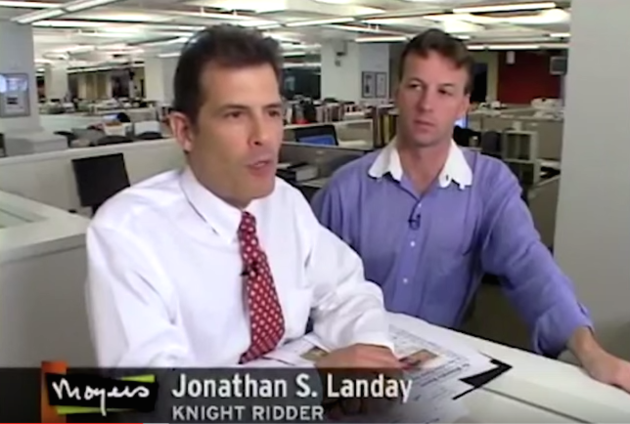
Jonathan Landay, a high-profile reporter in McClatchy’s Washington bureau, was quoted as saying:

“At a time when the world is careening into greater chaos and mayhem, Americans want to know what’s happening and how this is going to affect them. By closing the foreign bureaus, we’re shutting off an important source of news and analysis at a time when we need to be paying more attention because our mission is to inform and educate.”

landayPerhaps not coincidentally, Landay recently announced he was leaving McClatchy for a job with Reuters. When Knight Ridder still owned the papers that McClatchy later bought, Landay produced some of the most skeptical coverage of U.S. intelligence claims that Iraq possessed weapons of mass destruction.

Although McClatchy said there would be no layoffs, you can be assured that this is a money-saving move. Maintaining a foreign bureau is an expensive and time-consuming proposition.

In the same money-saving vein, many major metropolitan dailies, including The Star, have shrunk their national and international coverage in recent years. The emphasis on “local, local, local” is simply a cover story for reducing page count.

**

With all this going on, it is no mystery why publisher Mi-Ai Parrish departed for The Arizona Republic in Phoenix, where she will be working for a new company, Gannett, that was recently spun off from its parent company (renamed TEGNA) and is starting afresh with no debt.

With McClatchy, every publisher who gets up in the morning and goes to work carries with them the burden of the parent company’s nearly $1 billion debt — a debt incurred when McClatchy unwisely bought the Knight Ridder chain just when things were starting to go south for the newspaper industry.

Now, at the local level, every McClatchy paper is crying out to be set free.

We just got home last night from south central Colorado, where we spent a few days with friends who have a cabin in the Wet Mountains (a range of the Rockies), near the town of Westcliffe.

I was there last year with the cabin owner and another guy, and that time we took the overnight train from Kansas City to Trinidad and drove the 60 miles up to the cabin in a rental car. This year we drove, and I can tell you even though it’s a long drive, sitting in the car for 12 hours is a lot more comfortable than trying to sleep in a tilt-back chair on the train.

An even bigger bonus: This year we had women! Woo-hoo! I tell you it was a veritable nonstop party for three days…well, as much of a nonstop party as one person in her late 50s (Patty) and three in their and 60s can have.

I know you’re dying to see the photos, so let’s get started!

P1050401

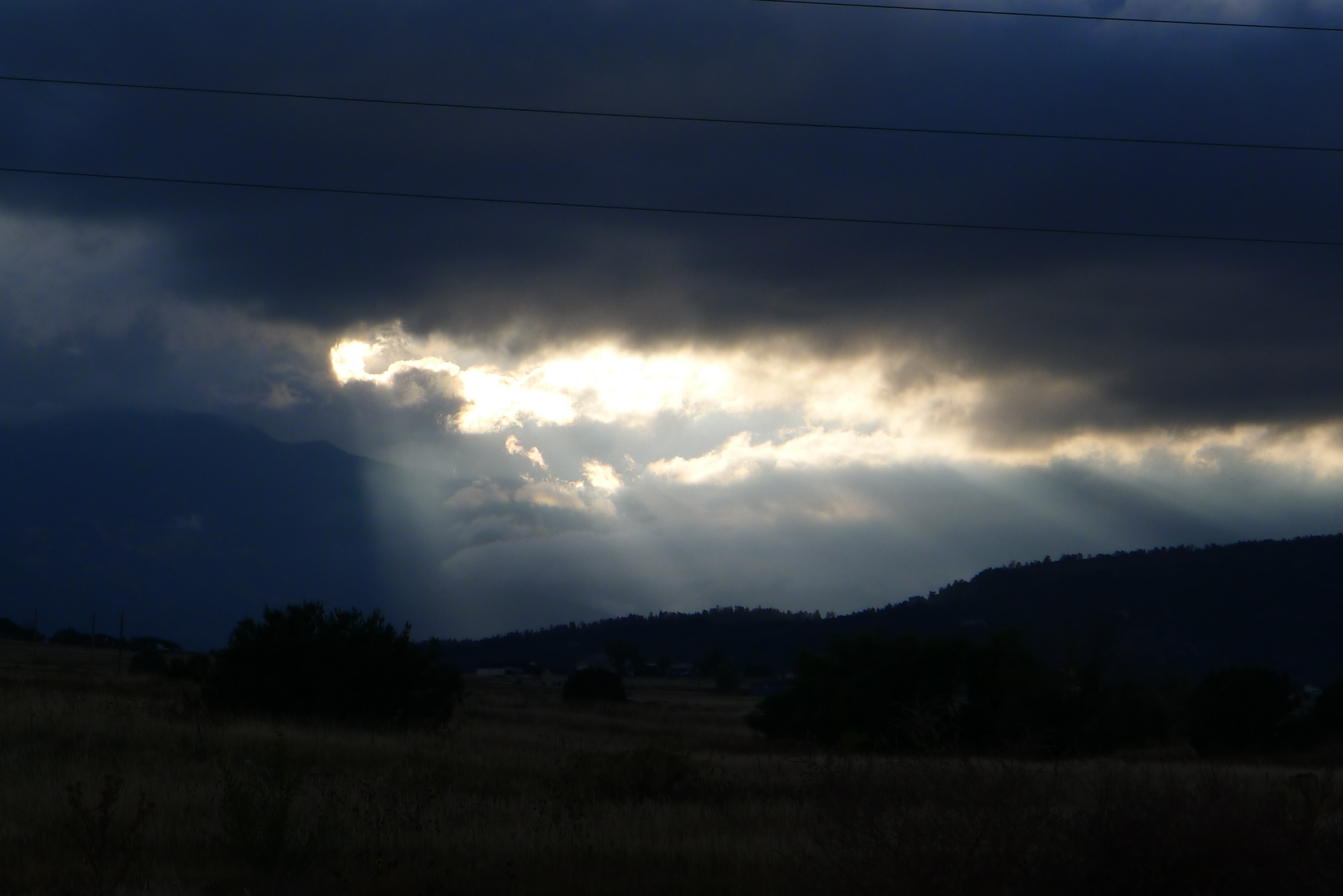
We had just gotten to the town of Colorado City, not far from the cabin, when we happened upon this view.

P1050403

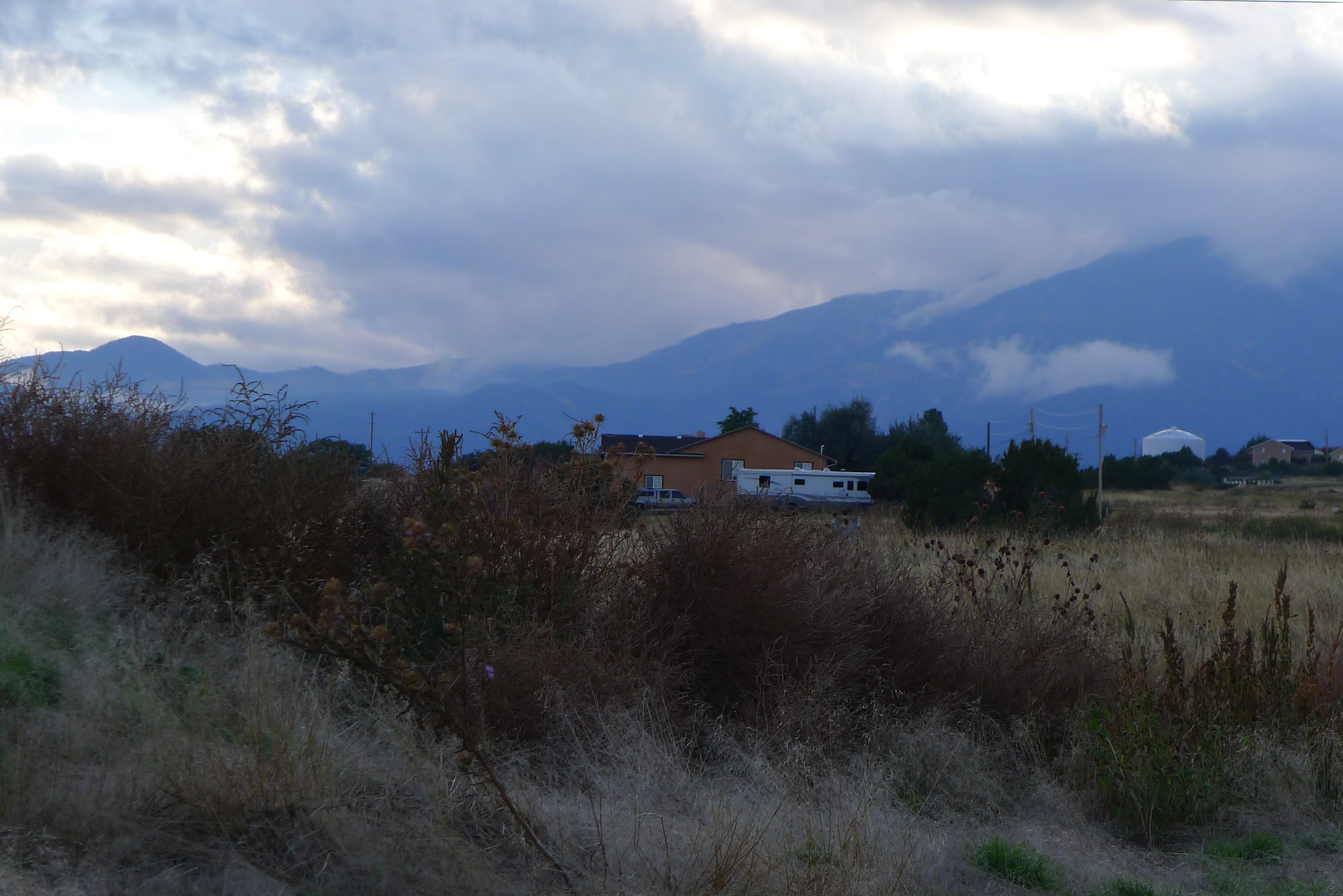
I took this one from the same vantage point, different view.

P1050411

Our cabin was a bit on the rough side, but…oh, wait…wrong photo.

P1050467

Not rough at all, actually. Kaler, who co-owns the place with his cousin, calls it “the little cabin in the woods.” I call it the Grand Villa.

P1050436

We shared the deck with some fine feathered friends.

P1050419

One day we took a 4.2 mile hike (two up, two down) to St. Charles Peak, elev. 11,784 feet. Strangely enough, Patty and Kaler were the only two who made it to the summit. Maybe if Kaler’s wife Eileen and I had laid down and rested we would have made it, too.

P1050426

The aspens had turned, and, boy, was it beautiful.

P1050449

On Colorado 165, the road to Kaler’s cabin, looms a structure called Bishop’s Castle, which a guy named Jim Bishop built by himself. It’s quite a tourist attraction. You can climb all the way to the top, if you have courage, strong legs and an iron will. The four of us came up lacking in each of those departments. Ground level is as high as I got.

P1050453

Then there’s the town of Westcliffe, at the feet of the Sangre de Cristo mountain range. One of my favorite stores in Westcliffe is a pawn shop called the The Loan A Ranger. Lots of guns for sale…Oh, baby, I just love those firearms!

P1050455

One day we went to a place called The Winery, at a former abbey near Canon (pron. Canyon) City.

P1050457

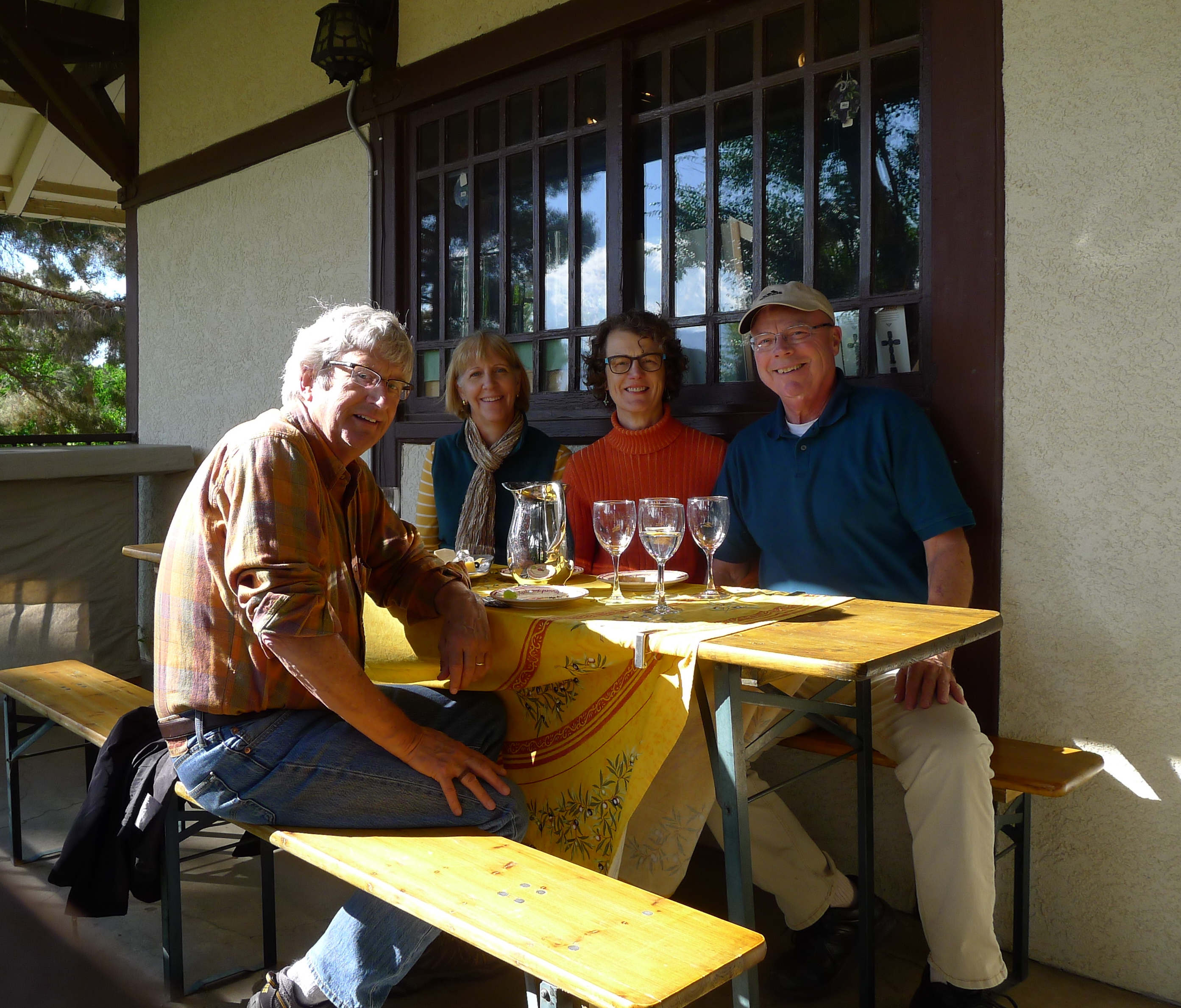
The wine tasting was $35 a head, except for me, a non-drinker. I drank grape juice and got in for the discount price of $10…That’s Kaler in the front and Eileen, Patty and me.

P1050458

As we left The Winery, a cloud buildup was underway.

P1050460

Like I said, a cloud buildup was underway. The cloud formations change quickly in the Centennial State.

P1050464

A friend of Kaler’s owns this place, with a view of Turtle Rock (left peak).

P1050465

A closer view of Turtle Rock.

P1050421

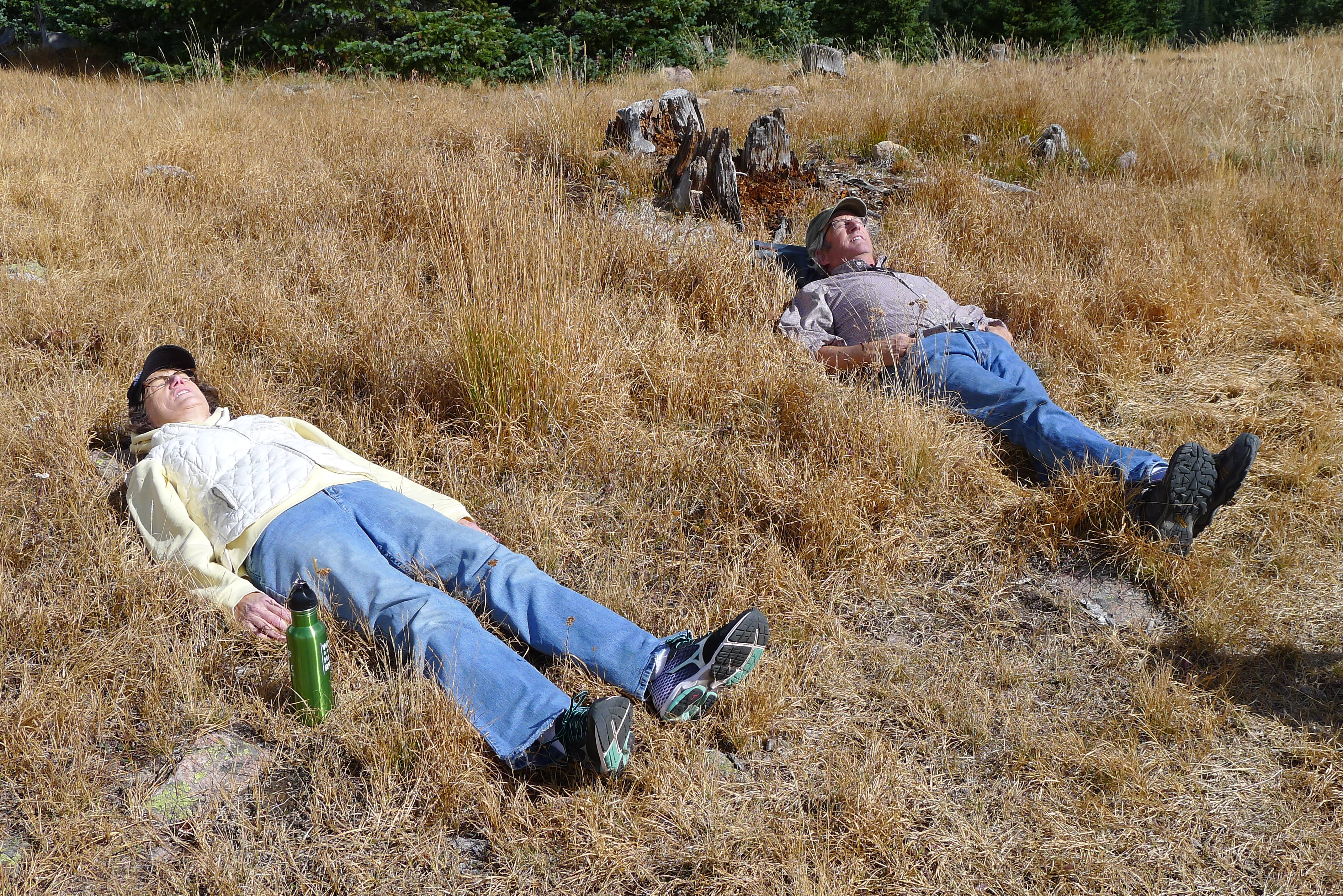
Naturally, I wanted to get an old-fashioned selfie, using the 10-second self-timer on my Lumix, but I couldn’t scramble down the rocks in time to join my companions. Tempus fugit, that’s for sure.

We’re in Day Two of The Kansas City Star’s redesigned website and print edition, and I thought you might be interested in getting some “expert opinions” on the changes. So, yesterday and today I sent emails to several former Star staffers, seeking their observations.

Here’s what the former insiders had to say…I will add the opinions of others, if I receive any, and I would like to get your observations. So, comment away.

Kevin Murphy, Metro Desk:

Web: I am still a print guy, but I like the redesign of the website better than I do the remade newspaper itself. The Star banner at top gives the home web page a newspaper look, and I like that a lot of headlines show up on the screen immediately without having to scroll down.

Print: The section fronts look like shoppers in a way, with the italic headings — Sports Daily, Chow Town, etc. The type face of the copy is unnecessarily large, especially in classifieds and makes for a smaller news hole. It’s encouraging to read that the paper will stress investigative work plus breaking news and beat reporting. Do they have enough reporters to do that?

Gene Meyer, Business Desk

Web: The new format looks a lot cleaner on the web. But the content seems thin. The Star was the slowest of five sources I checked to run the announcement that the Plaza was up for sale and didn’t add anything TV stations didn’t already have.
Print: The new format is going to take some getting used to. My initial impression of the print product is that it reminded me of the old Weekly Reader, the recap of each week’s news events prepared for elementary and junior high schools. About as deep and reasoned as some  of those old Ed Herlihy newsreels they used to show at movies when I was a kid. The waist-up portraits of the local columnists got me, too. We junked those shortly after I joined the old Kansas City Times staff in 1983.
Screen shot 2015-10-01 at 1.45.49 PM

Karen Brown, Editorial Page

Print: They may have finally lost me as a diehard subscriber. More air (white space) and less news. Who needs or wants that? I lived through many “redesigns,” and not one of them contributed to increased circulation or readership. I know many people now get the majority of their news online — I’m one of them — but for people who still want something of a print version, this latest iteration of The Star is even farther away than the last one.

Mike Rice, Metro Desk

Web: I think they’re just polishing a turd. Sure, they’re going to put a great piece of journalism like Laura Bauer’s story (“Saving Govi”) on the first day, but what comes after a week or two? I hate the pay wall and the pop-up ads. And most of all how there is no indication from the headlines whether it is a local or national story. For instance, you see a headline that says “Man Bites Dog.” You think, hmmm, that’s interesting — where did this sick puppy commit this act? Olathe, Northland, my neighborhood. You click it, and once you maneuver the story around the pay wall, you find that this happened in Florida!

Print: I cancelled my subscription to The Star after they laid me off and never renewed. I buy the print edition on occasion and am both amazed and depressed by how small it is.

Julius Karash, Business Desk

Web: I think the site looks better and is more compelling, and the electronic version of the print edition (E-Star) is easier to navigate on my laptop now. The website’s search mechanism seems to be improved but still needs work. To test it, I requested a search for the oldest Dave Helling byline and was presented with an item, “GOP Site Selection Committee Arrives,” which the website says is “about 174 years old.”  

Print: I am pleasantly surprised to see that there is still a business section. I like the additional subheads on news stories to help readers seeking quick summaries, but I question the value of publishing long, in-depth news features on weekdays. (Note: Julius stopped taking the print edition recently after experiencing delivery problems at his downtown residence.)

**

As Karen Brown noted, those of us who worked at The Star many years went through several redesigns, and it always took me at least a few weeks to get used to the changes.

Here are my initial, major observations of the redesign:

— The front page of the print edition contains just two stories a day, instead of three or four. Lame.

—  The ridiculously small amount of national and international news in both the print edition and on the website is not changing. Embarrassing.

— The larger type face is good, especially for the older readers, who comprise the vast majority of print-edition readership. One thumb up.

Finally, here are the opinions of the two women I live with:

Patty: “It looks like a small-town newspaper.”

Brooks: “It looks like they’re turning it into a picture book…You can quote me.”

Ah, the kid knows the lingo. Warms my soul.

Most of you know, I’m sure, that Mi-Ai Parrish, KC Star publisher the last four years, is headed to Phoenix to become president and publisher of The Arizona Republic.

It got big headlines on this blog last week. Where it didn’t get big headlines, interestingly, was in The Kansas City Star.

P1050395The Star announced the change on page A8, the business page, in a bland, one-column, nine-paragraph story.

Maybe Parrish is humble and instructed the newsroom not to make a big deal out of it. But probably not. The writer, Mark Davis, probably gave the story exactly what it deserved.

Here’s the important thing about that story: Its brevity and positioning weren’t as much reflections on Parrish as they were on the state of newspaper publishing.

Back in the 70s, 80s, and 90s — and earlier — it was almost always a big deal when the publisher of a major metropolitan daily resigned, retired or was fired. That was when a lot of papers were owned by families, the paper’s employees or newspaper barons, like William Rockhill Nelson.

These days, with so many metropolitan dailies owned by chains — such as Gannett (many dailies), McClatchy (The Star and several others) and Lee Enterprises (the St. Louis Post-Dispatch, among others) — most publishers are like cogs in wheels. That is, pretty interchangeable.

You might have read former Kansas City Star executive editor Mike Waller’s comment on last Thursday’s post. He said:

“It doesn’t matter today who the publisher is of any newspaper. It matters only who owns the paper. Only an enlightened ownership–there are few remaining–can assure quality journalism.”

He should know; he’s a former publisher of the Hartford Courant and The Sun of Baltimore. Both those papers were once owned by a good chain — Times-Mirror of Los Angeles — and, currently, a bad one — Tribune Co. of Chicago.

**

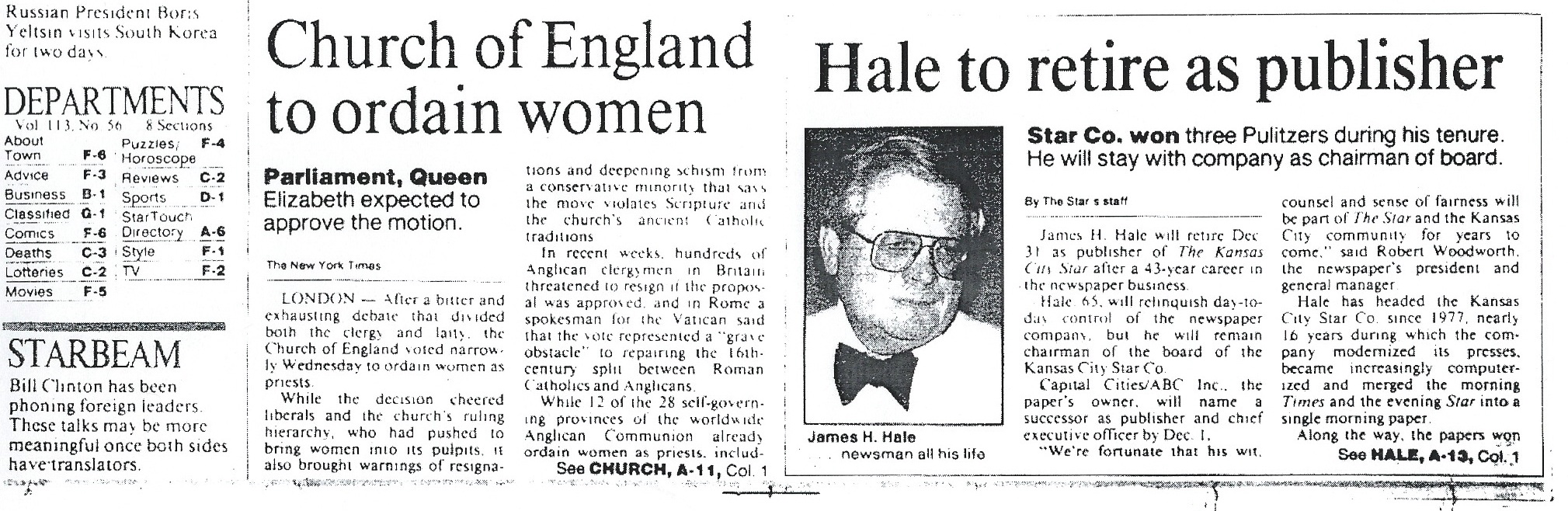
In contrast to the short story about Parrish’s departure for the desert, when the last great Kansas City Star publisher retired in 1992 –the late James H. Hale — he went off to a crescendo of tributes.

The Star ran the announcement story on the bottom of Page One on Thursday, Nov. 12. The story “jumped” inside and ran a total of 48 paragraphs.

hale retirement

hale jump

The story included laudatory quotes from Miller Nichols, former chairman of the J.C. Nichols Co.; Marion Kramer, a civic leader; former Kansas City Star editor Joe McGuff; and Phil Meek, senior vice president of Capital Cities Inc., which had purchased The Star in 1977 and shortly thereafter installed Hale, a Texan, as publisher.

During his 15-year run, Hale expanded the paper, approving the hiring of new employees and the addition of new sections; greatly increased the paper’s profitability — the profit margin soared to about 30 percent; and got the paper involved in the community in a big way, partly through sponsorships of major arts organizations. Plus, The Star won three Pulitzer prizes.

In short, he deserved every paragraph of that story.

He was succeeded by Robert Woodworth, another CapCities veteran.

Things started going downhill for The Star four years after Hale’s retirement, in 1996, when the Walt Disney Co. bought out CapCities (which had acquired the ABC-TV network). Disney owned the paper just one year before selling to KnightRidder. In 2006, KnightRidder folded its tent and sold out to McClatchy.

As the paper’s fortunes declined, the publisher’s post became less vital. The focus quickly shifted to McClatchy’s Sacramento headquarters, which delivered harsh marching orders in the face of rapidly falling advertising and circulation at all its papers.

The main job of KC Star publishers since 2008 — Mark Zieman and Parrish — has been to shrink-wrap the paper.

They’ve done a mighty fine job of it…It’s just not the kind of success that merits front-page headlines.


It was quite an eclipse, wasn’t it?

No, don’t tell me you missed it…and don’t tell me you weren’t interested. It was a wonder of nature so rare it comes around only about once every other papal visit.

…Speaking of which, I was just as mesmerized by the pope’s departure as I was by just about everything he did in the U.S. the last several days.  I watched intently as his Boeing 777 and  crawled along the taxiways at Philadelphia International Airport and then began accelerating and finally lifted off and quickly disappeared into the night-time sky.

Patty and I have joked for years about post-Derby Depression — the feeling we, particularly I, get the day after each Kentucky Derby. And tonight I’ve got a bit of post-papal depression. Nothing clinical, you know, just situational. But enough that the eclipse seemed a bit anticlimactic compared with the vivid memories of the pope’s radiating presence.

But anyway, I pulled myself out of the dumps to try to get some memorable eclipse photos.

I have to admit, I failed miserably. When I pointed my glorified Panasonic point-and-shoot at the sky and “zoomed” in the maximum of four times normal, all I got were images of a small white blob, with a tinge of red…For some reason, my camera refused to acknowledge the eclipse; it was looking more like moon over Miami, and by Miami I mean it looked on the camera display like the moon was a long, long way off — even father than Miami.

However, I know you’ll just be thrilled that I did, in fact, get some excellent eclipse-related photos. Here are the three best, and you’ll note, I’m sure, that in each of these three striking images, something looks like it’s in a state of eclipse.

Here we go…

P1050391

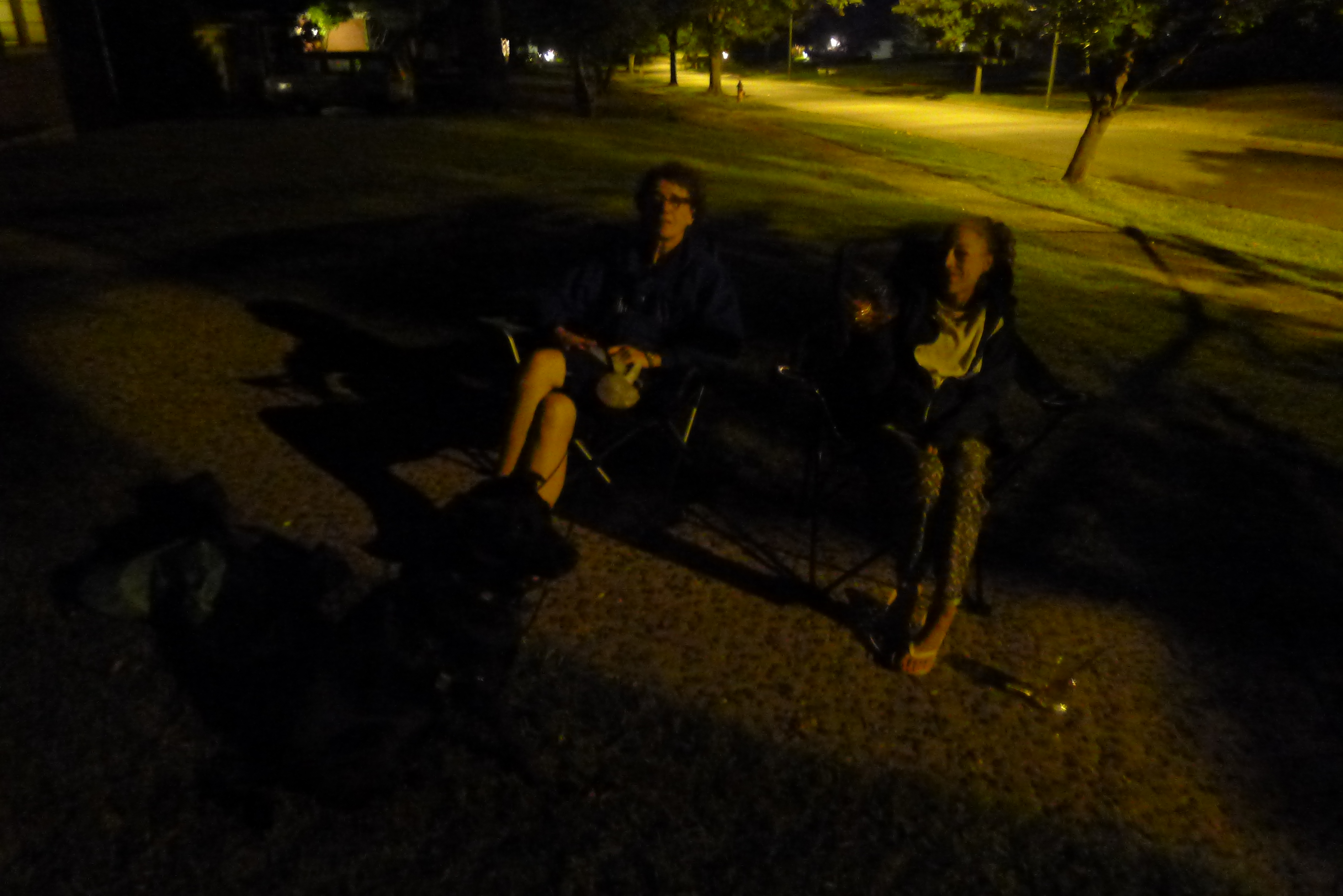
Here are a couple of ladies in the Romanelli West neighborhood who pulled up chairs to watch the grand event. (That shadowy looking thing in the left foreground is a Black Lab/German Shepherd who wanted in on the fun.)


P1050384

A man at the same household strained to see the shrouded “supermoon.”


P1050392

Since I couldn’t get the moon, I focused on a streetlight that was in nearly total eclipse. (You can see these just about every night if you position yourself right.)

Well, there it is. The pope is gone, and so is the eclipse. Now, off to bed and back to workin’ in the coal mine bright and early tomorrow.

After that brief interruption, we now return to our coverage of all things papal…

With The New York Times glued to Pope Francis’ visit to the States, it is hard to imagine that The Times yesterday once completely missed an entire papacy.

But it happened. Some of you will recall that the tenure of Pope John Paul I lasted only a month — from the end of August to the end of September 1978.

But readers of The Times didn’t get a word about John Paul I — not one word — until after he died. The reason? The newspaper went through an 88-day strike in 1978, and the strike spanned the entirety of John Paul’s brief reign.

After the strike, The Times published a Nov. 6 special section that included a page of obituaries of notable people who had died during the strike. Pope John Paul I got the longest obituary — 10 paragraphs — plus a photo.

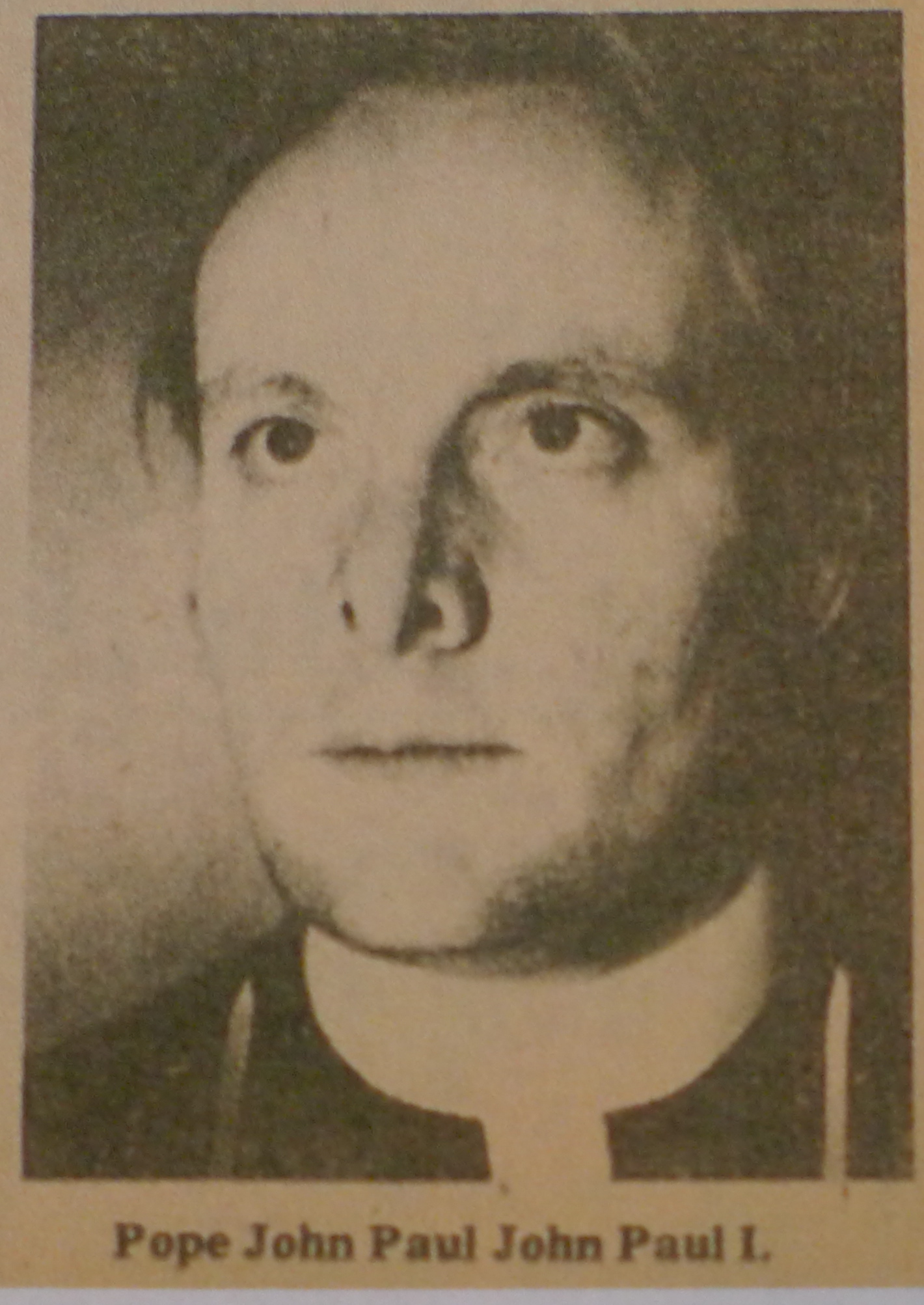
However, an Oct. 16, one-time edition of a publication called Not The New York Times chronicled the demise of another short-lived — even less-known — pope, John Paul John Paul I.

P1050380It seems John Paul John Paul I had been “Archbishop of Liverpool.” He took his papal name from his three predecessors — John XXIII, Paul VI and John Paul I — although speculation has it that John Lennon and Paul McCartney also influenced his choice. 

Here’s the Not The New York Times’ Oct. 16, 1978 report on the papacy of John Paul John Paul I.

Rome, Oct. 11 — Pope John Paul John Paul I, 264th Supreme Pontiff of the Roman Catholic Church, died this afternoon while administering the Papal benediction to thousands who had gathered in St. Peter’s Square for his investiture. He served as pope for 19 minutes, the briefest reign in the history of the church.

The cause of the Pope’s death was not immediately clear. The 41-year-old Pontiff, formerly Archbishop of Liverpool and the first non-Italian to ascend the throne of St. Peter, collapsed in mid-sentence and toppled forward into a battery of microphones as he blessed the faithful who filled the square below.

His last words, which were also his first as spiritual head of the world’s 49 million Roman Catholics, were heard by millions who watched the ancient rite of investiture via communications satellite. Raising his hand to make the Sign of the Cross, the Pope intoned, “In nomine patri” and seemed to falter. He regained his speech momentarily, but only long enough to pronounce the next two words of the sacrament, “et filio” in a choking voice. Then he emitted a high-pitched squeal, which many mistook as coming from the boys’ choir, and fell forward.

Pope John Paul John Paul’s death followed by two weeks that of his predecessor, Pope John Paul I, who reigned for only 38 days. The latest papal death produced renewed controversy, confusion and speculation inside the church about choosing a successor for John Paul John Paul and the circumstances of his demise. Highly placed Vatican sources predicted that many of the 112 members of the College of Cardinals would decline to remain in Rome for the selection of a new pope. Rather than return to their spartan quarters deep in the basilica, many cardinals were said to favor choosing John Paul John Paul’s successor in a conference call.

The Italian newspapers immediately seized on the latest papal demise as evidence of a conspiracy. Several possibilities were advanced, with the most serious consideration going to the “single heart attack theory” to account for all the deaths.

Meanwhile, from every corner of the globe came expressions of deep mourning for the little Liverpudlian…Only hours earlier the jocular Pontiff had told his closest aides that he wanted to be called Jay-Pee Two, as a symbol of the informality and bold change that he hoped would mark his reign.

…The moral, I suppose, is you can’t pay close enough attention to a papal visit, because you never know when the Almighty is going to call his representative on earth home.

KC Star publisher Mi-Ai Parrish, who never appeared to be a good fit for Kansas City or the Star during her four years here, is leaving the paper.

Parrish, 44, will become president and publisher of The Arizona Republic on Oct. 12.

Parrish has some history with The Republic. She served as a deputy managing editor there from 1999 to 2001.

In making this move, Parrish is going from one big corporate newspaper chain, McClatchy, to an even bigger one, Gannett.

I’ll tell you this much: Either company is a bad place to work. Both have been cutting staffs at their papers; their major newspapers have been losing circulation; and they have struggled with the transition from print to online.

p10108872

Mi-Ai Parrish

One factor that might have lured Parrish is that Gannett’s newspaper division recently was spun off from the broadcast and digital businesses. The result was two new publicly traded companies — Gannett, the newspaper company, and TEGNA, the broadcast and digital company. In a break for Gannett, TEGNA retained the company’s $4.6 billion debt, so Gannett gets the benefit of a clean slate.

McClatchy, on the other hand, carries a debt of about $1 billion, which weights on all newspapers in the chain.

Time will tell if there’s an underlying story here — if Parrish was frustrated with McClatchy or, perhaps, vice versa. In any event, Parrish presided over several rounds of newsroom and company-wide layoffs; pulled the plug on The Star’s longstanding sponsorship of major arts organizations; and shunned public appearances and civic involvement.

One recent firing that shocked me was that vice president of advertising Julie Terry, who was extremely popular with nearly everyone who worked with her. The firing bore all the hallmarks of…“Advertising is down, and you’ve gotta go.”  The fact is, print advertising — which had spun gold for The Star for decades — has been plummeting at most major metropolitan papers for a decade. It wasn’t Julie Terry’s fault that ad revenue kept falling. If anything, McClatchy should have fired Parrish. But that would mean McClatchy admitting failure.

**

The Republic, as you would expect, put a very positive spin on Parrish’s move. the paper quoted John Zidich, Gannett president, as saying: “In her industry and in her publisher roles, she has provided great leadership and also great results.”

Great results? There aren’t any I can think of at The Star, and many people would raise their eyebrows at the “great leadership” assessment.

The story also said:

“At The Kansas City Star, Parrish found success in growing the traditional media company’s connections with a changing community that wanted news on its Smartphones, fresh experiences at festival and events, and quality journalism in all its products.”

Fresh experiences at festivals and events? People might have wanted fresh experiences at, say, the Renaissance Festival and the Lyric Opera, but I can’t imagine in what way The Star would play a role.

**

For Parrish, this transition marks a clean getaway. Naturally, she told The Republic she was excited about the opportunities that lay before her in Arizona.

“Great people, great community, great tradition. We are going to do amazing things.”

Can’t wait to hear the reports about those amazing things.

…In the meantime, I wish the remaining employees at The Star the very best and hope they get a good, new publisher…Actually, my fondest wish is for McClatchy to sell The Star to Warren Buffett so the employees of this once-great great newspaper get a shot at a clean getaway. They deserve it.