Feeds:
Posts
Comments

I’m starting to think Pope Francis, who began his tenure in such promising fashion, is not going to remove Kansas City-St. Joseph Bishop Robert Finn from his post.

Perhaps even worse, I’m starting to think the pope is just rearranging the deck chairs on the Titanic, insofar as taking meaningful action on the clergy child-sexual-abuse scandal.

feel good pope

Maybe a smile and a wave are the most we’re going to see out of Francis

Last September, as many of you will recall, the pope sent a Canadian archbishop to Kansas City to investigate Finn’s leadership. The pope’s emissary asked several people he interviewed if they thought Finn was “fit to be a leader.” I can’t imagine that many of the respondents answered affirmatively.

Four months before that, in May of last year, the pope told reporters that three bishops were “under investigation” for their roles in the clergy sexual abuse scandal. One of the three, the pope said, had already been found guilty “and we are now considering the penalty to be imposed.”

From that, I concluded that Finn, the only American bishop to be convicted in the sex-abuse scandal, had a target on his back.

In the wake of Francis’ statement and the visit by the Canadian bishop, I confidently predicted that Finn would be out by at least Lent.

Well, Lent is almost over, and it looks like nothing is going to happen.

Furthermore, like a golfer frozen over the ball at address, the pope has fiddled and diddled with a commission he announced in December 2013.

The commission has an impressive name — the Pontifical Commission for the Protection of Minors. But it took three months for the pope to make the first appointments to the commission, and then nothing happened for another nine months, until last December, when the pope assigned some more members to it.

The group had its first meeting last month and came out of the meeting saying it would hold bishops accountable for abuse cases that occurred on their watch. But there wasn’t a word about disciplinary action for any bishops who heretofore had dropped the ball on accountability, like Finn so obviously did by failing to report the crimes of onetime priest Shawn Ratigan, who’s now doing 50 years in prison.

In a March 2 letter, Pope Francis said he had created the commission “for the purpose of offering proposals and initiatives meant to improve the norms and procedures for protecting children and vulnerable adults.”

To me, it sounds like the commission and everything else that the pope is doing in regard to the scandal is pointed toward the future — not past despicable deeds and administrative inaction.  

Again, “offering proposals and initiatives” sounds nice, but we’ve heard that before. Pope Francis’ predecessor, Pope Benedict, sounded the same alarm, and look what ensued — more crimes and cover-up.

**

I’m not alone in being disgusted by the pope’s failure to take action regarding Finn.

Yesterday, the Survivors Network for those Abused by Priests (SNAP) also harshly criticized the pope for twiddling his thumbs:

“It’s a travesty that Francis has done nothing to discipline or even denounce Finn…(W)ith glacial speed, Francis ignores a bishop who was convicted of endangering children.”

Sorry to say, at this p0int it appears to me Francis is quite content having established himself as a “feel-good,” popular pope.

It’s just dandy that he’s humble, but does he have any backbone? Is he “fit to lead,” as the Canadian archbishop asked about Finn?

Maybe not. Maybe he’ll be remembered as a pope who talked a good game and attracted rock-concert-type crowds around the world but didn’t have the stomach to look a crooked cleric in the eye and say, “You’re fired.”


A new wind that blew in today has once again kicked up dust around Missouri Republican Chairman John Hancock.

David Humphreys, a leading Republican donor from Joplin, released an affidavit alleging that Hancock had been conducting a “whispering campaign” against the last State Auditor Tom Schweich.

In Schweich’s eyes, the alleged whispering campaign was intended to plant seeds that he was Jewish and thereby discourage some big Republican donors from supporting him. Schweich, of course, committed suicide late last month while trying to pin the whispering campaign on Hancock, who has close ties to Catherine Hanaway, the likely 2016 Republican nominee for governor.

At first I thought Hancock would be relieved of duty as Republican chairman, but it now appears he will survive. KC Star political columnist Steve Kraske wrote earlier this week that Hancock would have trouble hanging onto the post only if Sen. Roy Blunt, former Sen. Kit Bond or Lt. Gov. Peter Kinder called for Hancock to step down. And none of them has.

Hanaway

Hanaway

The larger picture here, though, is that if Las Vegas was taking bets on the governor’s race, Hanaway would probably be an even-money favorite to win.

There are three main reasons I think Hanaway is going to be Missouri’s next governor.

1) She’s got name identity and significant political experience.

She was elected to the Missouri House in 1998 from suburban St. Louis and in the early 2000s became the first woman Speaker of the House. She presided over the Republican takeover of the House in the 2002 elections. In 2004, she was the Republican nominee for secretary of state and narrowly lost to Democrat Robin Carnahan.

In 2005, President George W. Bush appointed her U.S. attorney for eastern Missouri. She resigned in April 2009 and entered private practice. She is currently a partner at Husch Blackwell law firm in Clayton. (Husch Blackwell also has a Kansas City office.)

2) Her likely Democratic opponent, Attorney General Chris Koster, is extremely vulnerable to an attack on his integrity.

Koster, a former Cass County prosecutor, was the lead figure in a New York Times expose last October. That front-page story recounted how a lawyer for 5-Hour-Energy buttonholed Koster at a convention of state attorneys general and prevailed on him to pull Missouri out of a multi-state investigation of 5-Hour-Energy.

Koster was so eager to please that he pulled out his cell phone on the spot, called his office and in short order had his staff remove Missouri from the inquiry.

Right now, a very small percentage of voters knows about the New York Times story. But you can be sure that when Hanaway and her major campaign consultant, Jeff Roe, and her million-dollar campaign donor, Rex Sinquefield, get through, just about every voter in the state will be aware that Koster is not “a  man of the people.”

At a meeting of Republicans in Kansas City last month, Hanaway gave an indication of how she’s going to handle Koster: She passed out bottles of 5-Hour Energy drink with joke labels that showed a cartoon image of Koster under the name “24-Hour Corruption.”

If Schweich thought he had it bad with the “whispering campaign,” Koster better seek out his tailor and get fitted for a suit of armor.

3) Finally, over the space of less than 10 years, Missouri has gone from pale red to fire-truck red.

To me, this says it all: In 2008, Barack Obama lost to John McCain by less than 4,000 votes statewide. Four years later, Mitt Romney beat Obama by 250,000 votes in Missouri.

Now, some of that can certainly be attributed to disenchantment with Obama initiatives like the Affordable Care Act, but I think it’s also a strong indication that the state has become much more conservative.

…And here’s one more thing to think about: How do you think Hillary Clinton is going to fare in Missouri — at the top of the Democratic ticket?

Early on St. Patrick’s Day 27 years ago, our daughter Brooks entered the world at Overland Park Regional Medical Center. It was a cold, wet-snowy day, and Patty and I watched the St. Patrick’s Day Parade on TV from the hospital room, with Brooks close by.

Naturally, Brooks loves St. Patrick’s Day, and sometimes we take in the parade. We did so today, and although there was a stiff breeze from the northeast, it was pleasant, for the most part.

As usual, it was a great spectacle and one of those Kansas City traditions — like the lighting of the Plaza lights — that distinguishes Kansas City from other cities.

Our vantage point was 43rd and Broadway. Here are the photos…


P1040648

P1040650

P1040651

P1040653

P1040654

P1040655

P1040658

P1040673

P1040666

P1040659

P1040652

P1040663

P1040669

P1040674

P1040676


P1040680

THE END

Patty and I began going to Hot Springs about the time we married. We used to go almost every year — occasionally in January when the racing season begins anew at the city’s thoroughbred racetrack, Oaklawn Jockey Club.

One year, I distinctly remember, we started out with decent weather in Kansas City but hit snow and ice in Arkansas. We had to turn back when we reached the Boston Mountains, south of Ft. Smith. We stopped at a convenience store at the base of the mountain, where a convenience store clerk told me: “The mountain is closed. A couple of semis went off the road overnight.”

As it turned out, we wouldn’t have seen any racing even if we’d made it over the mountain because the ice had caused electrical problems at the track, and the starting gate — from which the horses break — was rendered inoperative.

For one reason or another, we haven’t made it to Hot Springs in recent years, but, as some of you will recall, last month we went to Bentonville, in northwest Arkansas, to visit the Crystal Bridges Museum of American Art.

That trip whetted my appetite to get back to Hot Springs, and over the weekend I made a wonderful solo trip.

On the way south, I stopped at Crystal Bridges for lunch. On the way back I stopped for lunch in Fayetteville and played golf in Springdale, before completing the final leg of the journey last night.

…I know, I just know, you’re dying to see the photos. Here they are:

P1040545

The nexus of Hot Springs is gently curving Central Avenue, which offers a wide variety of shops and restaurants.

P1040484

The Arlington Hotel, with several hundred rooms, dominates the intersection of Central Avenue and Fountain Street. To the right of the hotel, across Fountain, is the base of Hot Springs Mountain.

P1040487

The Pancake Shop is the main dining destination along Central. It and a couple of companion stores run the length of the green awning.

P1040497

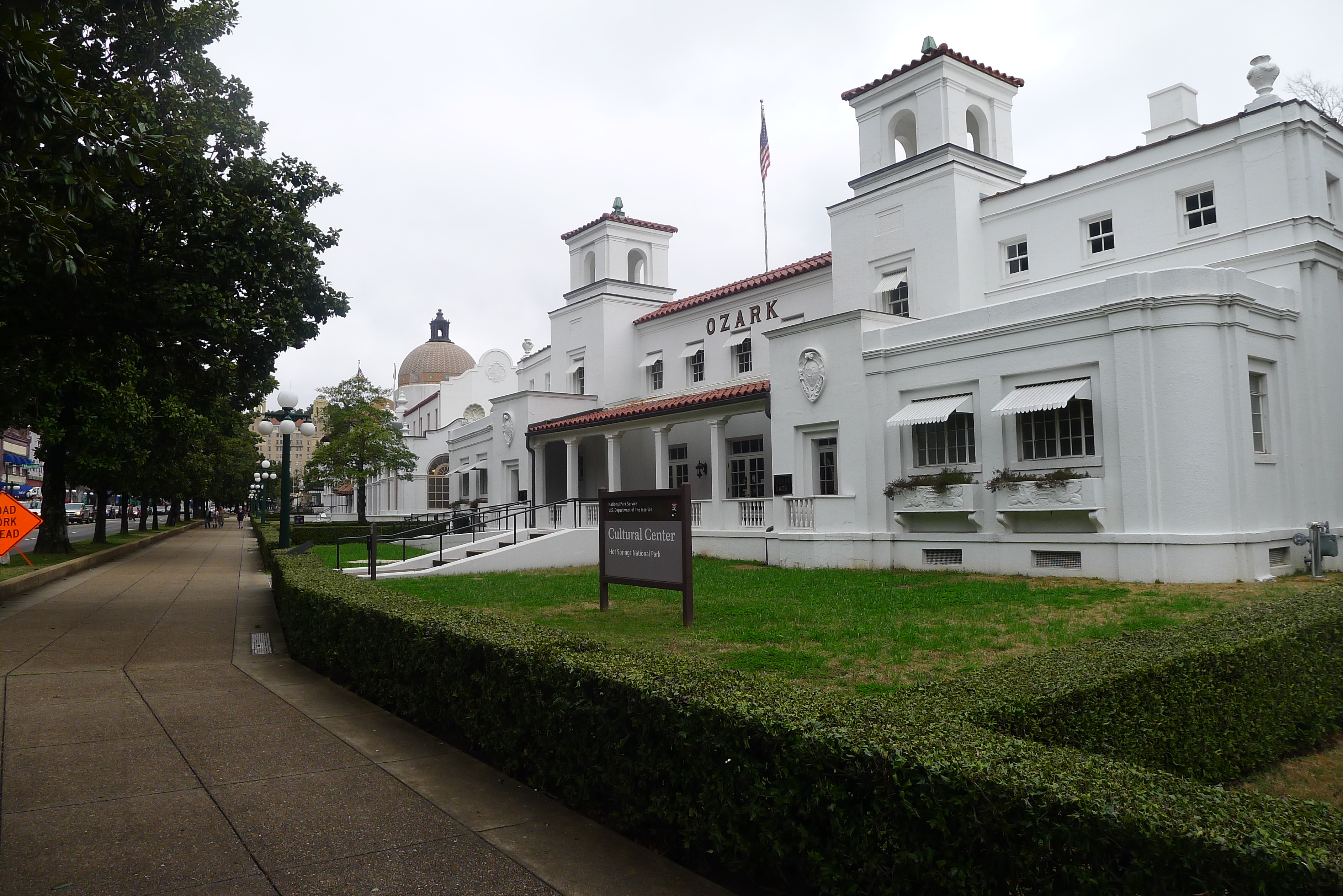
Past Fountain Street, at the base of the mountain, is a string of buildings that once were bath houses, with their supposed “therapeutic” waters. Water pushes up from deep underground and emerges from several “springs” at an average temperature of 143 degrees. The bath houses tapped the springs and cooled the water to about 100 degrees for bathing. Only two of the buildings now operate as bath houses, but the others have been preserved. P1040528

It’s always steamy around Hot Springs Mountain.

P1040546

Lest you think Hot Springs is a veritable dreamland, some parts of town have seen better, livelier days. This is the former Majestic Hotel, just a block away from the Arlington, gone to wrack and ruin.

P1040552

P1040553

At the end of Fountain Street, across from Hot Springs Mountain, sits the motel where we have long stayed. A Polish man named Emil Wencil and his brother built it decades ago. Mr. and Mrs. Wencil owned and operated it for many years, but both are now dead. A new owner is renovating it.

P1040559

A crowd of about 30,000 attended the races on Saturday. Early on, when it was misting, people gathered trackside to socialize, enjoy the air and see the horses close up.

P1040562

Part of the glass-enclosed grandstand.

P1040565

The horses neared the starting gate for one of the early races…In the background you can see the Hot Springs Mountain Tower, which you can go up in for $7. (Oaklawn is 2 1/2 miles south of downtown.)

P1040583

There were several big races Saturday, including a Kentucky Derby prep race, the Rebel Stakes, for 3-year-olds…These ladies must have thought they were at Churchill Downs in Louisville, KY, where the Derby is run the first Saturday of May.

P1040563

…but this is most assuredly cowboy country.

P1040595

Then came the rain. The track condition went from “good” to “sloppy.” The ladies with the hats, along with just about everybody else, went inside. And the mood ebbed.

P1040603

Looking a little soiled, three jockeys returned to their quarters after a race.

P1040615

Back on the road yesterday, I bypassed Interstate 540 for a while and meandered up U.S., which used to be the only way you could traverse the Boston Mountains…The old way takes longer, but you get the benefit of “local color.”

P1040623

This is why it’s called “The Natural State.”P1040620

The

P1040637

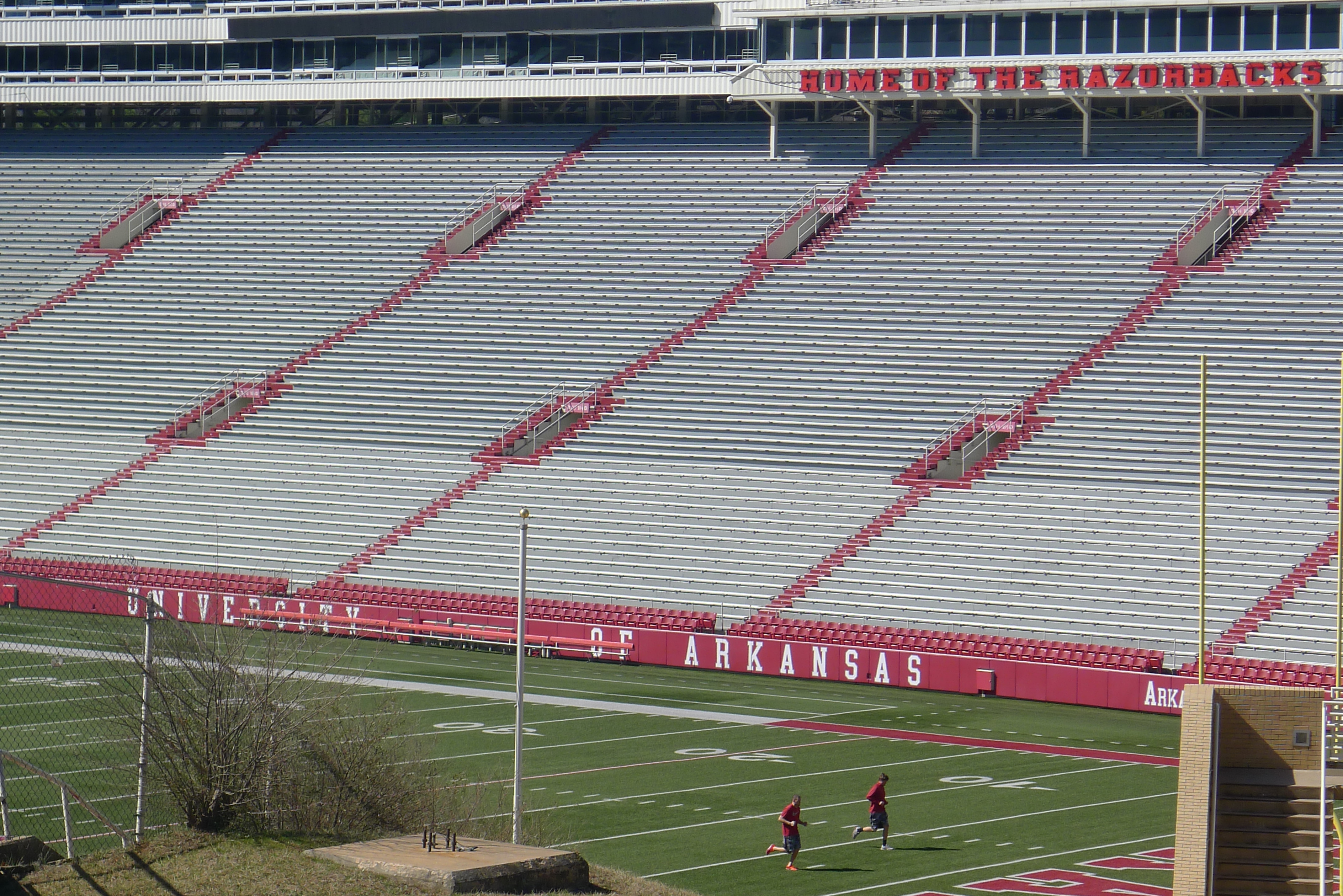
Out of the mountains and into the city — Fayetteville, that is, home to the University of Arkansas and Donald W. Reynolds Razorback Stadium. (Donald Reynolds, who died in 1993,  was a newspaper baron; his foundation also financed the Journalism Institute at the University of Missouri.)

P1040639

Dickson is the most dynamic street in Fayetteville. The university campus is at the top of the hill, at the very back of the picture.


I’m starting to think that a combination of voter expectations and newly agitated Clinton fatigue might end up denying Hillary Clinton her party’s presidential nomination next year.

I have no idea who can beat her, but it’s a long time between now and primary-election season. Other Democratic candidates are likely to include former U.S. Sen. Jim Webb of Virginia; former Maryland Gov. Martin O’Malley; and U.S. Sen. Bernie Sanders of Vermont.

Clinton, of course, is the presumed Democratic presidential nominee, but I think she has slipped badly with many voters as a result of the scandal over her decision to use only a personal email account — forgoing a State Department account — when she was secretary of state…How do we know she is turning over all government-related emails? We don’t know, and I think it’s safe to say she probably won’t turn them all over.  

I don’t see the email scandal going away quickly. For one thing, it has provided the U.S. House committee investigating the attack on the U.S. embassy in Benghazi, Libya, with fresh meat. Using the private email account exclusively is like handing the Republican-dominated Benghazi committee a hammer and saying, “Hit me and don’t stop hitting me.”

But there’s another factor that could easily eat away at Clinton’s status as presumptive Democratic nominee.

A recent NBC-Wall Street Journal survey of 1,000 people showed that a significantly larger percentage of respondents was much more interested in a candidate who would bring about greater policy changes than a candidate who was steeped in experience.

The pollsters read two key statements to respondents and asked them if they agreed or disagreed.

The first statement was:

“This is a time when it is important to look for a more experienced and tested person even if he or she brings fewer changes to the current policies.”

Thirty-eight percent of respondents said they agreed with that statement.

The second statement was:

“This is a time when it is important to look for a person who will bring greater changes to the current policies even if he or she is less experienced and tested.”
Fifty-nine percent of respondents said they agreed with that statement.

Hillary, of course, is the epitome of “experienced and tested,” but she seems to offer virtually no hope for “greater changes.”

Doesn’t the story with Hillary boil down to “same old same old”? How could it be anything else? I wonder how she plans to convince a majority of voters in the states whose electoral votes will determine the outcome that she is a change agent. That’s exactly how President Obama beat her last time, stealing the “agent-of-change” mantle right off her shoulders.

I bet many Republicans are feeling pretty hopeful these days. And they should be, in my opinion.

On the other hand, some Democrats — maybe a lot by now — are feeling queasy about having a candidate who appears destined to be the 2016 nominee.

One such Democrat, Deval Patrick, a former Massachusetts governor and an Obama supporter in 2008, told The New York Times that Democrats might be better off if at least one other Democratic challenger emerged.

The Times quoted Patrick as saying:

“My view of the electorate is, we react badly to inevitability, because we experience it as entitlement, and that is risky, it seems to me, here in America.”

**

…A wise uncle who died a few years ago once told me, “Expect the unexpected.”

I will.

After almost nine years of McClatchy Co. ownership, each of the remaining employees at The Kansas City Star must feel like he or she is carrying a donkey, not riding one.

Since 2008 — two years after McClatchy bought The Star and the other 31 daily papers in the KnightRidder chain — the employees have seen at least one buyout and several rounds of layoffs.

Six weeks ago, The Star laid off or offered retirement to four editorial employees, including ace energy reporter Steve Everly, and art critic Alice Thorson.

fannin

Fannin

Then today, or possibly yesterday, editor Mike Fannin put out a memo saying The Star was having a round of buyouts, with those taking the package getting a maximum of six months pay.

Here’s how Fannin’s memo began:

“Regrettably, I have some difficult news to share this morning. Given the economic pressures we’re facing at the start of 2015, we have to cut costs in the newsroom. This is not a failure of our terrific journalism, just a financial reality. 

“We are all familiar with those realities. While we are seeing growth in key areas like digital revenue and digital readership — and while this will be a year of energetic change for the news division as I outlined recently — other areas are still hurting. 

“So, for the first time since 2009, The Star is offering a voluntary severance program to full­time employees in the newsroom. This plan is similar to other programs we have offered in the past and is not a reflection of the value of anyone’s work or personal contribution to the organization. We are also in the process of trimming other newsroom expenses, including freelance, travel, etc. 

“Employees who elect will be eligible for two weeks of severance for every year of service, capped at 26 weeks. They will also be eligible for company­ subsidized COBRA (continuation of health insurance) for three months after leaving the company.”

Eligible employees who wish to take advantage of the offer must announce their intentions by next Monday.

Fannin’s memo doesn’t say what the qualifications are, but I presume it turns on some “magic” number — such as 70, 75, 80, 85 — that combines age and years of employment, or maybe a minimum number of service years plus an age minimum.

This offer could take out a lot of good editorial employees, and the quality of the paper — still pretty good — could suffer dramatically.

On the other hand, this is probably a day of rejoicing for the employees who qualify for the buyout. With The Star’s plummeting fortunes, along with those of many other metropolitan dailies, a lot of long-time employees have been waiting and hoping for a buyout, and now that they’re got the opportunity, I think they will jump on it.

Besides the overall decline of daily newspapers, another big problem for The Star is that McClatchy paid way too much for the KnightRidder properties — $4.5 billion. The company’s debt still stands at $1 billion, even after reducing debt by $523 million in the fourth quarter of 2014 by selling Apartments.com, Cars.com and the Anchorage Daily News.

At random and off the top of my head, I’m going to throw out some names of staff members who may qualify for the buyout.

I’m sure I will miss some obvious people who will qualify, and, as I said, I’m just speculating on eligibility. (Feel free to suggest additions to the list of potential candidates.)

In any event…

Political reporter and columnist Dave Helling; courts reporter Mark Morris; general assignment reporters Eric Adler and Rick Montgomery; general assignment reporter and former columnist Mike Hendricks; police reporters Glenn Rice and Tony Rizzo; general assignment reporter Matt Campbell; education reporters Mara Rose Williams and Joe Robertson; assistant metro editors, Jesse Barker, Elaine Adams and Donna McGuire; feature and celebrity writer Lisa Gutierrez; features editor Sharon Hoffmann; photographers Keith Myers and John Sleezer; copy editor and “Monday morning poet” Don Munday; columnist Mary Sanchez; all three business reporters, Diane Stafford, Joyce Smith and Mark Davis; all three business editors, Greg Hack, Steve Rosen and Keith Chrostowski; and all four editorial board members, Lewis Diuguid, Yael Abouhalkah, Barb Shelly and Steve Paul. (If all editorial board members left, I guess Publisher Mi-Ai Parrish would write the editorials in addition to overseeing the entire newspaper operation…Nose to the grindstone there, Mi-Ai!)

The desk that would get off easiest would be sports, which is nicely stocked with a bunch of young reporters and relatively new columnists Vahe Gregorian and Sam Mellinger — both standouts.

**

Before I retired from The Star in 2006 — at age 60 and with almost 37 years of service — I had been hoping for a KnightRidder buyout. And then along came McClatchy. I remember vividly when then-CEO and president Gary Pruitt came into the newsroom to talk to us about his vision of The Star under McClatchy ownership.

Naturally, he saw panoramic horizons and clear blue skies. When he finished his spiel, he asked if anyone had any questions. I raised my hand.

“Mr. Pruitt,” I said, “are you planning on any buyouts?”

Many in the crowded newsroom laughed because they knew what I was thinking, and some of them were hoping for the same thing.

“Why, no,” Pruitt said, with a puzzled expression on his face. “When we buy properties, we plan on growing them…adding staff.”

Then, he smiled and said, “Why, were you hoping for something?”

…At that moment, I knew that I had to make my own plans and could not hang around and wait for money to fall out of the sky.

So, a few weeks later, I gave my notice, and three days after the McClatchy purchase closed (June 27, 2007), I walked out of The Star for the last time.

**

I worked with a lot of the editorial employees who are still at the paper. I like a great many of them, and I’m happy that some of them will get to “retire” before being shown the door.

Naturally, I worry what’s going to happen with my beloved newspaper, but whatever happens, we’ll keep getting our news somewhere. Not in the quality and quantity we used to get it…or even the current, diminished quality and quantity. But we will get it, and The Star will continue to muddle along.

You’ll have to excuse me if I mess up a few words or my thoughts sound a bit jumbled…I’m kind of in shock. I just read that the Missouri Supreme Court today replaced the rent-a-judge in Ferguson with a state appeals court judge.

I’m going to go over it once again because I can hardly believe it. In our state, today, the highest court we’ve got took decisive action to address the kangaroo municipal court where Ronald J. Brockmeyer galavants around St. Louis County playing judge sometimes and prosecutor at others. As judge in Ferguson, he essentially operated the city cash register by fining — and then fining some more — Ferguson’s black residents.

In a recent report, the U.S. Department of Justice excoriated the Ferguson Police Department and Municipal Court for routinely violating people’s — mostly black people’s — constitutional rights. The report said Ferguson’s fines were among the highest in the region, with hundreds of dollars levied for such violations as “peace disturbance,” “failure to comply” and “manner of walking.”

Manner of walking?

Citing the need for “extraordinary action,” the Supreme Court appointed Judge Roy Richter of the Missouri Court of Appeals in St. Louis to go in, hear cases and clean up the mess.

The move is the equivalent of a Court of Appeals judge in Kansas City being assigned to take charge of the Grandview Municipal Court.

Those kinds of actions just don’t happen very often. The New York Times quoted Brendan Roediger, a St. Louis University law professor, as saying: “It’s a very big deal because it actually is the solution. It puts the cases in front of full-time professional courts with no conflicts of interest.”

brock

Brockmeyer

A recent St. Louis Post-Dispatch story painted Brockmeyer, a lawyer in St. Charles County, as a veritable Pone Express dispenser of legal services, working as a judge or prosecutor in five different municipalities, as well as representing defendants.

Here’s how incestuous and crooked the small-town system has been: “Judge” Brockmeyer once prevailed on Ferguson prosecutor Stephanie Karr to dismiss a traffic ticket he had been issued in a nearby municipality where Karr was also the prosecutor.

If that doesn’t frost you, Brockmeyer is also a smart aleck. When The New York Times emailed him questions about the Justice Department’s allegations, Brockmeyer wrote back, “Suggest you come to court someday and see for yourself that the allegations are unfounded.”

We can all be thankful that a New York Times reporter won’t have the chance to take Brockmeyer up on his challenge.

So, how did this happen — the Missouri Supreme Court moving in swiftly and surely to address the mess?

Let me suggest that the answer lies with Chief Justice Mary Rhodes Russell, who was appointed to the Supreme Court in 2004 by then-Gov. Bob Holden, a Democrat.

Russell, a Hannibal native, became chief justice in 2013. In an interview that year with The Missouri Times, an online publication, she made three statements that, in my opinion, indicate she is the type of person who won’t tolerate the type of crookedness and chicanery the Justice Department detailed in Ferguson.

Here are those quotes:

“My theme and the theme of the judges that follow me will be ‘how can we make the courts work better for all citizens?’ ”

“Our primary goal as judges is to resolve people’s problems timely and fair and in a form where everybody has access.”

“We need to help people understand how the (state) constitution is there to protect them, what their constitutional rights and responsibilities are and how the three branches of government check and balance each other.”

We’ll probably never know for sure, but I would bet almost anything that the Justice Department’s report made Chief Justice Russell’s blood boil, and she determined quickly that it was incumbent on the Supreme Court to act decisively.

Our Supreme Court made us look good today, not just in Missouri but throughout the nation. It’s gratifying to see that good things — very big, good things — can happen right here in the Show-Me State.

KC Star reporter Mike Hendricks had a Page One story in today’s paper that I’ll bet was the best read story in the paper.

It was the story of the late Ronnie Deffenbaugh’s $14 million (asking price), palatial residence, across the street from the Johnson County Landfill, which Deffenbaugh once owned and which holds the trash collected by those ubiquitous Deffenbaugh trucks we see throughout the Metro area.

…I know Hendricks’ story was well read because 1) our daughter, a rare, 26-year-old newspaper devotee, read it, and 2) when I was at McDonald’s at 79th and State Line this morning, a group of about five senior citizens was huddled around a woman who was reading the story aloud.

I haven’t seen a clutch of people gathered around a newspaper in years. So, Mike, congratulations — you had Kansas City turning the pages of the print edition today and going to the Website.

Oddly, Hendricks’ story ” “Trash titan’s home is for sale” — wasn’t the lead story in the paper. That honor went to Laura Bauer’s “Love conquers all” story, about Terri LaManno, one of three people shot to death last year outside Village Shalom and the Jewish Community Center.

As tragic and gripping as the LaManno story is, the Deffenbaugh story is more intriguing to me.

I mean, here’s a guy — Deffenbaugh — who, after being almost completely paralyzed as the result of a hospital mishap, built a 13,000-square-foot mansion, outfitted it with custom-made furniture and had waterfalls, fountains, an indoor-outdoor swimming pool and horse stables constructed outside. Plus, a 40,000-square-foot garage for his sports cars and antique fire engines.

Deffenbaugh got to enjoy the estate for only a few years. Work began in 2010, three years after Deffenbaugh fell off an X-ray table at Shawnee Mission Medical Center and broke his neck. He died last August at age 73.

In addition — according to Hendricks — “it as just him, and his staff” in the house. Twice divorced, Deffenbaugh had no partner or spouse for the last years of his life, although he did have children and grandchildren.

I’m sure this story prompted a lot of people besides me to think and reflect on Deffenbaugh and his end-of-life decisions. Why would he choose to spend millions on a humongous house and exquisite furnishings when he knew — had to — that he didn’t have long to live?

I guess he might have done it simply because he could…or maybe he wanted to go out in style. Perhaps he envisioned a front-page story that would supersede an obituary of any length. (His was longer than this post.)

But my first and persistent thought is that Ronnie might have been a lot better off arranging entry to the Jeanne Jugan Center, operated by the Little Sisters of the Poor at 87th and James A. Reed Road.

Instead of surrounding himself with luxury that he couldn’t fully appreciate, he could have had an airy room with lots of natural light, where he would have gotten great care and plenty of time to reflect and prepare for a happy death.

(I visited former State Sen. Harry Wiggins at the Jugan Center a few weeks before he died of cancer in 2004, and he was ensconced in an atmosphere of tenderness and serenity.)

…Now, I’m not saying Ronnie Deffenbaugh didn’t have great care or that he didn’t have a happy death. I truly hope he had both.

I’m just saying if it was me, and if I had all that money and had been almost completely paralyzed, I wouldn’t be spending millions on buildings and landscaping…I would just want to be in my comfortable ranch house, with my wife, daughter and maybe my son (if he wasn’t too busy) holding my hand and assuring me that God would forgive me my many trespasses and that, with luck, I would find peace and eternal happiness on the other side.

During my 35-plus years in journalism I worked with some reporters and editors who left the field and went on to become well known in other arenas.

CarolBeierGreenColorWEB

Copy editor/Kansas Supreme Court Justice Carol Beier

One such person is Carol Beier, who was a copy editor at The Kansas City Times for two years back in the early 1980s. It was her first job after getting a B.A. in journalism from KU…What I remember most about her is that she wore an ankle bracelet and turned the heads of the male reporters in the newsroom. In 1983, she bagged journalism and entered law school. She worked in criminal and civil law for several years, and in 2003 former Gov. Kathleen Sebelius appointed her to the Kansas Supreme Court. She is still there.

Another defector was Elizabeth “Betsey” Solberg, a Kansas City Star reporter when I arrived at The Kansas City Times in 1969. Betsey was spunky, effervescent and ambitious. For reasons I don’t know, she bore the nickname Betsey Two Shoes. Her husband, Rick, was a Star photographer.

betsey

Reporter/P.R. executive Betsey Solberg

In the mid-1970s, Betsey Two Shoes was recruited away from The Star to open the Kansas City office of FleishmanHillard, which went on to become either the biggest or one of the biggest public relations firms in the country. Betsey had a tremendous business career and held many civic leadership positions, including chairman of the Chamber of Commerce of Greater Kansas City and the Civic Council of Greater Kansas City, an organization of the city’s leading businesses. Betsey is mostly retired. She and Rick, who left The Star not long after Betsey, live in Kansas City’s Sunset Hill area. (Thanks to Laura Hockaday for update.)

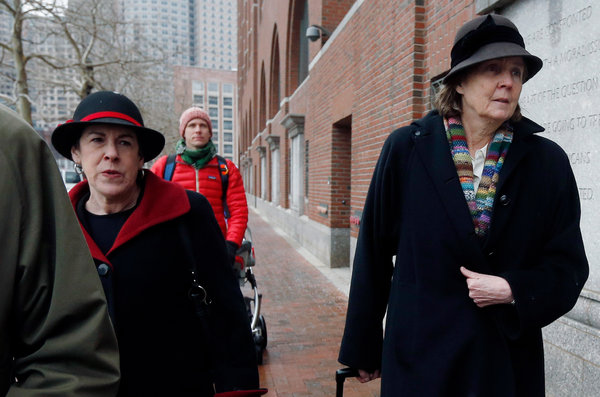
But the person I worked with who made the most startling transformation — at least to me — is Miriam Conrad, leader of Boston Marathon bomber Dzhokhar Tsarnaev’s defense team.

I vaguely was aware that she was on the Tsarnaev defense team, but it didn’t hit me hard until today, when I saw a photo that ran with a New York Times story in today’s edition.

Here’s that photo. Miriam is on the left (dark hat with crimson trim), and Judy Clarke, an anti-death-penalty lawyer whom Miriam recruited to handle most of the courtroom duties, is at the right.

miriam

Miriam Miriam worked in Kansas City a year or two in the mid-1980s and then entered Harvard Law School. After law school she went to work for the state public defender’s office in Boston. Since 2005 she has been chief of Boston’s Federal Public Defender’s Office, which represents indigent people accused of federal crimes in Massachusetts, New Hampshire and Rhode Island.

Tsarnaev isn’t the first terrorist Conrad, who is either 57 or 58, has represented. Previous clients include convicted shoe-bomber Richard Reid and Rezwan Ferdaus, a U.S. citizen serving 17 years for his role in a 2011 plot to bomb the Pentagon and U.S. Capitol with remote-controlled model airplanes.

I didn’t get to know Miriam very well. She had come to The Times from the Miami Herald, about the same time that another Herald reporter, Ernie Torriero, came to Kansas City. I did become close friends — and still am — with Ernie, who is an editor at the Voice of America in Washington.

What I remember about Miriam was that she was intense, hard-working and gritty. I say gritty partly because she walked with a noticeable limp, the result of a shattered ankle from a 1982 auto accident. In Kansas City, she was always in pain, to varying degrees, from the ankle injury.

A Detroit Free Press reporter named Brian Dickerson, also a former Herald colleague, profiled Miriam in a 2013 story and related details of the accident and how it changed the course of Miriam’s life:

“Conrad was on her way home from a party at my apartment one night in 1982 when her car struck a median that the Florida Highway Department had installed days earlier with no notice to motorists.

“There followed repeated surgeries to repair her shattered ankle, months of litigation and eventually a modest insurance settlement. Conrad used the settlement money to finance her first two years at Harvard Law School, graduating in 1987.”

Like I say, she was gritty. She’d have to be, not only to go through what she has physically but also to take the slings and arrows that go along with representing some of the most nefarious, cold-hearted criminals to ever walk the face of the earth.

More important, however, as my friend Ernie said of Miriam in the 2013 newspaper profile, “She was a real street journalist, and smarter than the rest of us.”

I’m starting to see red.

No, I’m not mad…I just mean I have the feeling that a tide that could sweep a Republican into the White House is rising.

In November 2012, after President Obama was re-elected, I said it appeared very likely that Democrats would hold the White House for the next 12 years –four more of Obama and eight of Hillary Clinton.

I also said it looked like all Hillary had to do was defeat New Jersey Gov. Chris Christie to win the presidency in 2016.

My, how things have changed. Christie looks like he’s finished politically, among other things for failing to deal with New Jersey’s public employee pension crisis and agreeing to settle an environmental lawsuit against Exxon Mobil Corp. for roughly three cents on the dollar after more than a decade of litigation.

And now I’m getting the sense that Hillary’s unrestrained arrogance is going to do her in.

The New York Times’ disclosure on Monday that she used, exclusively, a personal email account while secretary of state — instead of a Department of State email account — could be a crippling blow, in my opinion.

(By the way, The Star played this huge story on Page 2 yesterday and didn’t have anything about it in today’s paper. The Times, by comparison, had stories on Page One yesterday and today and has a new one on its website.)

hillary

Who me?

Not only did she thumb her nose at the public by using a private email address to conduct public business, she and Bill established their own domain name, clintonemail.com, which had a server linked to the Clintons’ home address in Chappaqua, New York.

In its latest story, The New York Times says Hillary used the private address for everything — “from State Department matters to planning her daughter’s wedding and issues related to the family’s sprawling philanthropic foundation.”

Time magazine said that establishing the domain name and maintaining a private server “raised questions about whether Clinton was making a deliberate attempt to prevent her messages from being disclosed by open records requests or subpoenas.”

Hillary was already carrying a significant amount of baggage — the Benghazi debacle, among other things — and now here’s another damaging disclosure suggesting that her government business was none of the public’s business.

**

It seems to me that most normal, logical-thinking people who were carrying baggage as heavy as Hillary’s would think along these lines when planning a run at the presidency…

“I need to be as transparent as possible, avoid any appearance of impropriety and do everything I can to convince voters that I’m a credible, trustworthy candidate.”

But, no, here comes another in-your-face, faith-shaking gambit. As Times’ columnist Frank Bruni said in an Op-Ed column today, “…this was reckless, given the questions that would surely be asked if it came to light the likelihood that it would, and how she’d wind up looking.”

“Does she have a political death wish?” Bruni asked.

I say, does she take the public for idiots?

The email scandal (let me be the first, I think, to apply that label) was the subject of a second Times Op-Ed piece, written by Matthew Connelly, a Columbia University history professor, and Richard H. Immerman, a Temple University history professor.

Here’s the sentence from their piece that jumped out at me:

“The revelation on Monday that Hillary Rodham Clinton used only a personal email account when she was secretary of state and did not preserve her emails on departmental servers seems to reflect a troubling indifference to saving the history she was living.”

Indeed, most of what the secretary of state does — like John Kerry trying to forge a nuclear deal with the Iranians — amounts to a lot more than a person going about a random job and consigning their actions and official interactions to their personal files.

Many Democrats are going to stick with Hillary regardless, but Hillary has handed the Republicans some powerful ammunition, which they will bombard her with and which undoubtedly will create, or reinforce, doubts about her judgment and integrity.

On another front, until now it appeared that a congressional committee examining the 2012 attacks in Benghazi was just a vehicle to lambaste Hillary on that subject one more time. But now the committee has fresh meat: The committee on Wednesday asked Hillary’s lawyers for all of her emails related to Libya. The intimation is that although she has surrendered 50,000 pages of emails from the personal account, she might not have turned over everything relating to Benghazi.

**

It looks like Jeb Bush will be the Republican nominee. His biggest problem so far, it appears to me, is that, a la Abe Lincoln, his wife is a shopaholic. Pretty tame by comparison to Hillary’s failure to adequately secure the Libyan embassy and her use of a private email account to conduct State Department business.

If Bush can maintain an appearance of moderation and reasonableness, partly by resisting the urge to suck up to the far right, he could make off with a lot of Democratic votes. That’s where John McCain and Mitt Romney failed as presidential candidates. In abandoning their “maverick” and “moderate” mantles respectively, they sacrificed any hope of getting the votes of moderate Democrats…And, as we all know, there are a hell of a lot more moderate Democrats than there are right-wing kooks.

Along with the Clinton arrogance and presumptuousness (have you noticed that she hasn’t bothered to step forward and address the issue herself?) a Republican nominee who came off as moderate could put in GOP hands the Oval Office, as well as the House and Senate.

The question is: Will the Republican nominee see the light this time around, or will he fall into the same old muddy well? Because if he kowtows to the far right, most moderate Democrats will likely set aside Hillary’s astonishing indifference to saving the history she was living and run right back into her insincere embrace.