Feeds:
Posts
Comments

Three short items today…

The Kansas City Star and writer Judy Thomas, in particular, wrung their hands today about the United States Conference of Catholic Bishops’ failure to significantly change their head-in-sand policies on child sex abuse.

Meeting in Bellevue, Wash., Thursday, the American bishops voted 187-5 to essentially stick with the policy that they adopted in 2002.

“We are dismayed that the new policy is almost identical to the current policy, despite horrifying recent evidence in Kansas City and Philadelphia that the church’s current policies are dangerously lenient and full of loopholes,” Terence McKiernan, president of BishopAccountability.org, was quoted as saying.

It was the lead story in the paper and ran under a one-inch headline that said “Bishops Resist Changes.”

All who are surprised please raise your hands.

Anyone who has any idea of how the Catholic Church operates — and that’s the vast majority of people — knows that the church’s turnaround time on major issues is usually a century or two, not a month or so.

The bishops’ assembly was probably set two years ago, and their position on the sex abuse policy was probably determined months ago.

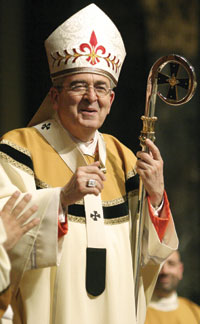
Rigali -- another pomp and circumstance bishop

The Philadelphia scandal — where Bishop Justin Rigali allowed 37 accused priests to continue working around children in Catholic parishes — took place earlier this year.

I predict it’s going to take decades for the church to come around to the idea that the correct action in priest-accusation cases is to call the police immediately — not mull it over, meet with and warn the priests and try to persuade them to get on the right path.

The Star’s headline and story smacked of hyperventilation.

Maybe it was just a vehicle to run a big photo of the Rev. Shawn F. Ratigan, the local priest who got his kicks by taking “up-skirt” photos of elementary-school girls.

Ratigan, who is in jail, was photographed in Clay County Circuit Court, where he made a brief appearance Thursday. Nothing happened in his case Thursday; the fact that he appeared was, correctly, worth only a paragraph in today’s story.

The story probably deserved front-page play, but certainly not top of the page with a four-column photo.

***

Here’s a funny correction from Wednesday’s New York Times…

Leona and Trouble

“An article on Friday about the death of Leona Helmsley’s dog, Trouble, misstated the reason that Trouble’s inheritance from Ms. Helmsley’s estate was reduced to $2 million from $12 million, the amount specified in the will. A judge determined that the greater amount exceeded that necessary to care for the dog, not that Ms. Helmsley was of unsound mind when she made the will.”

I guess the issue of the late Ms. Helmsley’s state of mind is still up in the air, eh?

***

Then, the Thursday Times carried an item that is one of the most dreaded events in newsrooms: the correction to a correction.

“A correction in this space on Tuesday misstated the size of the (Irish Fianna Fail) party’s Dublin delegation…there were 18 members, not 47.”

Ouch.

Two of my blogging compatriots, Hearne Christopher (kcconfidential.com) and Tony Botello (tonyskc.com) seem to be obsessed with what they refer to as “hotties.”

Their idea of hotties is young women with eye-catching qualities of one sort or another — sometimes beauty but more often physical endowments, such as curves or protuberances — that rivet the eye.

For example, on Tuesday, when The Star announced the hiring of Mi-Ai Parrish, a 40-year-old publisher in the McClatchy system, Hearne breathlessly gushed in the second paragraph of his story, “Blessed mother of god, they hired a hottie!”

Tony also weighed in with a “hottie” headline, and, on those two sites, at least, her appearance and youth took precedence over her credentials. (For a closer look at Parrish and her credentials, see my last post.)

Now, I’m completely in agreement with Hearne and Tony that beautiful young (and youngish) women are appealing to the eye, but my idea of a hottie is a bit more expansive than theirs. Probably, it’s because I’m 65 and look at women through a slightly different (more mature?) lens than those two “young” guys.

(For the record, Hearne will only admit to being “north of 50,” and I would guess that Tony is in his 30s.)

Anyway, as I have aged, I have come to appreciate the beauty of “older” women, which brings me to this…Christine Lagarde, the 55-year-old French finance minister and leading candidate for International Monetary Fund director, is one of the most striking women I have ever seen…At least from photos, that is, and I’ve seen a lot of photos of her.

As a teenager, Lagarde was a member of the French national synchronised swimming team. Wikipedia says that she is divorced and the mother of two adult sons. Since 2006, Wikipedia says, her partner has been an entrepreneur from Marseille named Xavier Giocanti.

She is a vegetarian and teetotaler, and her hobbies are yoga, scuba diving, swimming and gardening.

Take a look for yourself…

With Xavier

***

Here is a picture of Kansas Citian Susan Stanton, who is referenced in the comments below

Talk about continuing the youth movement at The Kansas City Star.

Wow.

The woman who will become the new publisher later this month is 40.

She succeeds Mark Zieman, who was 47 when he was named publisher three years ago.

And…Mike Fannin, the editor, is only 44.

Parrish

The new publisher of the McClatchy-owned paper is Mi-Ai, Parrish, who has been publisher of the company-owned Idaho Statesman since July 2006.

Parrish, whose first name is pronounced MEE-uh, had been deputy managing editor for features and visuals at the Minneapolis Star Tribune before being tapped for the Idaho post.

I sure hope that Parrish works out, and I wish her the very best. But putting a 40-year-old person with five years of publishing experience — especially small-market experience — looks like a rather big roll of the dice to me.

On the plus side, reporter Mark Davis reports in a story on The Star’s website that Parrish led the Statesman’s effort to “transform and diversify business operations, introduce new print and digital products, grow digital traffic and revenue while improving the core newspaper and enhancing its reputation for quality journalism.”

This year, for example, the Statesman rolled out a new product called Business Insider, a weekly business-to-business magazine. And in 2008, the Statesman was named a Pulitzer Prize finalist in the breaking news category for its coverage of events triggered by the men’s room arrest of former Idaho Sen. Larry Craig in Minneapolis.

But look at some statistics.

The Star has an average Monday-Friday circulation of 210,000 and a Sunday circulation of about 300,000. By comparison, the Statesman, in Boise, has an average weekday circulation of about 50,000 and Sunday circulation of about 73,000. (Sunday circulation has been up slightly the last two years, while daily circulation has declined each of the last four years.)

So, The Star is about four times larger than the Statesman. That’s quite a jump.

Parrish also will be tested right off the bat with her choices for top managers. Among other things, she’ll have to decide whether to keep vice presidents such as Editor Mike Fannin and advertising executive Tim Doty in place.

On the digital side, her youth should work to her advantage because that appears to be where the future lies for newspapers. But her youth could work against her on the personnel side, unless she gets some very good advisers.

On that front, my recommendation would be that, in the newsroom, she turn to long-time managing editor Steve Shirk, a tried and true leader at The Star for more than 35 years.

Steve’s an old guy — about 60. He’s got the wisdom and the temperament to help a new publisher make a safe jump from a small pond into the churning waters of the Lake of the Ozarks.

The lemmings are on the loose.

I was wondering how long it would take for the knee-jerk defenders of the Catholic hierarchy to rise in defense of Bishop Robert Finn of the Diocese of Kansas City-St. Joseph.

At first — after the shocking news of the diocese’s five-month-or-more cover-up of Father Shawn Ratigan’s child-porn propensities — the lemmings were quiet, for the most part. They were so taken aback at the gravity of the diocese’s action (or inaction) that they really didn’t know what to say or how to respond.

But now, after several weeks of the diocese coming under heavy bombardment from every direction, they’ve circled the wagons and launched a counterattack:

Call it the “good and holy man” defense.

Here are three examples:

Daniel G. Obermeier of Olathe, in a June 10 letter to the editor of The Star:

“Bishop Robert Finn made one mistake…Bishop Finn has lived and taught the One, Holy, Catholic and Apostolic faith. For this he should definitely not resign.”

Mark S. Robertson of Independence, in a June 11 letter to the editor:

“I have met Bishop Finn, but don’t know him personally It is quite obvious, though, that he is a good and holy man, and I think he has been a great bishop. He has launched many strong Catholic initiatives, and there are now over 25 seminarians, according to the Catholic Key 2011 diocesan directory.”

Kelly Roper of Platte City, in a June 12 letter to the editor:

“Bishop Finn is a true example of Christ in accepting the cross now being presented to him. He continues to talk to groups of people who are hurting, enduring persecution with the hope of correcting wrongs and bringing healing to his flock.”

As you know, Finn unleashed his own counter punch last Thursday, when he appointed former U.S. attorney Todd Graves to investigate the diocese’s handling of sex-crimes cases, including that of Ratigan, who is in the Clay County Jail on three felony counts of possessing child pornography.

“These are initial steps,” Finn said, regarding the appointment of Graves. “Other actions are forthcoming.”

So, Finn has decided to fight back, and unlike the sexting case of Rep. Anthony Weiner of New York, there’s no Nancy Pelosi or other higher-up to say to him:

“Robert, you’re embarrassing us. It’s time to get out from under the harsh spotlight.”

Finn may be a good and holy man, but he’s also shown his true stripes. He has done that by working, from Day One, to establish a set of priorities that puts the church hierarchy and Pope John Paul II’s vision of a very conservative church at the top of the list, with the laity — especially the welfare of children — at the bottom.

Bishops everywhere are trying to stack the deck with conservative priests, and I have heard enough to convince me that Ratigan is of that ilk. The conservative priests are going to get more rope than the liberals, it’s as simple as that.

If you look at this episode, then, within the context of the overall direction of the Catholic Church — and not as “one mistake” — it’s clear that it’s the product of a wayward philosophy, a philosophy that starts at the top.

I remember when my wife Patty and I had decided to join a Disciples of Christ Church in Olathe, and we were talking to the senior pastor, Rev. Holly McKissick, about our decision to leave the Catholic Church.

Something that Holly said that day stuck with me because it went right to the heart of our concerns.

“The Catholic Church has made a lot of good contributions over the centuries,” she said, “but there’s something wrong when one person at the top has all the answers and nobody else has any.”

The Catholic Church is strictly a vertical operation. Finn and the 5,000 other bishops are accountable to no one except the Pope. And Pope Benedict XVI, I feel sure, believes that Finn and almost every other conservative bishop is doing a fine job.

To me, the people who are putting up “the good and holy man” defense are, for the most part, moving in lockstep with church philosophy. To them, I think, the children who are victims of priestly perversion are collateral damage as the church plows ahead into the iceberg of conservatism.

I know that that’s a harsh opinion, but I just don’t see any other explanation for what happened in the Kansas City-St. Joseph Diocese. It’s a scandal, not “a mistake.”

Bishop Finn must be in agony right now.

Here’s a man who arrived in Kansas City from St. Louis six years ago, riding the crest of a big conservative wave that Pope John Paul II had set in motion in an attempt to wash liberalism out of church hierarchy.

Attaining the rank of bishop at 52 years old, he must have had visions of rising in the ranks, becoming at least a cardinal and — who knows what he saw in his dreams? — maybe the first American pope.

And now? His career is in tatters. Everywhere he turns — even to the editorial page of The Kansas City Star — he sees and hears calls for him to resign as a result of the latest priest-impropriety cover-up.

One of his priests, Shawn Ratigan, is in jail — six months after he should have been because of Finn’s foot dragging — and another, Michael Tierney, was suspended last week after a retrospective, hurry-up review found “credible reports alleging sexual misconduct with minors.”

Finn has been scrambling around, doing his mea culpas, hoping to hang on amid a situation that seems to be building to a crescendo. I was astounded, for example, to open the paper Saturday and read the editorial calling for Finn to resign.

Historically — probably because the editorial board sees its mission as primarily secular in nature — The Star has steered clear of religious matters on the opinion front. For the paper to plunge head deep into the controversy is a strong signal of the degree of the problem.

“…there was a disturbing pattern in his diocese,” the editorial states. “As of now, 18 current and former priests have been accused of abuse. Given those numbers, Finn can reasonably be held to a higher degree of diligence than he exhibited. And it’s understandable that some parishioners perceive a cavalier manner in which he loitered with allegations.”

The Star calls him cavalier. Others have characterized him as “self-important.”

Relatively few Catholics have risen to Finn’s defense. So obvious are Finn’s shortcomings that even most of the knee-jerk defenders of Catholic hierarchy have been silenced.

And listen to what a couple of committed Catholics have had to say about Finn.

Richard E. Smith, Altamont, Mo., letter to the editor, June 3:

“I have always been a Catholic. I will always be a Catholic. I don’t really know how to be anything but a Catholic. I firmly believe in the infallibility of the pope in matters of faith. Bishop Finn, you are hurting my church. Please resign.”

Ken Hansen, Smithville, letter to the editor, June 4:

“…the bishop was dishonest with his flock. He says he didn’t bother to look at any pictures, interview Father Ratigan directly or read a warning letter from the principal at St. Patrick School. If protection is truly a top priority, Bishop Finn should have been totally involved. He gave this whole thing about as much priority as a bid on a new furnace.”

Bishop Finn will probably not be fired, partly because of the church’s goofy managerial system.

The pope appoints all 5,065 bishops (as of the beginning of this year), and only the pope can remove a bishop…Now, whoever heard of a manager having 5,000 direct reports? How could one person possibly keep tabs on 5,000 employees?

I wonder if Pope Benedict XVI is even aware of the problem in the Kansas City-St. Joseph Diocese.

Here’s another strange fact, from a website called catholic-pages.com.

“All bishops are also required to submit a quinquennial report to the pope (i.e, every five years) reporting on their diocese and any problems that may have arisen in their diocese or difficulties the faithful are facing. At about the time that this quinquennial report is required, the bishops of the region make their visit ad limina Apostolorum where they travel to Rome to pray before the Tomb of St Peter and to meet individually with the Holy Father to ensure he is kept aware of the state of the Church throughout the world.”

With 5,000 bishops, that means the pope would have to meet with an average of 1,000 bishops a year, or about three bishops a day just to catch up with what’s going on in the far corners of the world… like America.

Unfortunately, Finn has been here six years, and if he had his quinquennial meeting with the Holy Father, it would have taken place last year.

Rats!

Now, you might be wondering what kind of activity or heresy is likely to get a bishop in deep water. I did a Google search for bishops getting fired, and the most recent case I found was that of an Australian bishop, William Morris, whom Pope Benedict dismissed early last month because he had argued that the Catholic Church should consider ordaining married men and women because of a shortage of priests.

The Morris flap had gone on for five years, and his diocese is in an uproar as a result of Benedict’s decision.

You see, then, what the church’s idea of a grave problem is.

As for Finn and the possibility of resignation…probably won’t happen. Without a clear threat to his job status from Rome, I suspect he’ll keep apologizing, keep meeting with angry Catholics (as he did Friday night at St. Thomas More) and try to ride out the crescendo.

Of course, as I’ve said before, that route will clearly cost the diocese members and money. It’s been gratifying to me — a former Catholic who left because the church was looking backward instead of ahead — to see the reaction to Finn’s attempted cover-up.

He now regrets it. He’s miserable, and people of good sense are fuming. It’s a bad combination, and it’s impossible to predict what’s going to happen.

Here’s the worst case scenario, again from catholic-pages.com:

“All bishops, (except the pope, Bishop of Rome) are required by Canon Law to tender their resignation if sickness or other grave reasons make them incapable of carrying on their role, or when they reach the age of 75.”

Hate to say it, but it’s possible we could have Finn another 17 years.

As I said yesterday, I’m observing the upcoming fifth anniversary of my retirement from The Star by looking back at a few of my favorite stories from the early years of my career in Kansas City.

On Sunday, June 14, 1970, just nine months after I started at 18th and Grand, I had the opportunity to interview Janis Joplin, who was then near the peak of her powers. Turns out she was also addicted to heroin, which probably accounted for her high state of agitation on June 14 — and many other days, undoubtedly.

She had been through a couple of bands, including the famous Big Brother and the Holding Company, and for the tour she had put a new one together called Full Tilt Boogie Band.

Janis...on June 14, 1970, Kansas City, Kan.

I was a huge Janis fan, and that summer’s tour included stops in Cincinnati and my hometown of Louisville, Ky., as well as Kansas City. In a couple of cities before hitting the Midwest, Janis had invited audiences to gather in front of the stage and dance. That led to at least a couple of shows being stopped temporarily.

At every stop after that, security officers and arena officials were wary of disturbances and stood ready to suspend concerts in the interests of public safety.

I took vacation time to attend the concerts in Cincinnati and Louisville. The Cincinnati concert was outdoors, and there were no problems. At Louisville’s Freedom Hall, however, Janis again incited the crowd, and as I recall, people rushed toward the stage. The lights came on quickly, and an announcement was made that if people didn’t get back in their seats, the concert would be over.

When it was time for her Kansas City appearance — Memorial Hall in Kansas City, Kan., actually — I asked the city editor, Donald D. Jones, to let me cover her. He acquiesced, although I think he was dubious about what I would come up with.

Two shows were scheduled that Sunday, one for about 6 p.m. and the other for 8.

I spoke with a publicist or assistant before the first show and told her I’d like to talk with Janis. She said I could ask her for an interview when she arrived.

With that set-up, then, here is the story in its entirety…

***

“Rock to Magic of Janis Joplin”The Kansas City Times, June 15, 1970

Half an hour before Janis Joplin, rock singer, was due to take the stage last night at Memorial Hall, Kansas City, Kansas, one of 10 security policemen approached another officer and said, “You don’t suppose we’d be lucky enough that she wouldn’t show up, do you?”

Minutes later Janis, wearing violet-tinted glasses and a maxi-length, flowered skirt, burst through a back door of the auditorium, and after reaching her dressing room began stomping on the floor. The woman who haunts security police everywhere was preparing to rock-n-roll in two shows.

Miss Joplin, noted for her shrieking style of singing and her occasional use of obscenities during performances, reappeared with violet and green ostrich feathers dangling from her hair and wearing a black outfit with bells jingling at the bottom of her crocheted pants.

A reporter approached her and asked for an interview. “No, man, no, not now,” she snapped. “I just got off the plane an hour ago. I haven’t even had a drink yet, all the bars are closed.”

She glanced out at 1,200 persons awaiting her appearance for the 6 o”clock show and looked back at the musicians who accompany her.

“This isn’t right,” she whined. “How can you rock-n-roll at 6 o’clock in the afternoon? I mean, man, you don’t even need lights out there, it’s God’s own light.

She was announced. She sprang on the stage, twisted up her face and wailed into the microphone, “Whattya need? Whattya want?” Her fans yelled, clapped their hands to the band’s ear-splitting background rhythm and bobbed up and down in their seats.

Only a few words were intelligible. It didn’t matter, the audience was hers and she was lost in her music. Occasionally she crouched near her guitarist and pleaded for him to “Go, go!”

The show went smoothly — no off-color language and no dancing with members of the audience. She didn’t even invite the crowd to dance, a move which in the past has prompted security police to threaten to stop performances.

At the end she was out of breath and the loose-fitting garment over her shoulders was wet with perspiration.

When the crowd had left the 27-year-old singer sat in the stands sipping bourbon from a pint bottle. She dabbed at her face with a white towel hanging around her neck and said, yes, sometimes she could relax.

“I try to sleep sometimes,” she remarked. “But I usually don’t go to bed and close my eyes and fall asleep — I usually pass out of exhaustion or one thing or another.”

She noted that it was a violation of her contract if she urged an audience to dance, and it only happens, she insisted, when it kind of slips out by mistake. Besides, she added, it is rarely a dangerous situation when her fans take to gyrating on their chairs or in front of the stage.

“Members of the audience never hurt each other,” she said, “and they never hurt the performers, and they don’t damage the auditoriums. The only time there is any danger is when the security force gets uptight.”

Janis said she and her troupe were treated badly in hotels, bars, restaurants and just about everywhere else they go.

“We’re the modern black man,” she said, “and that’s how they treat us. People don’t like our appearance and whatever threat that implies to them.” Asked when she would settle down and become an all-American wife and mother, Janis looked up quickly with sharp blue eyes and said, “I ain’t got no plans. I’m going to keep doing what comes naturally to me.”

Less than four months later, on Oct. 4, 1970, Full Tilt Boogie’s road manager, John Cooke, found Janis’ body in a room at the Landmark Motor Hotel in Hollywood Heights, Calif. She had been staying there since August. The official cause of death was an overdose of heroin, possibly combined with the effects of alcohol.

It was five years ago this month (actually, the end of the month) that I retired from The Star.

In honor of that occasion, I’d like to give you excerpts and recollections of a few of my earliest, more memorable stories.

Before the advent of The Star’s electronic library, which got going in the early 1990s, The Star librarians maintained our by-line files in gold, business-sized envelopes. The files were kept in dark green, metal file cases by year — 1969, 1970, etc. — and the stories inside were meticulously folded so that they opened up easily and collapsed almost naturally into their folded form.

At some point — after the files had been put onto microfiche — the decision was made to return the by-line files to the reporters. For a while, I kept almost all of them, but, as time went by, I discarded them. All but one, that is, where I put my favorite early stories.

Those stories, yellowed and dated with a blue-green stamp, reflect the broad range of my early work at the paper, when I was a general assignment reporter and before I moved into political and government reporting.

Come along now, as I relive two of those early stories.

***

“Riding Horse to Canada”

For some reason, this story isn’t dated. But I’m pretty sure it was from February 1970 or 1971. One night, a guy named Orville L. Fleshman called the metro desk and said he was attempting to break the record for an endurance horseback ride. He called from Greenwood, Mo., where he had stabled his horse for the night. The city editor told me to take the call and write a story.

Back then, we didn’t verify things as carefully as we do now, so I did a telephone interview with Fleshman, who was 32, and essentially wrote what he told me.

Fleshman, a truck driver from Cuba, Mo., said he had ridden 240 miles from his hometown and that his ultimate destination was Calgary, Canada. He was allowing himself five months so he could arrive in time for a rodeo, called the Calgary Stampede, which started in July.

(MapQuest has it as 230 miles from Cuba to Greenwood, so he had his distance figured pretty accurately.)

Fleshman was exceedingly ambitious: He said that the longest horseback ride up to that time had been 809 miles and that his goal was 2,400. Where he got his information about the 809-mile record I have no idea, but I give him credit for making it specific — 809, rather than 800 or 850 — lending it more credibility.

“I’m gettin’ tired of him holding that record,” Fleshman told me. “When I get to Denver, he’ll no longer hold the record, I’ll carry that horse into Denver if I have to.”

Here are a few more quotes from the intrepid traveler:

“I rode through sleet storms and snowstorms, and I don’t know how much worse it could get. I rode 43 miles in a sleet storm near Freeburg, Mo., a week ago last Tuesday. People couldn’t believe I did it, but I did…

“The wind, the way it’s blowing now, will get you so dumbfounded that when you get off your horse you have to stand still for a few minutes just to get your wits about you to even walk or get coffee.

“The wind has blown so much that once I woke up in the morning and my eyes were swollen closed.”

As a young man who had ventured West from Louisville, Ky., I was mighty impressed  — maybe too impressed — with this courageous frontiersman and his story.

He left me with this: “It’ll either be the biggest ride in history, or it’ll be a small funeral. I’ll freeze in the saddle before I back out. There’s been too much publicity.”

Orville, wherever you are now, I hope you made it to Calgary.

***

“Rock Group Is on the Way Up” — Feb. 28, 1971

By February 1971, I had become a big fan of a local band called the Stoned Circus, headed by a fellow named John Isom. I pitched a story line to the editor of the TV Scene magazine, and she took me up on it. (Why, I don’t know because this had absolutely nothing to do with TV.)

One of my most vivid memories of this story is that the night that a Star photographer was supposed to shoot photos of the band at the old Inferno Show Lounge on Troost, the photographer was too drunk to function. That he was drinking on the job was nothing new at all, but he usually was able to carry on. This time, however, the photo session had to be postponed a day.

The Stoned Circus, 1971. Leader John Isom is at upper right.

The Stoned Circus tilted decidedly toward the Hippie style — long hair, fringed vests — and played hard rock, a relatively new genre at the time.

Isom was — and is — quite a character.

I opened the story with him introducing a song to a nightclub audience like this:

“Here’s one of our own songs. You can buy the record at my house or behind the bar. It’s on the pizza label…If you don’t like it, you can eat it.”

The band played at such places as the Peppermint Barn in Johnson County, Marge’s Disc A-Go-Go in Midtown and the End Zone on the west edge of the Plaza.

Recalling the night the band debuted at the Peppermint Barn, Isom said:  “When I showed up, I was wearing brown corduroy bells and a yellow shirt, and my hair was down in my eyes. It blew some minds is what it did.”

Isom, a Johnson County resident, still has a band. It’s called Johnny I and the Receders. You can check them out here.

John’s long hair is long gone, though, replaced by a thin coating of gray.

(Next: My interview with Janis Joplin in June 1970, four months before she died of a heroin overdose.)

Former Kansas City Star publisher and now New York Times public editor Art Brisbane took his paper to the woodshed Sunday in an Op-Ed piece about The Times’ increasing tendency to get caught up in (or pulled down into) entertainment and gossip-scene coverage.

As public editor, Brisbane is accountable essentially to no one at The Times: He is free to write as he sees fit about what he thinks the nation’s premier paper does well and what he sees as its shortcomings. He can only be fired for 1) not writing or 2) violating the paper’s code of ethics.

Surely, one of the last things that many reporters and editors at The Times want to see in their e-mail in-box is a memo from Brisbane asking them to explain why they wrote this story or that story or why they approached it the way they did.

Brisbane

On Sunday, Brisbane took on not just one or two stories but an increasing, overall tilt toward covering gossip-related material. Brisbane opened his story with this brilliant lead:

“The culture is headed for the curb, and The New York Times is on the story.”

He cited, among others, a recent article about the media coverage of the women in the Arnold Schwarzenegger and Dominique Strauss-Kahn cases and a story about “pay-to-play” tabloid journalism in the digital age.

Brisbane said in his piece that he can appreciate the newspaper’s attempt to walk a fine line between maintaining its “dignified brand” and covering events and culture “wherever they may lead.”

But he chided the paper for including “the seamy stuff” in the Schwarzenegger/Strauss-Kahn story.

The seamy stuff included repeating an assertion made by the gossip website TMZ that the household staff member whom Schwarzenegger impregnated “decked herself out as a sexy swashbuckler for Halloween” a year before she gave birth to the boy.

The story also quoted a blogger on Forbes.com as having said that the housekeeper, Mildred Patricia Baena, “would never appear on the cover of Maxim magazine.”

By regurgitating lurid and derogatory statements, Brisbane said, “the story took a kind of anthropological approach, donning  latex gloves to report on how others were reporting the story — chronicling, as it were, others’ low standards.”

In other words, Brisbane implied,The Times wanted to appear to be including the juicy stuff, not for its prurient value, but to seemingly acquit itself of its duty to publish “All the News That’s Fit to Print.”

Brisbane cited several other stories, which, he concluded, constituted “loitering at the edge of propriety.”

At the root of the increasing tendency of The Times to venture into the previously off-limits garden of gossip, he said, was “the strong tug on The Times and other mainstream news media to follow society, sometimes eagerly, to its fringes.”

And then, in his very measured and tasteful way, Brisbane delivered the hammer:

“My preference would be to see more restraint. True, other media are indulging in questionable journalism, and it is difficult to resist the downward revision of standards. But The Times could just as easily pull back, recognizing that its readers don’t need and aren’t relying on it to chronicle these badlands. Other news outlets are more than willing to go there.”

In other words, Brisbane is urging the Grey Lady to stay true to its colors and not turn blue or purple.

I’m in full agreement. As a subscriber, I want my New York Times to be high road, not low brow.

Today, I would like you to consider a speech that Bishop Robert Finn made on April 18, 2009, at the “Second Annual Gospel of Life Convention” at St. Thomas Aquinas High School in Overland Park.

It shows how strong and assertive Finn can be when he’s on a subject that he truly believes in — right to life for the unborn.

Among other things, he declared war on the infidels — people who believe that abortion is a personal choice. He called for militancy; he vowed that he would not be silenced; he said that every day we are presented with the choice between right and wrong.

And then, after he got warmed up, he called for the head of the Rev. John Jenkins, president of Notre Dame University, who invited President Barack Obama, who is pro-choice, to speak at Notre Dame’s 2009 commencement ceremony.

Obama and Jenkins, I’m happy to say, both survived with their jobs intact.

Finn finished the first part of his speech by chiding Notre Dame — which is run by Jesuits, a liberal order of priests — for its “waywardness.”

As you read this, contrast its tone with the actions and tone that Finn has set in the scandal over the Rev. Shawn Ratigan, a “wayward” priest whom Finn and the Kansas City-St. Joseph diocese shielded from authorities for a year before finally turning him in a little more than a week ago. Ratigan is now in jail, charged with three counts of possessing child pornography.

In his speech, I submit, Finn depicts himself as a prelate who is totally preoccupied with own personal war, while a bigger one — the war to cull out abusive priests and protect children’s welfare — is completely off his radar.

Here, then, word for word, is the first major section of that speech, from two years ago.

Dear friends,

Thank you for coming together for this second annual Gospel of Life Convention, co-sponsored by the Archdiocese of Kansas City in Kansas, and the Diocese of Kansas City-St. Joseph. It is a privilege to welcome you and greet you this morning. I am grateful for the encouragement of your presence and – as a Bishop it is my solemn and joyful duty to do all I can to fortify you in your own faith.

But as I speak a word of encouragement today I also want to tell you soberly, dear friends, “We are at war!”

We are at war.
Harsh as this may sound it is true – but it is not new. This war to which I refer did not begin in just the last several months, although new battles are underway – and they bring an intensity and urgency to our efforts that may rival any time in the past.

But it is correct to acknowledge that you and I are warriors – members of the Church on earth – often called the Church Militant. Those who have gone ahead of us have already completed their earthly battles. Some make up the Church Triumphant – Saints in heaven who surround and support us still – tremendous allies in the battle for our eternal salvation; and the Church Suffering (souls in purgatory who depend on our prayers and meritorious works and suffrages).

But we are the Church on Earth – The Church Militant. We are engaged in a constant warfare with Satan, with the glamour of evil, and the lure of false truths and empty promises. If we fail to realize how constantly these forces work against us, we are more likely to fall, and even chance forfeiting God’s gift of eternal life.

The ultimate promise of the Gospel.
Before I go any further I must proclaim a most important truth – a truth that we have just been celebrating throughout the last week: Jesus Christ, in His life, death, and Resurrection, has already won the war: definitively and once for all. He has conquered sin and death and has won the prize of life on high in heaven forever. We know the final outcome, but the battle for eternal life is now played out in each human heart with a free will to love or not, to be faithful or to walk away from the life which has been offered as God’s most wonderful gift.

Every day the choice is before us: right or wrong; good or bad; the blessing or the curse; life or death. Our whole life must be oriented toward choosing right, the good, the blessing; choosing life.

If you and I fail to realize the meaning and finality behind our choices, and the intensity of the constant warfare that confronts us, it is likely that we will drop our guard, be easily and repeatedly deceived, and even lose the life of our eternal soul.

As bishop I have a weighty responsibility to tell you this over and over again. This obligation is not always easy, and constantly I am tempted to say and do less, rather than more. Almost every day I am confronted with the persuasion of other people who want me to be silent. But – with God’s grace – you and I will not be silent.

This work of speaking about the spiritual challenges before us is not just the responsibility of the Bishop. I am not the only one entrusted with the work of faith, hope and charity. You are baptized into this Church militant. You are also entrusted with the mission of righteousness. You have the fortification of the sacraments, and the mandate to love as Jesus loved you. You share in the apostolic mission and work of the Church.

What can we say about this constant warfare?
Our battle is ultimately a spiritual battle for the eternal salvation of souls – our own and those of other people. We are not engaged in physical battles in the same way military soldiers defend with material weapons. We need not – we must not – initiate violence against other persons to accomplish something good, even something as significant as the protection of human life.

But it is true that we might have to endure physical suffering to prosper the victory of Jesus Christ. He carried the Cross. He promised us that – if we were to follow Him – we also would share the Cross. We must not expect anything less. When you stand up for what is right – you will be opposed. The temptation will be to avoid these attacks. But through our responses we must see what kind of soldiers we are.

Who is our enemy in this battle of the Church Militant?
Our enemy is the deceiver, the liar, Satan. Because of his spiritual powers he can turn the minds and hearts of men. He is our spiritual or supernatural enemy when he works to tempt us, and he becomes a kind of natural enemy as he works in the hearts of other people to twist and confound God’s will. In our human experience people deceived by Satan’s distortions and lies may appear as our “human enemies.”

But, in his Letter to the Ephesians, St. Paul makes, for us, a very important distinction. “Draw strength from the Lord and from His mighty power,” He tells them and us. “Put on the armor of God, in order that you can stand firm against the tactics of the devil.” “For, our struggle,” St. Paul tells us, “is not with flesh and blood but with the principalities, with the powers, with the rulers of this darkness, with the evil spirits in the heavens.” (Eph 6:10-12).

So let’s be clear: Human beings are not Satan, but certainly they can come under his power, even without their fully realizing it. When we, in our sinfulness, put something in the place of God: pleasure and convenience; material success; political power and prestige, we open a door for the principalities and contrary spirits who war against God. They want you and me for their prize. When we forsake God and outwardly reject His law and what we know to be His will, we make an easy victory for our supernatural enemies. We fall right into their hands.

But what about the so-called human enemies?
What about the persons who wish to establish a path of living which contravenes God’s law: promoting abortion; unnatural substitutes for marriage, and all such distortions of true freedom? Here Jesus is clear: “But I say to you, love your enemies: and pray for those who persecute you.” (Matt 5:44)

We cannot hate these human enemies, and we must find a way to love them. But we need not show them any sign of agreement. We pray for them. We do not lie to them – and we seek that which pertains to their conversion – not to their worldly comforts, but to their eternal salvation. To ignore their destructive errors, particularly those that cost the lives of others, is to shirk our responsibility to attend to their eternal salvation.

There are people who make themselves the public enemies of the Church. They openly attack belief in Christ, or the Church’s right to exist. Quite honestly such groups or individuals are less prevalent than they might have been in prior moments of history. In some ways they are not the most dangerous opponents in our spiritual warfare, because they show themselves and their intentions more forthrightly.

The more dangerous “human enemies” in our battle are those, who in this age of pluralism and political propriety seek ways to convince us of their sincerity and good will. With malice or with ignorance, or perhaps with an intention of advancing some other personal goal, they are willing to undermine and push aside the values and the institutions that stand in their way. They may propose “tolerance” and seem to have a “live and let live” approach to all human choices – even if the choice is not to “let live,” but actually to “let die,” or “let life be destroyed.” These more subtle enemies are of all backgrounds. They may be atheists or agnostics, or of any religion, including Christian or Catholic.

This dissension in our own ranks should not surprise us because we all experience some dissension against God’s law of love within our own heart. But the “battle between believers,” who claim a certain “common ground” with us, while at the same time, they attack the most fundamental tenets of the Church’s teachings, or disavow the natural law – this opposition is one of the most discouraging, confusing, and dangerous.

In my first U.S. Bishops’ Conference meeting – June of 2004 – the bishops passed what seemed to me to be a compromise statement as a result of our lengthy debate on politicians and Communion. There we stated that pro-choice leaders (and specifically, Catholic leaders were mentioned) should not be given public platforms or honors. As we all know the eminent American Catholic University, Notre Dame, is poised to bestow such an opportunity and honor on President Obama, who is, of course, not Catholic. But it doesn’t take another Bishops’ Conference statement to know this is wrong: scandalous, discouraging and confusing to many Catholics.

God knows what all motivates such a decision. I suspect that, since Notre Dame will need a scapegoat for this debacle, and Fr. Jenkins will probably lose his job, at this point perhaps he ought to determine to lose it for doing something right instead of something wrong. He ought to disinvite the President, who I believe would graciously accept the decision. Notre Dame, instead, ought to give the honorary degree to Bishop John D’Arcy of the Diocese of Fort Wayne-South Bend, who has supported and tried to guide the University, despite their too frequent waywardness, faithfully for 25 years.

Correction: Notre Dame isn’t a Jesuit university. It is run by the Congregation of Holy Cross.
The latest news on the Robert Finn-Shawn Ratigan case — the emergence of a warning letter a year ago from the principal of St. Patrick Catholic School in Kansas City, North — has transformed the case into an unmitigated scandal for Bishop Finn.

From the diocese response to the letter, it is also clear that Finn and diocesan officials are trying to cover up what Finn knew and when he knew it.

What we do know is that Finn failed to report the evidence to authorities for five months and that he tried, unsuccessfully, to deal with the wayward priest “in house.”

The four and a half page letter, written by school principal Julie Hess, details troubling and perverted behavior by Father Ratigan around children at the school.

It is clear from the letter that Ratigan, who now stands charged with three counts of possessing child pornography (computer images downloaded from his camera), was obsessed with children and spent most of his workdays at the school, instead of on church business.

(I don’t have the letter, but here’s a link to it, as first published yesterday on tonyskc.com.)

Hess and other staff members, including many teachers at St. Patrick School, were obviously very concerned about Ratigan’s preoccupation with the children and his “hands-on” approach to them. It’s apparent that Hess took notes for a long time and left nothing to chance or speculation.

She simply recounted facts — very troubling facts, including an instance when a parishioner who was helping out at the church one day couldn’t find her young son, whom she had brought with her. When she called out for him, he came around and said, “I was in Father Shawn’s office. He wanted to show me something.”

Hess went on to say, “The mother was very uncomfortable with this since Father has a back room off his office that no one can access and her son was alone with the priest.”

Hess sent the letter, dated May 19, 2010, to the Rev. Robert Murphy, diocesan vicar general, who is Finn’s principal deputy.

Just as troubling as the letter itself is the diocese’s “explanation” of how it was handled. Yesterday, once again, the diocese trotted out out its spokeswoman, Becky Summers, to answer questions.

Listen to what Summers told a Kansas City Star reporter:

1) “Monsignor Murphy went through each point (in the letter) with Ratigan and set clear boundaries for him.”

I’d like to know if Murphy met with him in person. Or did he talk to him on the phone, or did he even handle it by e-mail? Who knows? If it was anything but a face-to-face meeting, it was a sham.

2) The Star’s story says, “Summers said she didn’t know whether Murphy gave the memo to Bishop Robert Finn.”

WHAT? SAY THAT AGAIN — SHE DIDN’T KNOW IF FINN GOT THE MEMO?

Summers, you know, works in the same building with the bishop at 20 W. Ninth Street, Kansas City, Mo.

What’s to stop her from ambling over to Finn’s office and asking him, “Did you get the memo?” And why wouldn’t she have done just that? Is she too busy? Is he too busy?

I have no intention of trying to pin her down on this because it’s clear that giving the press the runaround and trying to keep the bishop under cover have become the top priorities. Finn and the diocese are now in full circle-the-wagons mode, and I think we’re going to see a lot of stone-walling from here on out.

It’s going to be a long summer for Becky Summers.

In my opinion, the stone-walling and obfuscation are only going to hurt the diocese, however. This case has now reached the point where it is obvious that Finn put his desire to see Ratigan — reportedly a fellow conservative — continue functioning as a priest far ahead of the safety and well-being of the children.

Finn has been bishop six years. When he arrived from St. Louis, lugging his conservative track record, I think a lot of liberal and moderate Catholics were circumspect. They have been waiting to see how he might handle an ethical dilemma, along the lines of alleged priestly impropriety.

Now it has happened. And Finn has completely blown it. He has shown his colors: It’s clergy and conservative ideology above all. The laity, especially the children, are secondary.

I think what we’ll see now is many Kansas City area Catholics leaving the church. For many who were teetering, this will be the last straw.

Also, this is going to cost the diocese hundreds of thousands of dollars, maybe millions,  in future contributions. Many people are going to ask themselves, “Why would I contribute to a corrupt organization?”

And they’re either going to keep their money in their pockets or give to other, more credible, organizations.

Footnote: At 4:40 p.m., The Star posted a story saying that Finn had held an afternoon news conference at which he said, “I must also acknowledge my own failings. As bishop, I owe it to people to say things must change.”

The Star paraphrased Finn as saying that Murphy, the vicar general, briefed him on Hess’s letter at the time but that he (Finn) did not ask to see it first hand. “Hindsight makes it clear that I should have requested from Monsignor Murphy an actual copy of the report,” Finn said.

Finn said that Murphy met with Ratigan in person after Murphy got Hess’s letter.

Finn said he would be holding meetings to determine how best to change the diocese’s internal structure, reporting and procedures, presumably regarding cases of alleged priestly misconduct.