Feeds:
Posts
Comments

For the dwindling number of us who like to hold the daily Kansas City Star in our hands and go through the paper leisurely, Saturday’s paper was one that had a lot to offer.

The edition was a good example of why newspapers, beat down though they are, often deliver more intellectual stimulation than the Internet.

One reason I think the print edition is more satisfying than the Internet is the juxtaposition of illuminating photos with well-written stories. Of course, photos are all over the Internet, too, but for some reason, the photo-print combination is more compelling when you’re holding the newspaper and letting the words and images settle slowly.

The importance of the image-word linkage was most evident in Saturday’s lead stories — side-by-side reports by senior political reporter Dave Helling on the final days of campaigning by Roy Blunt and Jason Kander.

Kander, a Democrat, and Blunt, the Republican incumbent, are locked in an epic battle for one of Missouri’s two U.S. Senate seats. (The other seat, held by Democrat Claire McCaskill, is not up for election this year.) Helling spent a day or two with each of the candidates last week and provided readers with an intriguing look at the approaches the two men have been taking as they near the wire.

The contrast between the two was clearly evident in the side-by-side photos taken by Star photographer Allison Long. The photo of Kander shows him talking on the phone after stepping off his campaign bus in Warrensburg. Kander’s name is printed in huge letters on the side of the bus, and in the photo his head is centered beneath those big letters.

Kander is wearing distressed jeans, a long-sleeved dress shirt and casual shoes. His left hand is on his belt buckle. The picture reflects Helling’s story of a candidate who is focused but seemingly confident and at ease.

The photo of Blunt also depicts him as composed and confident. He is standing on a stage, in a warehouse in Springfield, speaking to and pointing toward a group we cannot see. He is wearing cuffed, gray slacks, a blue or gray dress shirt and what looks to me like tan cowboy boots. Large “Roy for Missouri” signs surround him.

The opening quotes in both stories reflect the candidates’ contrasting styles as Election Day hurtles toward them. Helling quotes Kander, 35, as saying: “There is a new generation stepping forward right now. It is a generation that is more focused on ideas than on ideology.”

The words make him sound like a political science teacher smoking a pipe and exchanging high-minded thoughts with colleagues.

Blunt, on the other hand, sounds like a colonel brandishing a sabre and preparing for battle.

“Religious liberty is at stake,” he tells the warehouse crowd. “The Second Amendment is at stake. Freedom of speech is at stake. Our rights and liberties are at stake.”

With those strong beginnings, Helling effectively grabbed the readers’ attention and set the stage for an additional half-page of text on an inside page.

…Good stuff. These are the types of stories that make newspapers very relevant, even in the electronic age. And stories like those are one reason I won’t be giving up my printed edition until it isn’t printed any longer.

**

While a good news story still gets me pumped up, I am strangely indifferent about the diminution of The Star’s editorial page.

On Facebook, former editorial page writer Barb Shelly has been hammering away at Publisher Tony Berg for decimating the editorial page and making a hard right political turn in recent weeks. (The paper has endorsed at least three Missouri Republicans — Blunt in the Senate race, Josh Hawley in the attorney general’s race and Jay Ashcroft in the secretary of state’s race — who probably would not have been endorsed if Berg had not fired longtime editorial writer Yael Abouhalkah a few weeks ago.

But this is how things can go when a big, once-stable organization — any organization, not just a major metropolitan daily — has become a shadow of its former self. The Star is down to probably fewer than 500 employees, where it once employed more than 2,000. The once-pulsating newsroom, I understand, now resembles the clubhouse of a baseball team that has lost 10 in a row.

I have watched this paper lose its verve over the last decade or so, and it just isn’t coming back. All momentum is gone. And, so, while I still love to read the paper, I’m through wringing my hands. And you know what? I think a lot of readers feel the same way. Among my circle of friends, I don’t hear a lot of complaining about The Star. I used to. But many of them have canceled their print subscriptions, either because of spiraling subscription prices or the downturn in quality, or both.

Many of those who haven’t abandoned the print edition are like me: They sit down with it, read and enjoy whatever good reporting and good photography remain, and then toss it aside and get on with their day.

OK, class, smoke break is over; get back to those desks.

We’ve got a lot of reviewing to do before you go to the polls on Tuesday. (Hey, I’m talkin’ to you, Missouri voters; you Kansans are on your own!)

Yesterday, we covered the five Missouri constitutional amendments and Missouri Proposition A. Today we look at the three Jackson County questions, the three Kansas City, MO, questions and the Mid-Continent Public Library Proposition L.

Jackson County Question 1

p1060461With so many bogus and confusing proposals on the ballot, it’s no wonder Jackson County officials, including County Executive Frank White and Prosecutor Jean Peters Baker are pushing hard for renewal of the quarter-cent Community Backed Anti-Drug Tax, aka COMBAT. This tax has been in effect since 1984, and voters generally look favorably on renewing taxes that have not been marred by scandal. Although I’m a bit dubious about the effectiveness of COMBAT funds, it has been free of scandal, as far as I know. Among other things, COMBAT funds support 23 drug-treatment organizations, according to a Frank White letter to the editor in today’s Kansas City Star.

I see no good reason to vote against this renewal. Also, I trust Frank White and Jean Peters Baker.

My recommendation: Vote YES on Jackson County Question 1.

Jackson County Question 2

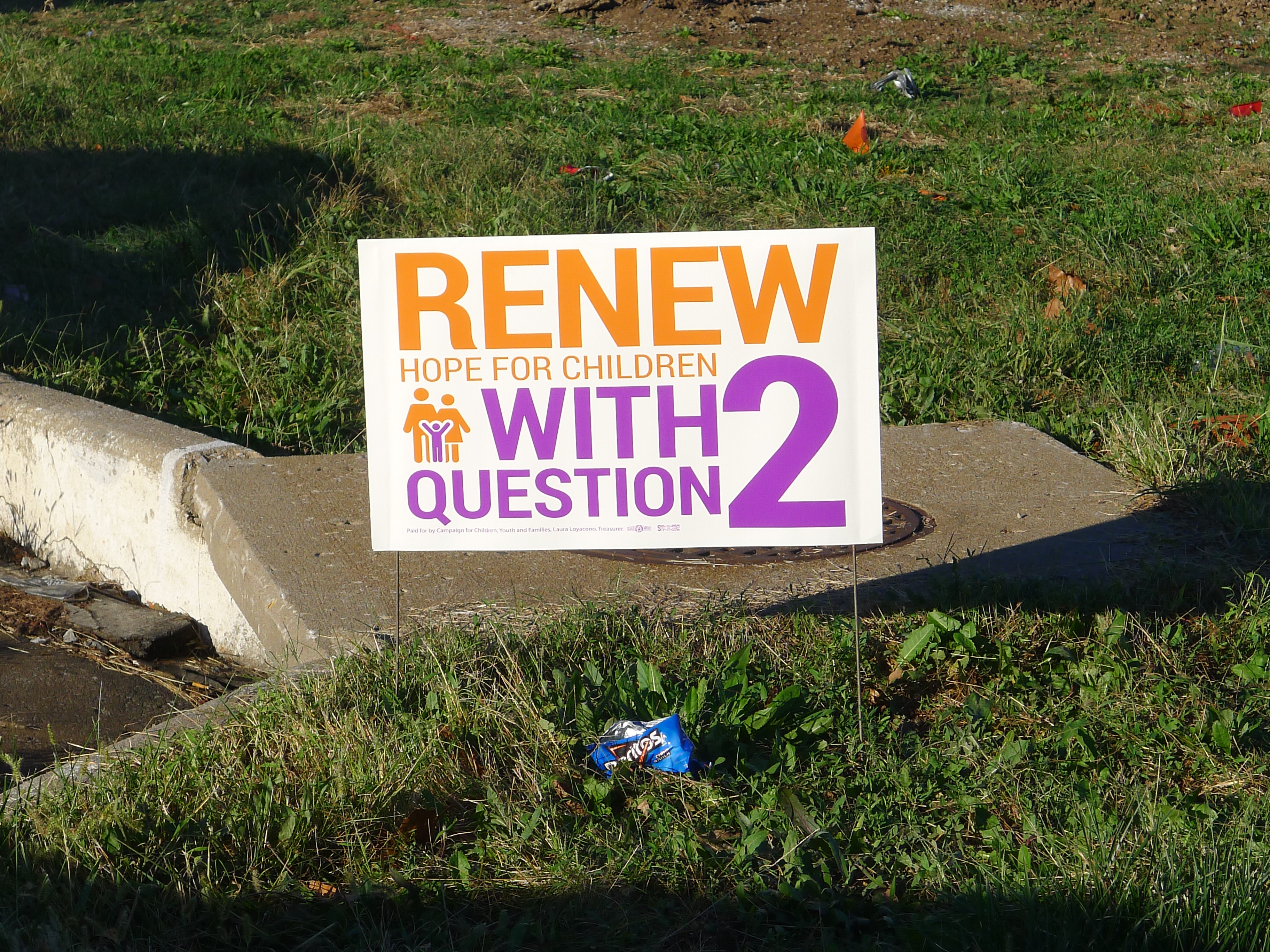
p1060471Despite the misleading yard signs you might have seen (RENEW with Question 2), this would be a NEW sales tax — always something to be leery about. An eighth of a cent, to be precise. The yard signs also play on people’s perceived empathy for child-related measures, with the words, “Hope for Children.” The ballot language says the revenue would establish “a Community Children’s Services Fund for the purpose of providing services to protect the well-being and safety of children and youth nineteen years of age or less and to strengthen families.

Too vague for me. Sounds like the backers are promising a sinecure for all juvenile problems.

My recommendation: Vote NO on Jackson County Question 2. 

Jackson County Question 3

This one is going to have voters scratching their heads, partly because the ballot language is a challenging. Once you’ve figured it out, it’s appealing in one sense because it would end the collection of county sales taxes on cars, trucks, boats, trailers and motors purchased out of state. So, you could go to Kansas, buy a car and avoid paying the Jackson County sales tax when you register it in Missouri. Sounds good, but the down side is it would put Jackson County car and boat dealers at a competitive disadvantage with Kansas dealers.

Who among us want to do something to help Kansas at Jackson County’s expense? Raise your hands…I thought so.

My recommendation: Vote NO on Jackson County Question 3. 

Kansas City Question 1

This would “remove from the park system vacant property of about 1.2 acres located generally between E. 23rd Street and E. 24th Street west of Flora Avenue.”

In a ballot as long and difficult as this, it’s understandable if voters are looking for machine gunners behind every tree. Not to worry. This is hamburger stuff. 

My recommendation: Vote YES on Kansas City Question 1.

Kansas City Question 2

This would “remove from the park system vacant property of approximately 2.6016 acres located generally east of Lister Avenue and south of E. Linwood Boulevard.” (Note: approximately 2.6016 acres. I’m sure glad they didn’t try to measure it down to the last hundred-thousandth acre.)

No machine gunner behind this tree, either.

My recommendation: Vote YES on Kansas City Question 2. 

Kansas City Question 3

Let’s face it, Clay Chastain isn’t going away until he’s dead. (I hate to wish a premature death on anyone, but with Clay, it’s tempting.) This is his hundred-thousandth light rail plan, and I won’t dignify it with a recommendation.

Mid-Continent Public Library Proposition L

1585This library system has 31 branches and serves 800,000 people in Jackson, Clay and Platte counties. Some of those people are in Kansas City, although Mid-Continent does not overlap the Kansas City Public Library system. Proposition L would provide for a property tax increase of 8 cents for each hundred dollars of assessed valuation (for homeowners in the district boundaries). The current 32-cent levy has been the same since 1983.

It’s about time I quoted the late, great (actually still living and still kicking) KC Star editorial writer Yael Abouhalkah. Recently, on his blog, he said this about Proposition L. “If your house is worth $100,000, the tax increase would cost you an extra $15.20 a year. Got a $200,000 piece of property? That’s $30.40 extra a year. That’s a reasonable price to pay for improved public assets.”

My recommendation: Vote YES on Mid-Continent Public Library Proposition L  

**

There you have it, readers. You should be well armed now, at least as it pertains to most of the issues on the Missouri-side ballot…A frequent commenter asked yesterday if I had any candidate recommendations. I think most of you know your candidates and how you’re going to vote, but for the record my big three in Missouri are Kander (he can assemble an automatic rifle blindfolded!), Koster (bought and paid for by the special interests, but consider the alternative!) and Hensley (she cares for the kids!)

Go get ’em, voters.

I hear you crying out in the wilderness, Missouri voters. The words are faint because you’re deep in the forest, but what I’m hearing is: “Please, help me understand this long, crazy election ballot.”

Today and tomorrow, your supplications will be answered.

Since The Kansas City Star is not in a position to render much assistance (its editorial board having been effectively wiped out by a new publisher bent on taking the paper in a new editorial direction), JimmyCSays will help you cut through the ballot fog.

I voted absentee Wednesday at Center High School, and I can assure you the lines and wait times will be long at the polls next Tuesday. It took me 30 to 40 minutes to check in, wait in a line of six or seven people to get a ballot and then fill out the paper ballot by hand. (At Center, you do not have the option of voting absentee on one of the relatively few electronic machines the Kansas City Election Board has.)

…As an aside, Missouri and the Kansas City Election Board are incredibly backward when it comes to election systems. Missouri does not allow early voting because the Republicans who control the Legislature want to keep the vote down. And the KCEB clings tenaciously to the paper-ballot system, which makes voters feel like kindergartener experimenting with their first sets of crayons.

logo-buttonAnyway, the Kansas City, MO, ballot includes five state constitutional amendments; a statewide proposition; three Jackson County questions; three Kansas City questions; and, in parts of the city, a Mid-Continent Library proposition.

Today, let’s take a look at the five constitutional amendments and the statewide proposition. The biggest oddity on the ballot is dueling measures that would raise the cigarette tax — the lowest in the nation, at 17 cents a pack. We look at the dueling measures first.

Amendment 3 and Proposition A

:: Amendment 3 would add 60 cents to the cigarette tax, to be phased in over four years. The revenue would go toward child health and education programs.

The initial backers of this amendment were early childhood education advocates in St. Louis. Their intentions were, and are, good. The main problems: the tax hike is not large enough to deter people from smoking, and none of the revenue would go toward educating people about the hazards of smoking or smoking cessation programs. Here’s another wrinkle: R.J. Reynolds, seeing an opportunity to pre-empt a larger tax increase down the road, jumped in and decided to push hard for passage. So far, it has spent $12 million promoting the measure…That should tell you everything you need to know.

My recommendation: Vote NO on Amendment 3.

:: Fielding its own pawns and bishops in this smoking chess game, the convenience store industry countered with Proposition A, which would raise the cigarette tax by a measly 23 cents a pack and would allow marketers of discount cigarettes to keep their price advantage over the major brands. (One part of Amendment 3 would eliminate that advantage.) Revenue generated by Proposition A would go for roads and bridges.

Like I said, the convenience store industry is promoting the measure…That should tell you everything you need to know.

My recommendation: Vote NO on Proposition A.

Amendment 1

This is a proposed renewal of a one-tenth-of-a-cent sales tax that generates $90 million a year for soil and water conservation and to help cover operational costs at state parks and historic sites.

Voters first approved this sales tax in 1984. It’s been a big positive for Missouri.

My recommendation: Vote YES on Amendment 1.    

Amendment 2 

Since 2008, Missouri has had no limit on campaign contributions in state races. Amendment 2 would set a limit of $2,600 per election cycle — $2,600 in a primary and $2,600 in a general. It also would set a ceiling of $25,000 on donations to a political party. Credit for this proposal goes to Fred Sauer, a businessman from St. Louis, who says caps would help to rebuild trust in state government.

This is about as straightforward and basic as a proposal gets: Do you want to live in a state that limits campaign contributions or one where the special interests can spend as much as they like and are able?

My recommendation: Vote YES on Amendment 2. 

Amendment 4

Like Amendment 3 and Proposition A, this is another crazy proposal. It would bar any new state or local taxes on services or transactions that are not currently subjected to sales taxes. Some of its chief backing comes from realtors, who are peering into the forest and envisioning real-estate-transaction fees behind every tree.

I don’t like sales taxes. It’s the most regressive tax there is, hitting hardest those with the lowest incomes. At the same time, it makes no sense to me to attempt to pre-empt every conceivable new sales tax. I prefer to vote on tax proposals one at a time, considering the merits of each.

My recommendation: Vote NO on Amendment 4. 

Amendment 6
This looks suspiciously like Kris Kobach creep. The man who has made a name for himself by trying to limit Democratic voter turnout in Kansas must have inspired the backers of Amendment 6, which would require voters to show photo i.d. at the polls.

I’m a Democrat…Need I say more?

My recommendation: Vote NO on Amendment 6.

**

One final recommendation: Whatever jurisdiction you live in, go to your election board’s website and carefully review the “Sample Ballot,” which lays out exactly what you will see at the polls. You’ll be glad you took the time to familiarize yourself with the issues and ballot language.

Tomorrow: The three Jackson County questions; the three Kansas City, MO, questions; and Proposition L, which would benefit the Mid-Continent Library.

I’ve managed to wean myself off the Chiefs, for the most part, but while on the Internet looking for news developments Sunday, a football-related headline on The Star’s website caught my eye.

It said something about Chiefs’ quarterback Alex Smith having taken a hard hit to the head in the first half of the game against the Indianapolis Colts.

Although I’ve pretty much given up watching the Chiefs, mainly because of the high incidence of long-term brain injury from repeated head poundings, I turned on the TV a few minutes later to see who would be substituting for Smith.

To my surprise and wonderment, none other than Alex Smith was still quarterbacking the team. I didn’t understand…Hadn’t he taken a hard shot to the head? Shouldn’t he be out of the game?

It was near the end of the first half, and the announcers weren’t talking about a hit to the head, so I turned off the TV and didn’t think anything more about it.

Later, I learned that he had taken a second hard hit to the head, and that time they took him out of the game for good.

The line the Chiefs put out later was Smith had passed the “concussion protocol” test, administered by physicians on the sideline, and had been cleared for return to play.

But there was great confusion after the game about whether Smith had passed one or both concussion tests. In his post-game news conference, Coach Andy Reid said Smith had passed both tests, theoretically making him eligible to return after the second hard hit. But a Chiefs’ official corrected him, advising him Smith had failed the second test. Today, however, the Chiefs said that Smith had, indeed, passed the second test, although he didn’t return to the game.

What a disaster.

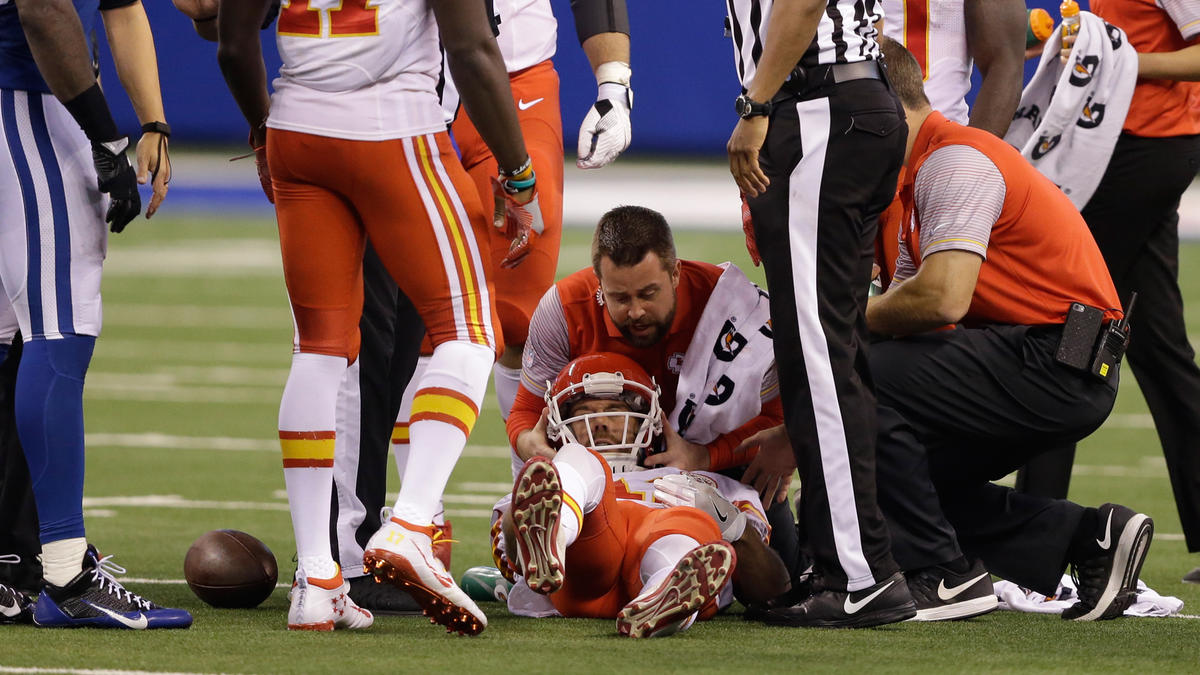
smithThis is a quarterback getting paid $17 million a year, and they put him back in the game after a hard hit to the head that left him woozy. I didn’t see either hit, but the second one must have been a doozy. The centerpiece photo in The Star’s sports section on Monday shows Smith lying flat on his back, his right hand slightly elevated and limp, while a trainer holds his head and talks to him. I don’t think Alex was hearing much, though, because, looking at the picture, you could clearly see his eyeballs had rolled up under his eyelids. It was the classic image of a guy who was totally out of it.

In his post-game column, The Star’s Sam Mellinger lambasted the NFL for its hazy and sloppy concussion protocol. He said, in part…

But if the league is wondering why it’s losing so many casual fans, it might look at a system it admits is broken, is avoided by some players and deemed suspicious by others, in no small part because it sometimes means a quarterback we all suspect has a concussion is being allowed to play until taking another hit we all know damn well caused a concussion.

**

That’s fine, but Mellinger missed the mark by, oh, about 100 yards. Here’s why…

At a news conference Monday, Andy Reid tried to wash his hands of responsibility. “Experts,” he said, make the determination on whether a player has suffered a concussion, and if the experts clear a man to play, then back in the game he goes. “They’ve taken the coach out of it,” Reid said.

Oh, really? Well, that’s not my understanding of football…I don’t care how many people tell a coach a player “passed” the protocol, the final determination — the judgment that matters most — lies with the coach. He’s responsible for everything that takes place on the field and on the sidelines during the game. He’s the person ultimately responsible for making sure that a player, once injured, does not get injured more severely.  

reid

Andy Reid

It’s elemental. But what I heard was Reid sloughing off the questions in a clipped and casual manner and failing to take responsibility. And Mellinger? Well, it’s a lot easier for a sports columnist to blame the league than the head coach, whose cooperation and access he needs week in and week out.

The NFL concussion protocol may be faulty, but Mellinger put the brunt of the blame on the wrong party: It was Andy Reid who failed Alex Smith.

Finally, although he supposedly passed both concussion tests, I bet Alex Smith will not be playing when the Chiefs take the field Sunday against the Jacksonville Jaguars. They’ll say they’re keeping him out as a “precaution.”

Well, that’s exactly what Andy Reid should have done Sunday. These head hits are a serious business, and Reid should not be sloughing them off like irritating questions at a news conference.

When I was teenager in Louisville in the 1960s, one of our favorite places to go was the Gardiner Lane Ice Skating Rink, a couple of miles from my home in the Highlands section of Louisville.

As I’ve written before, adolescence was difficult for me, partly because I attended an all-boys Catholic high school — St. X — and then an all-male Catholic college — Bellarmine.

(Thankfully, before my junior year in college, the ’66-’67 school year, Bellarmine merged with an all-girls Catholic college — Ursuline. That first year, the boys could sign up for classes at Ursuline and the girls could sign up for classes at Bellarmine…I’ve claimed ever since that I was the first boy on the inter-campus bus.)

Deprived of everyday female companionship, we St. X students desperately sought occasions and places where we could at least see some girls and perhaps make the acquaintance of one or two. So, on crisp, fall afternoons — after school — some of us would go to Seneca Park to watch the girls from Sacred Heart Academy, the closest all-girls school, play field hockey games. I can’t recall ever meeting a girl at any of those hockey games — which didn’t help my aching, anguished heart — but it at least put me within a few arms’ lengths of the girls as they ran by, exuding energetic and blessed femininity.

Another place where we could see girls, and where we had an even better chance to mingle with them, was the skating rink. I loved that rink, even though it was all I could do to stay upright and plant one foot in front of the other on the ice. Enhancing the experience was the rink’s excellent sound system, which constantly blared the Oldies that were on the pop charts at any given time.

I have a memory of one night and one song that particularly lifted my spirits. It was Bobby Vee’s “Walkin’ With My Angel,” released in 1961. For a lonely kid, it said everything…

Aww, when we’re strollin’ hand in hand
I’m as happy as can be
‘Cause she’s the prettiest girl in town
And everyone can see she belongs to me

Well I feel so proud
It’s as good as walkin’ on a cloud
When I’m walkin’ walkin’ with my angel

I think I skated better than ever that night, to that song. Even without “an angel” to skate with, I was almost giddy.

**

bobby-vee

Bobby Vee

“Walkin’ With My Angel” — written by the great team of Carole King and Gerry Goffin — was one of several hits for Bobby, who died Monday at age 73. Others included “Run to Him,” “Come Back Baby When You Grow Up” and “Take Good Care of My Baby.” (The latter, also written by King and Goffin, was Bobby’s only No. 1 hit.)

The New York Times’ obit on Bobby said, “Mr. Vee was one of a crop of dreamboat singers promoted by the music industry in the late 1950s and early ’60s, joining Ricky Nelson, Frankie Avalon, Bobby Rydell and others on the charts.”

Boy, those guys were great. Ricky, of course, died in a plane crash many years ago. Frankie and Bobby Rydell are still alive.

I tell you, each of them eased the pangs of adolescence for this boy from Derby City. And I’ll never forget that night at the skating rink, when Bobby Vee and “Walkin’ With My Angel” salved my restless, teenage soul.


Here’s the song.

A high-powered journalist, David Von Drehle, spoke Sunday at an educational forum at my church (Country Club Christian) and explained in a context I had not fully understood some of the ramifications of the digital age.

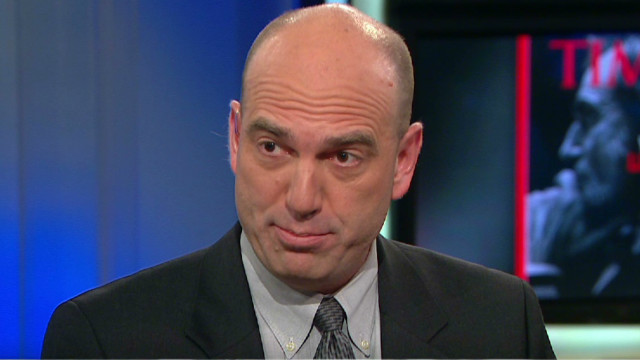
Von Drehle (pronounced Von Drai-ly) is a 55-year-old editor at large for Time magazine. In addition to having written scores of cover stories for Time since he joined the magazine in 2007, he has written three books, including his most recent one, Rise to Greatness: Abraham Lincoln and America’s Most Perilous Year. Before going to work for Time, he was an assistant managing editor at The Washington Post. Von Drehle and his wife, Karen Ball, also a journalist, live in Kansas City.

von-drehle

David Von Drehle

Von Drehle’s subject was the presidential election, and I was wondering how he was going to strike a balance, seeing as how Country Club is an old-line, traditional type of church that draws heavily from across the state line. (What am I getting at there is that the membership doesn’t look anything like The Kansas City Star newsroom; a goodly number of Country Club members probably will be voting for Donald Trump.)

As it turned out, being even handed was no problem for Von Drehle. Instead of assessing the two major candidates or trying to predict which of them would prevail in key states, he focused on how Trump has turned conventional campaigning on its head.

A key area in which Trump has vaulted ahead of Hillary Clinton — and ahead of almost all other politicians, for that matter, Von Drehle said — is disintermediation.

When Von Drehle introduced the word (wisely, he didn’t break it out until more than halfway through his talk), it left many heads in the room spinning, but he quickly explained it.

The gist of it is that in all presidential campaigns heretofore, the candidates went through intermediaries to get out their ideas and try to convince people to vote for them. Those intermediaries included the respective political parties, the candidates’ spokespersons, their consultants and pollsters, and, of course, journalists. But Trump has taken his campaign straight to the people, for the most part, thus waging a dis-intermediated campaign.

Trump planted the seeds for such a campaign on his hit TV show, The Apprentice, where viewers saw him unfiltered and felt like they got to know him. Two years ago, when he set out to attain the Republican nomination for President, he took the unfiltered approach to a higher level, using mainly his phone and his Twitter account to send his thoughts and ideas directly to millions of followers.

Von Drehle was quick to point out, however, that Trump doesn’t have a corner on disintermediation. There is an excellent local example, he said, citing the issue of whether Kansas City should build a new, single-terminal airport.

Before disintermediation, Von Drehle said, civic and political leaders — probably aided and abetted by The Kansas City Star — would have paved the way for a new airport by holding hearings, coming to a consensus and calling an election on whether to issue bonds to build a new airport.

The familiar script was followed to some extent…except that after a mayoral-appointed commission held hearings and determined a new, single terminal was the way to go, at least one City Council member, Teresa Loar, began squawking. It would be a big waste of money, she said, adding that the three-terminal facility that has served Kansas City for more than 40 years was convenient for passengers and did not need to be replaced.

By extending their electronic tentacles, like-minded people formed a wide circle around Loar’s position and effectively blunted not only the airport commission’s effort but the political push being led by Mayor Sly James. In the face of significant public opposition, James capitulated and put the onus on business leaders, saying if they wanted it, they needed to take the reins. Predictably, the initiative has languished.

The moral of that particular disintermediation story, as Von Drehle said, is this: In the disintermediation era, “no is easier than yes.” What that means is it’s easy to go online or onto Facebook and Twitter and grouse about the cost of a new, single terminal and assert that what we’ve got is adequate. And it’s much more difficult for a group of people, even influential people, to mount a strong case for a costly initiative that is vulnerable to simplistic opposition.

**

You probably already know how I feel about this, but here it is, for the record:

It’s a pathetic state of affairs when knee-jerking people decide they’re for or against something (or someone) on the basis of initial impressions formed and cemented in the absence of research and reflection that would cultivate a more reasoned, informed position.

And that’s where we are in regard to a badly needed new airport:

The status quo is held hostage by a bunch of people intimidated by a big price tag and grasping desperately at the notion that a new airport cannot possibly be as good as the 40-year-old one, which is as gloomy and lifeless as Donald Trump’s campaign.

It’s a blockbuster story with classic elements: beautiful women, sex and revenge.

It revolves around Carolyn J. Heckert, now charged with first-degree murder, and Sarah DeLeon and Diana Ault, young Kansas City area women who were killed more than 20 years ago.

The story hit big Thursday, with news of the arrest of Heckert, a 48-year-old real estate agent who lives in Smithville.

Unfortunately, local news consumers couldn’t get the story in understandable context from any single news outlet. It took me more than an hour to sort it out from a variety of sources.

I’m sure people who read about this case yesterday or heard about it on radio or TV were asking themselves, “What the hell was going on there?”

Many of those same news consumers probably read or watched only one account of Heckert’s arrest and were left with their curiosity brimming.

…Having been a reporter who “ate his bylines for breakfast” (that’s what one of my first editors once said of me), I wasn’t going to let it lie until I had checked it thoroughly. That meant going to the websites of The Kansas City Star and the four local TV stations — KCTV5; Fox4, KSHB, Channel 41; and KMBC, Channel 9.

**

Ground Zero for me was The Star’s long but limited account, which said DeLeon and Ault were the victims of harassment or bullying before their deaths. The Star quoted Kansas City, KS, police as having said several months ago, “The investigation has revealed that the suspect and an accomplice have been involved in other incidents involving the harassment and intimidation of romantic rivals.”

OK. That provided a motive. Then it was on to the TV websites…

:: Fox4, which tends to be very aggressive in its crime reporting, offered nothing, not even the “romantic rivals” element.

:: KSHB’s only insight was this line: “Last May, KCK police told 41 Action News they suspected DeLeon may have been targeted because she was a romantic rival.

:: KCTV5 had a curious report, but it did offer some illumination. A reporter interviewed DeLeon’s father, Bill Laskey, who said he had long believed Heckert had killed his daughter.

carolyn-heckert

Carol Heckert

But the story immediately turned curious, when, out of the blue, Laskey was quoted as saying: “I said no, it wasn’t a robbery. It’s the b**** your son’s been with. I think it’s Carol.

The story offered no indication who Laskey was addressing when he said, “it’s the bitch your son’s been with.”

The answer to that question became a bit clearer two paragraphs later, when the reporter dropped in this telling line: “Ault’s husband admitted to an affair.”

Voila! Laskey must have been speaking with the mother or father of Diana Ault’s husband.

The Channel 5 report concluded with this: “Laskey said Heckert threatened his daughter. As a result, Ault changed her locks and phone number, even filing a harassment report with Independence police. Within weeks, she would be dead.”

:: To put the final pieces of the puzzle together, I had to go not only to KMBC’s Thursday story but also to a 2004 KMBC story that gave the full backdrop.

Here are the key paragraphs from the 2004 story, which quoted Ault’s husband, Tim Ault:

“Ault said he had an affair and moved out to live with another woman shortly before his wife’s death. The other woman was Tim’s co-worker at a Kansas City, Kan., postal facility.

“Investigators found out she had ties to another murder victim — 18-year-old Sarah DeLeon. DeLeon was stabbed to death fours years earlier and her body dumped by some railroad tracks. Police found her car abandoned on 78th Street underneath Interstate 70.”

Why did Sarah DeLeon die? The 2004 story said the postal worker (undoubtedly Heckert) had had an affair with DeLeon’s boyfriend (not named) during a period when the boyfriend and DeLeon were broken up. DeLeon was murdered after the boyfriend dumped the postal worker and went back to DeLeon.

**

Now, people wanting to know what’s going on with any big story shouldn’t have to go to that much time and trouble to get to the root of it. Some reporter and at least one of the five news outlets I went to should have pulled the Heckert-Ault-DeLeon story together.

Seriously, it wouldn’t have been very difficult…But, unfortunately, that’s the way it is in journalism’s “new and not-improved” era.

The wrenching changes — diminution, that is — of newsrooms and editorial pages across the nation were the subject of an interesting discussion on KCUR’s Central Standard show today.

Host Gina Kaufmann’s main guest was Yael Abouhalkah, a Kansas City Star editorial writer for 32 years..until Publisher Tony Berg fired him (with severance) a few weeks ago.

As most of you are painfully aware, The Star currently has no editorial writers and has been filling the editorial page with letters to the editor — a great thing for letter writers but not so good for the community at large, especially in the weeks leading up to the Nov. 8 general election.

What has happened at The Star is not unique at major metropolitan dailies. You have to look no farther than to St. Louis, where that paper’s editorial page was down to two people a while back. Also, of course, the number of editorial employees at newsrooms nationwide is severely diminished from 10 years ago, when the sledgehammer effect of people turning to the Internet for their news and opinions began registering.

reinardy

Scott Reinardy

Scott Reinardy, a journalism professor at the University of Kansas, said on today’s show that between 2005 and 2015, newsrooms across the country cut about a third of their editorial employees, or about 20,000 people. Some newspapers, he said, sliced editorial-side employment 60 to 70 percent.

A third guest, David Uberti of the Columbia Journalism Review, said that as newsrooms cut loose experienced employees, what they forsake is “local or regional knowledge of power players” and a font of institutional knowledge.

“Editorial writers,” Uberti said, “tend to be very experienced journalists with deep ties to the communities. There’s no substitute for experience in that regard.”

A new editorial page editor — Colleen McCain Nelson — is due to begin working at The Star perhaps late next month, and she will face big challenges. In addition to having to assemble a staff (I doubt that Berg will allot her more than a couple of writers) she will have to familiarize herself with the community and its political and civic leadership. Although she is a KU graduate, she has never worked in this area. She’s currently a political reporter for the Wall Street Journal, and before that she was an editorial writer for the Dallas Morning News.

(Coincidentally, a former editorial-page colleague of hers at the Morning News, Tod Robberson, was named editorial page editor at the Post-Dispatch early this year. Robberson and Nelson worked on a series of editorials that won the 2010 Pulitzer Prize for editorial writing. The series, called “Bridging Dallas’ North-South Gap,” focused on gaps in economic opportunity, race relations, housing and education in different parts of Dallas.)

gina

Gina Kaufmann

As for Abouhalkah, who is 61, he has started a blog — http://www.yaelabouhalkah.com — and told Gina Kaufmann he did not go away mad. He managed to get a career in and build a financial nest egg that should afford him and his family a comfortable lifestyle.

I was lucky that way, too, having retired at age 60 in 2006. But a lot of journalists — those whose careers were cut down when they were in their 30s, 40s, 50s and some in their early 60s — not only went away mad, but frustrated and disillusioned. I know a few of them, and I completely understand how they felt and still feel to some degree. So does Reinardy, the KU professor, who has written a book called Journalism’s Lost Generation: The Un-Doing of U.S. Newspaper Newsrooms.

In a recent Columbia Journalism Review interview, Reinardy said that in doing research for the book he spent a lot of time interviewing current and former journalists. He described the mood that has formed in newsrooms around the country as a sort of “organizational depression.”

He explained it this way:

“There has been so much loss in those newsrooms. Journalists don’t necessarily just lose jobs, they lose careers and some real self-identity. I had many journalists who broke down and cried, who were so genuinely upset about what had happened to the profession they loved so dearly. It was really troubling.

“So I don’t have a statistical measurement for morale, but when you start walking into these newsrooms and talking to people who dedicated 20 years or 25 years or 30 years of their life to not only the profession but maybe even this individual newspaper, it was pretty telling to see how upset they were at what had occurred to their beloved industry.”

…One final note: Gina Kaufmann told listeners she invited Tony Berg to appear on the show. Berg accepted an invitation to appear on Central Standard back in March, two months after he had become publisher. But this time, when the subject matter was obviously going to be dicey for him, it was a different story. “We never heard back,” Kaufmann said.

For a long time now, I’ve had what I considered a pretty clever way of dealing with tailgaters.

What I was doing — on highways for the most part, because that’s where you encounter the largest number of people dealing with corn cobs up their asses — was grad-u-a-l-l-y slowing down.

I did that for two reasons: First, to send the tailgaters a not-so-subtle message that they were free to go into another lane and shoot around me whenever they wanted. Second, I admit with some shame, I just wanted to aggravate them.

I guess I’ve been lucky not to have been shot while engaging in such gamesmanship.

Here I am at 70 years of age, glad to be happy and healthy. I’d like to get to at least 75 in the same condition. So, as of today, gamesmanship on the highways is in my rear-view mirror. When someone comes up on me fast, I’m going to signal for a lane change and do it as soon and safely as possible.

You might ask: Why the change of heart now?

Well, I’ve just read two stories on local news outlets about people who got shot to death on area roads recently after becoming involved in road-rage incidents.

One was a woman. On Sunday night, 22-year-old Whitney M. Gray met her demise after an altercation near Winner Road and Sterling Avenue in Independence. The craziest part of that case is that Gray had three children in her minivan when things got out of hand. Fortunately, the three youngsters — a teenager, a 3-year-old and a child of less than a year — were not injured.

Fox 4 News is reporting that youngest children were Gray’s.

15369285_1476722028-4178

Whitney Gray and the two children who were in her car when she was shot and killed in a road-rage incident Sunday night in Independence.

The victim’s father, Sean Gray, told a Kansas City Star a reporter, “She was a great mother, and she was an awesome person.”

How awful — to be called by a reporter to sum up your dead daughter’s life after she was caught up in something as seemingly inconsequential as a roadway pissing match.

Independence police on Monday said they were searching for the driver of a white SUV they think was involved in the homicide.

**
Then there was the Friday night case of a rolling clash between 22-year-old Bobby Crumpton of Wichita and 35-year-old Clinton R. Alsobrook of Texas.

Alsobrook will be going back to Texas (or already has) in a coffin or urn. And Crumpton is in the Platte County Jail, charged with second-degree murder.

Crumpton gave this account of the incident to authorities:

Both drivers were eastbound on Missouri 152. As they exited southbound onto I-29, Alsobrook’s SUV struck Crumpton’s car. Both drivers pulled over. Crumpton, carrying a loadedl handgun, got out of his vehicle and walked toward Alsobrook’s SUV.

Here’s where you’ve got to take Crumpton’s account with circumspection:

Crumpton said he heard Alsobrook yell, “I’m going to kill you.” Then, according to Crumpton’s account, Alsobrook began to drive toward him and Crumpton responded by shooting toward the SUV’s engine block and driver’s side-view mirror.

Crumpton then got back into his car, drove to a gas station and called 911…Police did not find a weapon in Alsobrook’s vehicle.

The Star quoted Platte County Prosecutor Eric Zahnd as saying: “If you’re the victim of a road rage incident, try to drive to a safe place. If you’re the instigator, this case is a tragic reminder of how quickly things can get out of control.”

Good advice. Here’s better advice: Don’t let yourself get sucked into a road-rage incident in the first place. It usually takes two to engage. Me? I’m getting out of the business of trying to send not-so-subtle messages to drivers in a big hurry. Way too many of those people are out there on the roads, and the best policy is to move over and let ’em blow by, especially now that we’re in the lock-‘n-load era.

Like I say, I want to make it to 75. I might even have grandchildren by then.


If you’ve ever thought about writing a “letter to the editor” for possible publication in The Kansas City Star — but for some reason didn’t act on the impulse — now’s the time to do so.

This is a very strange period as far as The Star’s editorial page is concerned. For the past three days — Tuesday, Wednesday and Thursday — the editorial page (not the Op-Ed page, just the editorial page) has contained only letters to the editor and political cartoons.

The editorial page has been devoid of editorials, staff produced or commissioned. It looks and feels downright weird.

The last editorial to appear was on Monday, and it was a boring piece — obviously not staff written — about an Internet conspiracy theory that Texas Sen. Ted Cruz harbors.

The reason for this strange period, of course, is that the editorial board is down to one person, Publisher Tony Berg, who took charge of the paper last January. Berg recently fired the paper’s longtime lead-editorial writer, Yael Abouhalkah. Several days later, Lewis Diuguid, the only other editorial writer, resigned. Both men’s last day was last Friday, and since Monday, the only name under the words “Editorial Board” on the masthead has been Tony Berg.

Only at small-town papers do publishers routinely write editorials, and, as a result, Berg is a supervisor with no one to supervise, at least as far as the editorial page is concerned.

…From a few e-mail exchanges and the fact that Berg has reduced newspaper delivery problems (the level of complaints I’ve heard is way down), I have the impression Berg is a smart man and will pull the editorial page back together. A few months ago he hired a new editorial page editor, Colleen McCain Nelson, who has excellent credentials, but she won’t be coming for at least another month. She currently is covering Hillary Clinton’s campaign for the Wall Street Journal.

So we’re in an interregnum of sorts, between the Abouhalkah and McCain Nelson eras, and it’s a bit ugly right now. A friend pointed out that in addition to running loads of letters to the editor, the political cartoons are being sized much larger than they had been…I would think that would please only editorial cartoonist Lee Judge.

I have heard (and reported this recently) that former editorial page editor Rich Hood might be returning as an editorial writer. I have also heard that Miriam Pepper, another former editorial page editor, might be returning for a while. But I have no knowledge if either of those moves is happening.

All that being said, I haven’t received a lot of complaints about the lack of editorials, other than from a couple of friends who have repeatedly bemoaned the fact that The Star is without opinion writers at a time when the paper would normally be analyzing political races and running editorial endorsements.

As a dedicated reader and former Star employee, I certainly hope this situation gets turned around soon.

One other thing…I would like to see the editorial page returned to its rightful place on the last inside-facing page of the A section. It should be there every day, in the same place.

Currently, on Tuesday, Wednesday, Thursday and Friday, the editorial page is on the second page of the four-page “In Depth” insert. But where the “In Depth” insert starts varies from day to day, making it difficult for readers to turn quickly to the editorial page.

“In Depth” has been a good addition to the paper, giving it more meat than it used to have. But hiding the editorial page four days a week is a big mistake. Tony Berg needs to fix that, and I suggest he start when Colleen McCain Nelson arrives.

For now, the king is dead. Long live the queen. She can’t be crowned soon enough.